## Flowchart: Logic Modules and Framework
### Overview
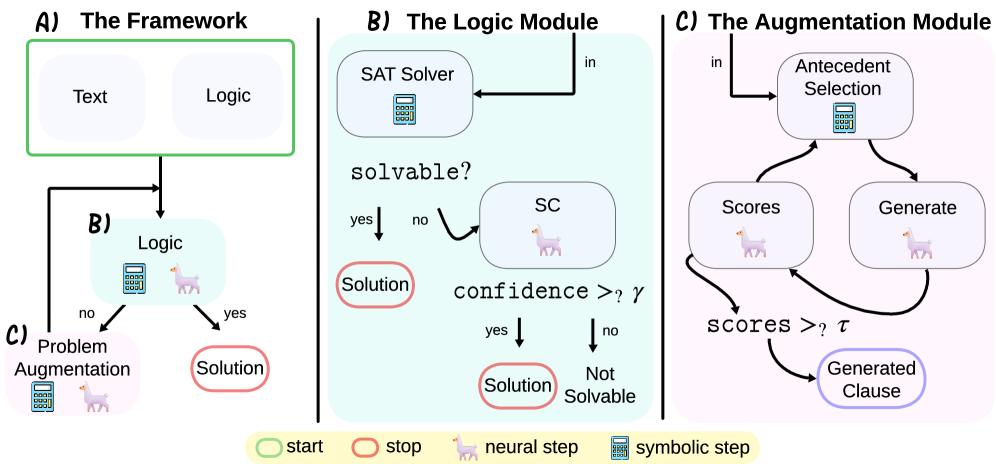
The image presents a flowchart illustrating a framework involving logic modules and augmentation. It is divided into three sections: A) The Framework, B) The Logic Module, and C) The Augmentation Module. The flowchart uses visual cues to represent different types of steps (start, stop, neural, symbolic).
### Components/Axes
* **Titles:**
* A) The Framework
* B) The Logic Module
* C) The Augmentation Module
* **Legend:** Located at the bottom of the image.
* Green outlined shape: start
* Red outlined shape: stop
* Llama icon: neural step
* Calculator icon: symbolic step
* **Modules:**
* **The Framework (A):** Contains "Text" and "Logic" components.
* **The Logic Module (B):** Contains "SAT Solver" and "SC" (likely short for Score).
* **The Augmentation Module (C):** Contains "Antecedent Selection", "Scores", and "Generate" components.
### Detailed Analysis or ### Content Details
**A) The Framework:**
* A green outlined box labeled "The Framework" contains two white rounded rectangles labeled "Text" and "Logic".
* An arrow points from the "The Framework" to "Logic" in section B.
* An arrow points from "Problem Augmentation" in section C to "Logic" in section B.
**B) The Logic Module:**
* A light blue shaded area labeled "The Logic Module" contains the following components:
* "SAT Solver" (symbolic step - calculator icon) with an input arrow labeled "in".
* A decision point "solvable?".
* If "yes", the flow goes to a red outlined "Solution" box (stop).
* If "no", the flow goes to "SC" (neural step - llama icon).
* "SC" (neural step - llama icon) leads to a decision point "confidence >? γ".
* If "yes", the flow goes to a red outlined "Solution" box (stop).
* If "no", the flow goes to "Not Solvable".
**C) The Augmentation Module:**
* A light pink shaded area labeled "The Augmentation Module" contains the following components:
* "Antecedent Selection" (symbolic step - calculator icon) with an input arrow labeled "in".
* "Scores" (neural step - llama icon).
* "Generate" (neural step - llama icon).
* Arrows connect "Antecedent Selection" to both "Scores" and "Generate".
* Arrows connect "Scores" and "Generate" back to "Antecedent Selection", forming a loop.
* A decision point "scores > τ" leads to a blue outlined "Generated Clause" box.
* Arrows connect "Scores" and "Generate" to the decision point "scores > τ".
### Key Observations
* The framework starts with "Text" and "Logic" inputs.
* The "Logic Module" attempts to solve the problem using a SAT solver. If unsolvable, it uses a scoring component (SC) and a confidence threshold.
* The "Augmentation Module" iteratively refines the problem by selecting antecedents, scoring them, and generating new clauses.
### Interpretation
The flowchart describes a system that combines symbolic logic and neural networks to solve problems. The framework first attempts to solve the problem using a SAT solver. If that fails, it uses a neural network to augment the problem with new information, and then tries to solve it again. The "Logic Module" acts as a core solver, while the "Augmentation Module" refines the problem iteratively. The parameters γ and τ likely represent thresholds for confidence and scores, respectively, influencing the flow of the process. The system appears to be designed to handle problems that are not easily solvable by traditional symbolic methods alone.