\n
## Diagram: System Framework for Problem Solving
### Overview
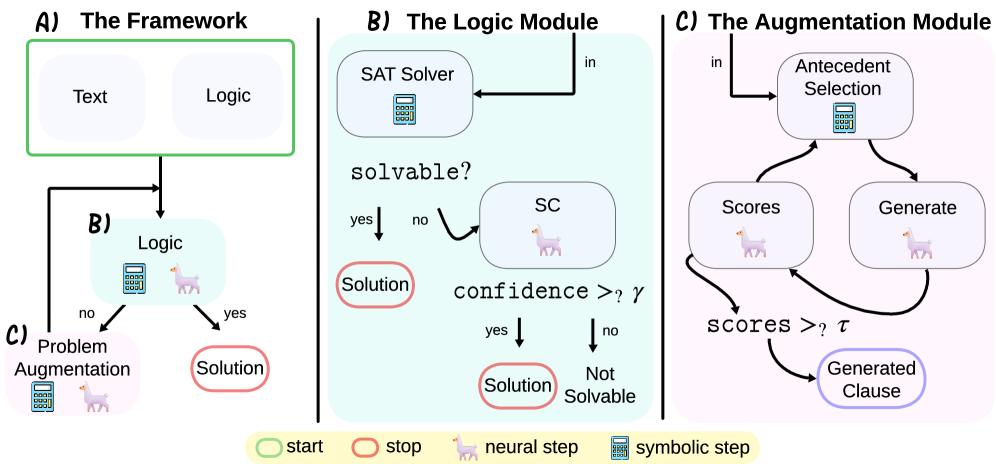
The image depicts a system framework for problem solving, broken down into three modules: The Framework, The Logic Module, and The Augmentation Module. The diagram illustrates the flow of information and decision-making processes within the system, utilizing both symbolic and neural steps. It appears to be a high-level architectural overview.
### Components/Axes
The diagram is divided into three main sections labeled A, B, and C. Each section represents a module within the system. The diagram uses arrows to indicate the flow of information and decision points. A legend at the bottom clarifies the meaning of different shapes and icons:
* Yellow circle: start
* Pink oval: stop
* Purple unicorn icon: neural step
* Blue calculator icon: symbolic step
The modules are:
* **A) The Framework:** Shows the overall system with "Text" input flowing into "Logic".
* **B) The Logic Module:** Contains a "SAT Solver" and decision points based on solvability and confidence levels.
* **C) The Augmentation Module:** Includes "Antecedent Selection", "Generate", and a loop for generating clauses based on scores.
Key labels within the modules include: "in", "solvable?", "confidence > γ?", "scores > τ", "Solution", "Not Solvable", "Generated Clause", "Scores", and "SC".
### Detailed Analysis or Content Details
**A) The Framework:**
* Text input flows into the Logic module.
* The Logic module outputs either "Solution" or returns to the Problem Augmentation module.
**B) The Logic Module:**
* Input "in" to a "SAT Solver" (symbolic step).
* Decision point: "solvable?".
* If "yes", output "Solution" (stop).
* If "no", flow to "SC" (neural step).
* From "SC", a confidence check: "confidence > γ?".
* If "yes", output "Solution" (stop).
* If "no", output "Not Solvable" (stop).
**C) The Augmentation Module:**
* Input "in" to "Antecedent Selection" (symbolic step).
* "Antecedent Selection" outputs "Scores" (neural step).
* "Scores" flow to "Generate" (neural step).
* "Generate" outputs "Generated Clause".
* Loop: "Generated Clause" feeds back into "Antecedent Selection".
* Decision point: "scores > τ?".
* If "yes", output "Generated Clause".
* If "no", loop back to "Antecedent Selection".
### Key Observations
* The system utilizes a combination of symbolic (SAT Solver, Antecedent Selection) and neural steps (SC, Generate).
* There are clear decision points based on thresholds (γ and τ).
* The Augmentation Module operates in a loop, continuously generating clauses until a satisfactory score is achieved.
* The framework is designed to handle cases where the initial problem is not solvable, by augmenting it and attempting again.
### Interpretation
The diagram illustrates a hybrid approach to problem solving, combining the strengths of traditional symbolic reasoning (SAT solving) with the learning capabilities of neural networks. The system attempts to find a solution using a SAT solver. If the problem is not solvable, it leverages neural networks to augment the problem (generate new clauses) and tries again. The confidence threshold (γ) and score threshold (τ) likely represent parameters that control the balance between exploration and exploitation in the search process. The loop in the Augmentation Module suggests an iterative refinement process, where the system continuously improves the problem formulation until a solution is found or a stopping criterion is met. The use of "SC" (likely standing for Score Calculation) indicates a neural network component is used to evaluate the quality of potential solutions or augmentations. The overall architecture suggests a robust and adaptable problem-solving system capable of handling complex and potentially intractable problems.