## Diagram: Hybrid Symbolic-Neural Reasoning Framework
### Overview
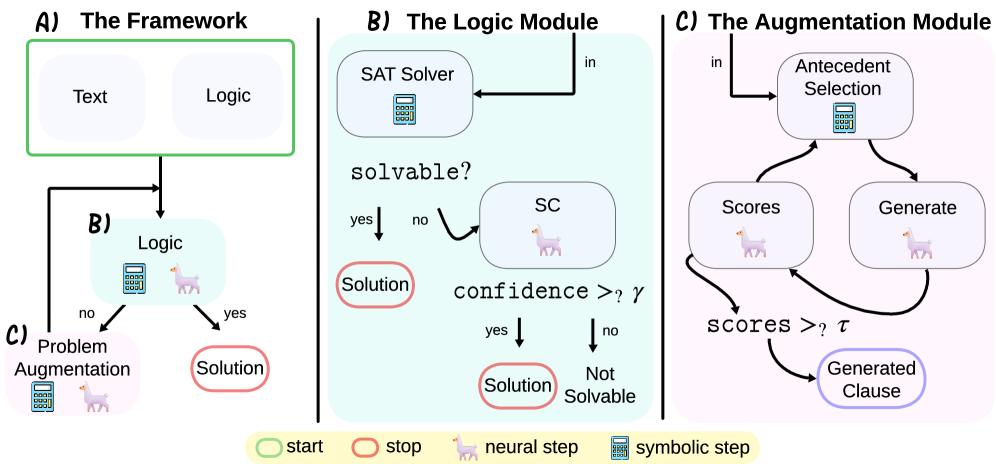
The image is a three-panel flowchart illustrating a hybrid system that combines symbolic (calculator icon) and neural (llama icon) processing steps for logical problem-solving. The diagram details the overall framework, a specific logic module, and an augmentation module, showing the flow of data and decision points.
### Components/Axes
The diagram is divided into three vertical panels, each with a distinct background color and title:
- **Panel A (Left, light green background):** Titled "A) The Framework". Contains the high-level system flow.
- **Panel B (Center, light blue background):** Titled "B) The Logic Module". Details the core solving process.
- **Panel C (Right, light pink background):** Titled "C) The Augmentation Module". Details the clause generation process.
**Legend (Bottom Center):**
- Green oval: `start`
- Red oval: `stop`
- Llama icon: `neural step`
- Calculator icon: `symbolic step`
### Detailed Analysis
#### Panel A: The Framework
1. **Top Section:** A green-bordered rectangle contains two white boxes labeled `Text` and `Logic`.
2. **Flow:** An arrow points from this rectangle down to a light blue box labeled `Logic` (containing a calculator and llama icon).
3. **Decision Point:** From the `Logic` box, two arrows branch out:
- Labeled `no`: Points left to a light pink box labeled `Problem Augmentation` (containing a calculator and llama icon).
- Labeled `yes`: Points right to a red oval labeled `Solution`.
4. **Loop:** An arrow from the `Problem Augmentation` box loops back up to the input of the `Logic` box.
#### Panel B: The Logic Module
1. **Input:** An arrow labeled `in` enters from the top.
2. **Step 1:** Points to a white box labeled `SAT Solver` (containing a calculator icon).
3. **Decision 1:** An arrow leads to the text `solvable?`.
- `yes` branch: Points down to a red oval labeled `Solution`.
- `no` branch: Points right to a white box labeled `SC` (containing a llama icon).
4. **Decision 2:** From the `SC` box, an arrow leads to the text `confidence >? γ` (where γ is the Greek letter gamma).
- `yes` branch: Points down to a red oval labeled `Solution`.
- `no` branch: Points down to the text `Not Solvable`.
#### Panel C: The Augmentation Module
1. **Input:** An arrow labeled `in` enters from the top.
2. **Step 1:** Points to a white box labeled `Antecedent Selection` (containing a calculator icon).
3. **Parallel Processing:** Two arrows branch from `Antecedent Selection`:
- Left arrow points to a white box labeled `Scores` (containing a llama icon).
- Right arrow points to a white box labeled `Generate` (containing a llama icon).
4. **Feedback Loop:** An arrow loops from the `Generate` box back to the `Scores` box.
5. **Decision & Output:** An arrow from the `Scores` box leads to the text `scores >? τ` (where τ is the Greek letter tau).
- The `yes` branch (implied) points to a blue oval labeled `Generated Clause`.
### Key Observations
1. **Hybrid Architecture:** Every major processing step (`Logic`, `Problem Augmentation`, `SC`, `Scores`, `Generate`) explicitly combines a symbolic step (calculator) and a neural step (llama), indicating a tightly integrated neuro-symbolic approach.
2. **Iterative Refinement:** Both the overall framework (Panel A) and the augmentation module (Panel C) contain feedback loops (`Problem Augmentation` -> `Logic`; `Generate` -> `Scores`), suggesting an iterative problem-solving or refinement process.
3. **Multi-Stage Verification:** The Logic Module (Panel B) employs a two-stage verification: first a symbolic SAT solver, then a neural confidence check (`SC`), before declaring a problem unsolvable.
4. **Threshold-Based Decisions:** Key decisions are governed by thresholds: a confidence threshold `γ` in the Logic Module and a score threshold `τ` in the Augmentation Module.
### Interpretation
This diagram outlines a sophisticated system designed to solve logical problems (likely from natural language text) by leveraging the strengths of both symbolic AI and neural networks.
- **What it demonstrates:** The system first attempts a direct logical solution using a SAT solver (symbolic). If that fails, it doesn't give up immediately. Instead, it uses a neural component (`SC`) to assess the confidence of a potential solution path. If confidence is high enough, it accepts a solution; otherwise, it deems the problem unsolvable. Concurrently, an augmentation module works to generate new logical clauses (`Generated Clause`) by selecting antecedents and using neural scoring/generation, which can be fed back to reformulate (`Problem Augmentation`) and re-attempt the problem.
- **Relationships:** The Framework (A) is the orchestrator, calling upon the Logic Module (B) for solving and the Augmentation Module (C) for problem reformulation when initial solving fails. The modules are interdependent, with the output of C potentially becoming the input for A and B in a subsequent iteration.
- **Notable Anomalies/Patterns:** The architecture is notable for its defensive, multi-check approach before declaring failure (`Not Solvable`). The clear separation of "solvable" (a syntactic check) from "confidence" (a semantic/quality check) is a key design pattern. The use of distinct colors (green start, red stop, blue generated output) provides clear visual cues for process initiation, termination, and successful output generation.