## Flowchart Diagram: AI Problem-Solving Framework with Neural-Symbolic Integration
### Overview
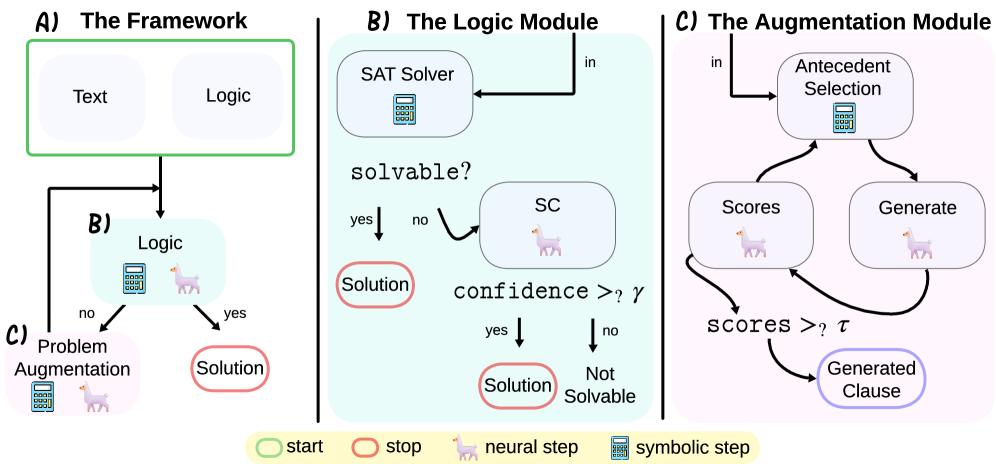
The diagram illustrates a three-module framework for solving logical problems using a hybrid neural-symbolic approach. It combines text processing, logical reasoning, and problem augmentation through iterative neural and symbolic steps.
### Components/Axes
**A) The Framework**
- **Inputs**:
- Text (left box)
- Logic (right box)
- **Core Module**:
- Logic (center box with calculator and llama icons)
- **Output Branches**:
- Problem Augmentation (pink box with calculator/llama)
- Solution (red oval)
**B) The Logic Module**
- **Components**:
- SAT Solver (top box with calculator icon)
- SC (confidence threshold γ, middle box with llama icon)
- **Flow**:
- Input → SAT Solver → "solvable?" decision node
- Yes → Solution (red oval)
- No → SC → Confidence > γ? decision node
- Yes → Solution
- No → Not Solvable (red oval)
**C) The Augmentation Module**
- **Components**:
- Antecedent Selection (top box with calculator icon)
- Scores (middle box with llama icon)
- Generate (bottom box with llama icon)
- **Flow**:
- Input → Antecedent Selection → Scores → Scores > τ? decision node
- Yes → Generated Clause (blue oval)
- No → Loop back to Antecedent Selection
**Legend** (bottom of diagram):
- 🟢 Start (green arrow)
- 🔴 Stop (red oval)
- 🦙 Neural step (pink llama icon)
- 🧮 Symbolic step (blue calculator icon)
### Detailed Analysis
1. **Framework Flow**:
- Text and Logic inputs feed into the Logic Module.
- If the problem is solvable (SAT Solver output), it proceeds directly to Solution.
- If unsolvable, the system routes to the Augmentation Module for neural-symbolic enhancement.
2. **Logic Module Mechanics**:
- SAT Solver determines initial solvability.
- Confidence threshold γ filters solutions (confidence > γ required for acceptance).
3. **Augmentation Module Dynamics**:
- Antecedent Selection generates candidate clauses.
- Scores evaluate clause quality (scores > τ threshold for acceptance).
- Successful clauses are output as "Generated Clause"; otherwise, the process repeats.
### Key Observations
- **Neural-Symbolic Hybridity**:
- Neural steps (llama icons) handle ambiguity and generation.
- Symbolic steps (calculator icons) enforce logical rigor.
- **Threshold-Driven Decisions**:
- γ and τ thresholds prevent low-confidence/low-quality outputs.
- **Iterative Augmentation**:
- The Augmentation Module loops until a clause meets the τ threshold.
### Interpretation
This framework demonstrates a **neural-symbolic AI architecture** where:
1. **Direct Solving**: Simple logical problems are resolved via SAT Solver.
2. **Augmentation for Complexity**: Unsolvable problems trigger iterative clause generation, blending neural creativity (antecedent selection) with symbolic validation (scoring).
3. **Quality Control**: Thresholds γ and τ ensure outputs meet minimum confidence/score standards, preventing "hallucinated" solutions.
The system reflects a **multi-stage reasoning pipeline** where neural modules handle uncertainty and symbolic modules enforce logical consistency, mirroring human problem-solving's balance between intuition and analysis.