## Diagram: Conceptual Models of Letter Processing
### Overview
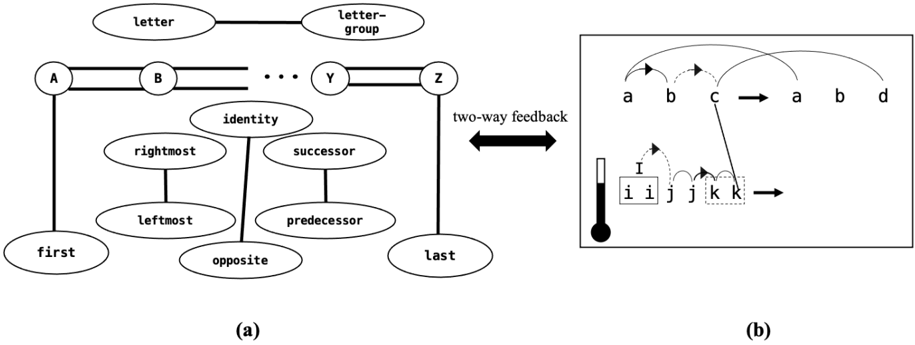
The image presents two conceptual diagrams, labeled (a) and (b), illustrating different aspects of letter processing. Diagram (a) depicts a network of relationships between letters, letter groups, and associated concepts like "first," "last," "identity," etc. Diagram (b) shows a sequence of letters and a process involving a "thermometer" and letter manipulation. The two diagrams are linked by a "two-way feedback" arrow, suggesting an interaction between the two models.
### Components/Axes
**Diagram (a): Network of Letter Relationships**
* **Nodes:** Represented as ovals containing terms such as "letter," "letter-group," individual letters (A, B, Y, Z), and concepts like "identity," "rightmost," "leftmost," "successor," "predecessor," "first," "opposite," and "last."
* **Edges:** Represented as lines connecting the nodes, indicating relationships between them.
* **Letter Sequence:** A sequence of letters A, B, ... , Y, Z is shown at the top.
* **Positioning:** The "letter" and "letter-group" nodes are positioned at the top of the diagram. The sequence of letters (A, B, ..., Y, Z) is below them. The remaining concept nodes are positioned below the letter sequence, connected to the letters "A" and "Z".
**Diagram (b): Letter Sequence Processing**
* **Letter Sequence:** A sequence of letters "a b c a b d" is shown at the top.
* **Thermometer:** A vertical thermometer-like graphic is present on the left side.
* **Letter Group:** A group of letters "i i j j k k" is shown below the letter sequence. The letters "k k" are enclosed in a dashed rectangle.
* **Arrows:** Arrows indicate the flow and manipulation of letters. Curved, dotted arrows show relationships between letters in the top sequence. A solid arrow connects "c" in the top sequence to "k" in the bottom sequence. Solid arrows also indicate the direction of processing in both sequences.
**Link between Diagrams**
* **Two-way feedback:** A double-headed arrow labeled "two-way feedback" connects diagram (a) and diagram (b), indicating a reciprocal relationship between the two models.
### Detailed Analysis or ### Content Details
**Diagram (a):**
* The "letter" node is connected to the "letter-group" node.
* The letters A, B, ..., Y, and Z are connected in a sequence.
* "A" is connected to "first".
* "Z" is connected to "last".
* "rightmost" is connected to "leftmost".
* "successor" is connected to "predecessor".
* "identity" is connected to "opposite".
* "first" is connected to "leftmost" and "opposite".
* "last" is connected to "rightmost" and "opposite".
* "identity" is connected to "A" and "Z".
* "successor" is connected to "Z".
* "predecessor" is connected to "A".
**Diagram (b):**
* The letter sequence "a b c a b d" is present.
* Curved, dotted arrows connect "a" to "b", "b" to "c", and "c" back to "a". Another curved, dotted arrow connects "a" to "b".
* A solid arrow points from "c" in the top sequence to "k" in the bottom sequence.
* The letter sequence "i i j j k k" is present.
* Curved, dotted arrows connect "i" to "j" and "j" to "k".
* The letters "k k" are enclosed in a dashed rectangle, and a solid arrow points to the right, indicating further processing.
* The thermometer is filled to approximately 25% of its capacity.
### Key Observations
* Diagram (a) represents a static network of relationships, while diagram (b) represents a dynamic process.
* The "two-way feedback" arrow suggests that the static relationships in diagram (a) influence the dynamic process in diagram (b), and vice versa.
* The thermometer in diagram (b) might represent a level of activation or some other internal state.
* The dashed rectangle around "k k" in diagram (b) suggests a specific operation or selection.
### Interpretation
The diagrams likely represent different levels of abstraction in a cognitive model of letter processing. Diagram (a) describes the conceptual relationships between letters and related concepts, providing a framework for understanding letter properties and their roles within words or sequences. Diagram (b) illustrates a specific process involving letter manipulation, potentially representing a reading or writing task. The "two-way feedback" suggests that the conceptual knowledge in diagram (a) informs the processing in diagram (b), and the results of that processing may update or refine the conceptual knowledge. The thermometer could represent the level of attention or cognitive load during the processing. The selection of "k k" might indicate a focus on specific letter combinations or patterns.