\n
## Diagram: Conceptual Relationships and Feedback Loop
### Overview
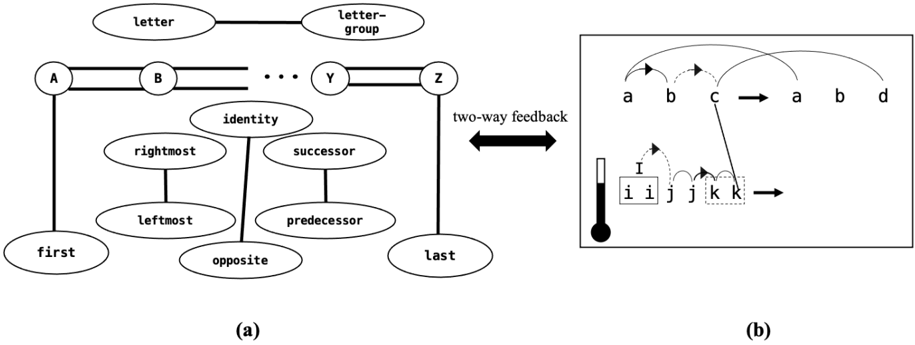
The image presents two diagrams, labeled (a) and (b). Diagram (a) illustrates relationships between letters and letter groups, with associated properties. Diagram (b) depicts a feedback loop involving elements labeled 'a' through 'd' and a thermometer-like device with markings 'i' through 'k'.
### Components/Axes
**Diagram (a):**
* **Nodes:** A, B, ..., Y, Z, letter, letter-group, first, rightmost, leftmost, opposite, identity, successor, predecessor, last.
* **Edges:** Arrows indicating relationships between nodes.
* **Labels:** "letter", "letter-group", "first", "rightmost", "leftmost", "opposite", "identity", "successor", "predecessor", "last".
**Diagram (b):**
* **Nodes:** a, b, c, d, i, j, k.
* **Edges:** Curved arrows indicating a feedback loop. A straight arrow points from 'd' to 'a'.
* **Icon:** A thermometer-like device with markings 'i', 'j', and 'k'.
* **Label:** "two-way feedback" with a double-headed arrow.
### Detailed Analysis or Content Details
**Diagram (a):**
* The diagram shows a sequence of letters from A to Z, represented as nodes.
* The "letter" node connects to the sequence of letters.
* The "letter-group" node also connects to the sequence of letters.
* Several properties are associated with the letters:
* "first" is connected to A.
* "last" is connected to Z.
* "rightmost" and "leftmost" connect to the letter sequence.
* "opposite" connects to the letter sequence.
* "identity" connects to the letter sequence.
* "successor" connects to the letter sequence.
* "predecessor" connects to the letter sequence.
**Diagram (b):**
* A feedback loop exists between nodes a, b, c, and d. The loop is indicated by curved arrows connecting each node to the next in a circular fashion.
* A straight arrow points from node 'd' back to node 'a', suggesting a directional influence.
* The thermometer-like device is positioned within the feedback loop, with markings 'i', 'j', and 'k'. The thermometer appears to be influencing or being influenced by the loop.
* The "two-way feedback" label indicates a reciprocal relationship within the loop.
### Key Observations
* Diagram (a) represents a conceptual model of letters and their properties.
* Diagram (b) illustrates a dynamic system with feedback, potentially representing a control mechanism or iterative process.
* The thermometer in diagram (b) suggests a measurement or regulation aspect within the feedback loop.
* The combination of the two diagrams might imply a system where letters or letter groups are processed within a feedback loop, potentially with a measurable output (indicated by the thermometer).
### Interpretation
The diagrams likely represent an abstract model of a system involving sequential processing and feedback. Diagram (a) defines the elements (letters) and their properties, while diagram (b) describes how these elements interact within a dynamic loop. The thermometer suggests that the system's state is measurable and can influence the feedback process.
The "two-way feedback" label is crucial, indicating that the output of the system affects its input, creating a self-regulating or iterative behavior. The straight arrow from 'd' to 'a' could represent a dominant influence or a reset mechanism within the loop.
The diagrams could be used to model various systems, such as:
* **Language processing:** Letters as input, feedback loop as grammatical rules or semantic analysis.
* **Control systems:** Letters as parameters, feedback loop as a controller adjusting parameters based on measured output.
* **Iterative algorithms:** Letters as data points, feedback loop as an algorithm refining its output based on previous results.
Without further context, the specific application of these diagrams remains ambiguous. However, the diagrams clearly demonstrate a conceptual framework for understanding systems with sequential elements and feedback mechanisms.