## Chart Type: Line Chart: Proportion of Flips by Iteration for Gemini-2.0-Flash
### Overview
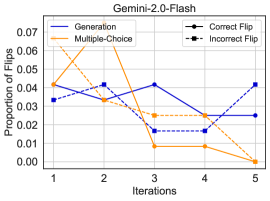
This image displays a line chart titled "Gemini-2.0-Flash" which illustrates the "Proportion of Flips" over five "Iterations". The chart presents four distinct data series, combining two task types ("Generation" and "Multiple-Choice") with two flip outcomes ("Correct Flip" and "Incorrect Flip"). The y-axis represents the proportion of flips, ranging from 0.00 to 0.07, while the x-axis represents iterations from 1 to 5.
### Components/Axes
* **Chart Title**: "Gemini-2.0-Flash" (positioned centrally at the top).
* **X-axis Label**: "Iterations" (positioned centrally below the x-axis).
* **X-axis Markers**: 1, 2, 3, 4, 5.
* **Y-axis Label**: "Proportion of Flips" (positioned vertically along the left side of the y-axis).
* **Y-axis Markers**: 0.00, 0.01, 0.02, 0.03, 0.04, 0.05, 0.06, 0.07.
* **Legend**: Located in the top-left and top-right corners of the plot area. It defines the visual encoding for two orthogonal dimensions:
* **Task Type (Line Color/Style)**:
* `Generation`: Represented by a blue line.
* `Multiple-Choice`: Represented by an orange line.
* **Flip Outcome (Line Style/Marker)**:
* `Correct Flip`: Represented by a solid line with square markers.
* `Incorrect Flip`: Represented by a dashed line with square markers.
Combining these legend elements, there are four distinct data series plotted:
1. **Generation - Correct Flip**: Blue solid line with solid square markers.
2. **Generation - Incorrect Flip**: Blue dashed line with solid square markers.
3. **Multiple-Choice - Correct Flip**: Orange solid line with solid square markers.
4. **Multiple-Choice - Incorrect Flip**: Orange dashed line with solid square markers.
### Detailed Analysis
The chart tracks the proportion of flips for each of the four combined conditions across five iterations.
1. **Generation - Correct Flip** (Blue solid line with solid square markers):
* **Trend**: This series generally shows an initial increase, then a plateau, followed by a decrease and another plateau.
* **Data Points**:
* Iteration 1: Approximately 0.034
* Iteration 2: Approximately 0.041
* Iteration 3: Approximately 0.041
* Iteration 4: Approximately 0.025
* Iteration 5: Approximately 0.025
2. **Generation - Incorrect Flip** (Blue dashed line with solid square markers):
* **Trend**: This series starts high, decreases significantly, plateaus, and then sharply increases at the final iteration.
* **Data Points**:
* Iteration 1: Approximately 0.042
* Iteration 2: Approximately 0.035
* Iteration 3: Approximately 0.017
* Iteration 4: Approximately 0.017
* Iteration 5: Approximately 0.041
3. **Multiple-Choice - Correct Flip** (Orange solid line with solid square markers):
* **Trend**: This series shows a consistent downward trend, starting moderately high and decreasing to zero by the final iteration.
* **Data Points**:
* Iteration 1: Approximately 0.041
* Iteration 2: Approximately 0.034
* Iteration 3: Approximately 0.008
* Iteration 4: Approximately 0.008
* Iteration 5: Approximately 0.000
4. **Multiple-Choice - Incorrect Flip** (Orange dashed line with solid square markers):
* **Trend**: This series starts as the highest proportion, remains high for the second iteration, then drops sharply and continues to decrease to zero.
* **Data Points**:
* Iteration 1: Approximately 0.062
* Iteration 2: Approximately 0.062
* Iteration 3: Approximately 0.025
* Iteration 4: Approximately 0.025
* Iteration 5: Approximately 0.000
### Key Observations
* **Initial State (Iteration 1)**: "Multiple-Choice - Incorrect Flip" has the highest proportion of flips (~0.062), followed by "Generation - Incorrect Flip" (~0.042) and "Multiple-Choice - Correct Flip" (~0.041), with "Generation - Correct Flip" being the lowest (~0.034).
* **Overall Decrease in Multiple-Choice Flips**: Both "Multiple-Choice - Correct Flip" and "Multiple-Choice - Incorrect Flip" proportions decrease significantly over iterations, reaching 0.000 by Iteration 5.
* **Fluctuation in Generation Flips**: The "Generation" task types show more fluctuation. "Generation - Correct Flip" peaks at Iterations 2-3 before declining, while "Generation - Incorrect Flip" drops and then sharply rises again at Iteration 5, almost returning to its initial level.
* **Crossover Points**:
* At Iteration 1, "Generation - Incorrect Flip" is higher than "Generation - Correct Flip".
* At Iteration 2, "Generation - Correct Flip" becomes higher than "Generation - Incorrect Flip" and remains so until Iteration 4.
* At Iteration 5, "Generation - Incorrect Flip" surpasses "Generation - Correct Flip" again.
* "Multiple-Choice - Incorrect Flip" is consistently higher than "Multiple-Choice - Correct Flip" until Iteration 5 where both reach zero.
* At Iteration 3, "Generation - Correct Flip" (0.041) is notably higher than all other series, which have dropped significantly.
* **Final State (Iteration 5)**: Both "Multiple-Choice" flip types reach zero. For "Generation" flips, "Incorrect Flip" (~0.041) is significantly higher than "Correct Flip" (~0.025).
### Interpretation
The data suggests that for the "Gemini-2.0-Flash" model, the propensity for "flips" (which likely refers to changes in prediction or state) varies significantly between "Generation" and "Multiple-Choice" tasks, and also between "Correct" and "Incorrect" outcomes, across iterations.
For **Multiple-Choice tasks**, the model appears to stabilize quickly, with both correct and incorrect flips diminishing to zero by the fifth iteration. This could imply that the model either converges on a stable answer or becomes less prone to changing its mind (flipping) as iterations progress in a multiple-choice context. The initial high proportion of "Incorrect Flips" in Multiple-Choice suggests early instability or exploration, which is then resolved.
For **Generation tasks**, the behavior is more complex and less stable. While "Generation - Correct Flip" shows an initial improvement (higher proportion of correct flips) before declining, "Generation - Incorrect Flip" demonstrates a concerning rebound at Iteration 5. This suggests that for generation tasks, the model might not be converging to a stable state regarding incorrect flips, or it might be re-evaluating its generations in a way that leads to more incorrect changes later in the process. The fact that "Generation - Incorrect Flip" ends higher than "Generation - Correct Flip" at Iteration 5 indicates a potential issue with the model's stability or accuracy in generation tasks over extended iterations, where it might be making more incorrect changes than correct ones.
In summary, the model appears to achieve stability and reduce flips for multiple-choice tasks, but exhibits more volatile and potentially problematic behavior for generation tasks, particularly concerning incorrect flips in later iterations. This could point to differences in how the model learns, adapts, or explores solutions depending on the task type.