## Screenshot: Task Interface with AI Model Prediction
### Overview
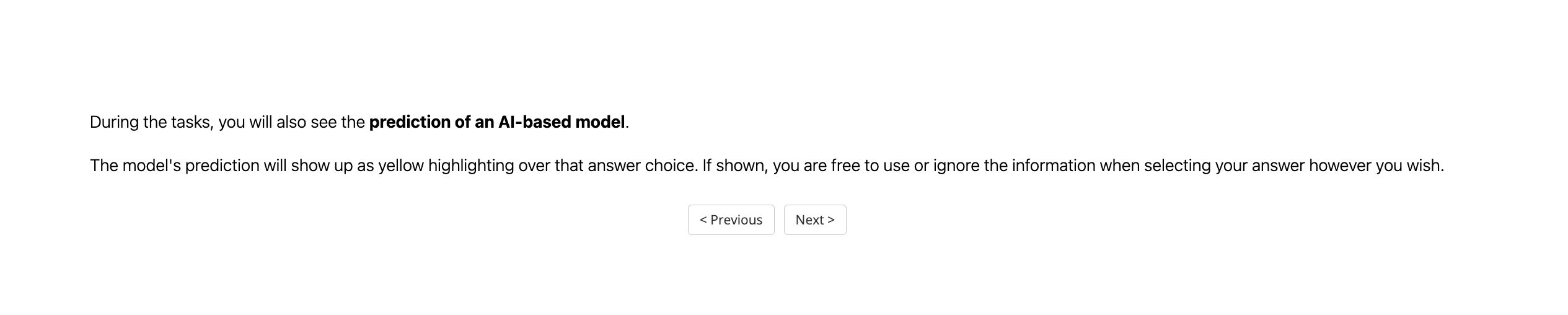
The image depicts a minimalist user interface for a task-based system where participants interact with AI-generated predictions. The interface includes instructional text, a highlighted AI prediction, and navigation controls.
### Components/Axes
- **Text Elements**:
- Instructional text: "During the tasks, you will also see the **prediction of an AI-based model**."
- Guidance: "The model's prediction will show up as yellow highlighting over that answer choice. If shown, you are free to use or ignore the information when selecting your answer however you wish."
- **Navigation Buttons**:
- "Previous" (left-aligned) and "Next" (right-aligned) buttons with gray backgrounds and black text.
- **Visual Highlighting**:
- Yellow highlighting (bold text) over the phrase "prediction of an AI-based model" in the instructional text.
### Detailed Analysis
- **Textual Content**:
- The primary instruction emphasizes the presence of AI-generated predictions during tasks.
- The highlighted text ("prediction of an AI-based model") is bold and yellow, drawing attention to the AI's role.
- Secondary text clarifies that the AI's predictions are optional for decision-making.
- **UI Layout**:
- Text is centered on a white background with black font.
- Navigation buttons are positioned at the bottom, separated from the main text.
- No additional visual elements (e.g., charts, diagrams) are present.
### Key Observations
- The interface prioritizes clarity, using bold and colored text to emphasize critical information (AI predictions).
- The optional use of AI predictions suggests a user-centric design, allowing autonomy in decision-making.
- Navigation buttons imply a sequential task flow, typical of multi-step experiments or surveys.
### Interpretation
This interface is designed for a controlled experiment or user study where participants engage with AI-assisted tasks. The AI's predictions are presented as supplementary information, not mandatory guidance, indicating a focus on evaluating human-AI collaboration dynamics. The simplicity of the design minimizes cognitive load, ensuring participants focus on the task rather than the interface itself. The absence of additional visual elements (e.g., progress bars, timers) suggests the study may prioritize qualitative over quantitative data collection.