\n
## Diagram: Syntactic Parsing Tree
### Overview
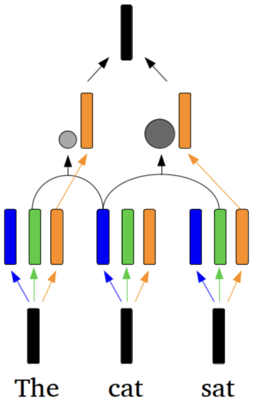
The image depicts a syntactic parsing tree, likely illustrating the grammatical structure of a sentence. The sentence appears to be "The cat sat". The diagram uses colored rectangles and circles to represent different parts of speech and grammatical relationships, with arrows indicating dependencies.
### Components/Axes
The diagram consists of:
* **Terminal Nodes:** Black rectangles at the bottom representing the words "The", "cat", and "sat".
* **Intermediate Nodes:** Colored rectangles (blue, green, orange) representing phrases or grammatical categories.
* **Root Node:** A black rectangle at the top, representing the sentence as a whole.
* **Circles:** Grey circles representing intermediate nodes.
* **Arrows:** Arrows of different colors (blue, green, orange) indicating the relationships between nodes.
### Detailed Analysis or Content Details
The diagram can be broken down as follows:
1. **"The"**: A black rectangle at the bottom left. A blue arrow points upwards from it to a blue rectangle.
2. **"cat"**: A black rectangle at the bottom center. A blue arrow points upwards from it to a blue rectangle.
3. **"sat"**: A black rectangle at the bottom right. A blue arrow points upwards from it to a blue rectangle.
4. **Blue Rectangles**: There are three blue rectangles. Each receives an arrow from one of the terminal nodes ("The", "cat", "sat"). These likely represent noun phrases or individual noun/determiner combinations.
5. **Green Rectangles**: Two green rectangles are present. Each receives an arrow from a blue rectangle. These likely represent verb phrases or similar grammatical structures.
6. **Orange Rectangles**: Two orange rectangles are present. One receives an arrow from a green rectangle and a grey circle. The other receives an arrow from a green rectangle. These likely represent higher-level phrases or clauses.
7. **Grey Circles**: Two grey circles are present. One receives an arrow from a blue rectangle and sends an arrow to an orange rectangle.
8. **Root Node**: A black rectangle at the top receives arrows from both orange rectangles. This represents the complete sentence.
### Key Observations
* The diagram shows a hierarchical structure, with the sentence broken down into progressively smaller components.
* The color-coding of the arrows suggests different types of grammatical relationships.
* The diagram appears to be a simplified representation of a parse tree, focusing on the core grammatical structure.
* The diagram does not provide any numerical data or quantitative measurements.
### Interpretation
This diagram illustrates a possible syntactic parse of the sentence "The cat sat". The tree structure shows how the sentence is composed of phrases and words, and how these elements relate to each other grammatically. The use of different colors for the arrows likely indicates different types of dependencies (e.g., subject-verb, determiner-noun). The diagram suggests a relatively simple sentence structure, with a noun phrase ("The cat") as the subject and a verb ("sat") as the predicate. The diagram is a visual representation of the underlying grammatical rules that govern the sentence's structure. It is a common tool used in computational linguistics and natural language processing to analyze and understand the meaning of sentences. The diagram does not provide any information about the semantic meaning of the sentence, only its syntactic structure.