## Line Chart: Average Rounds across Similarity Thresholds — All Models
### Overview
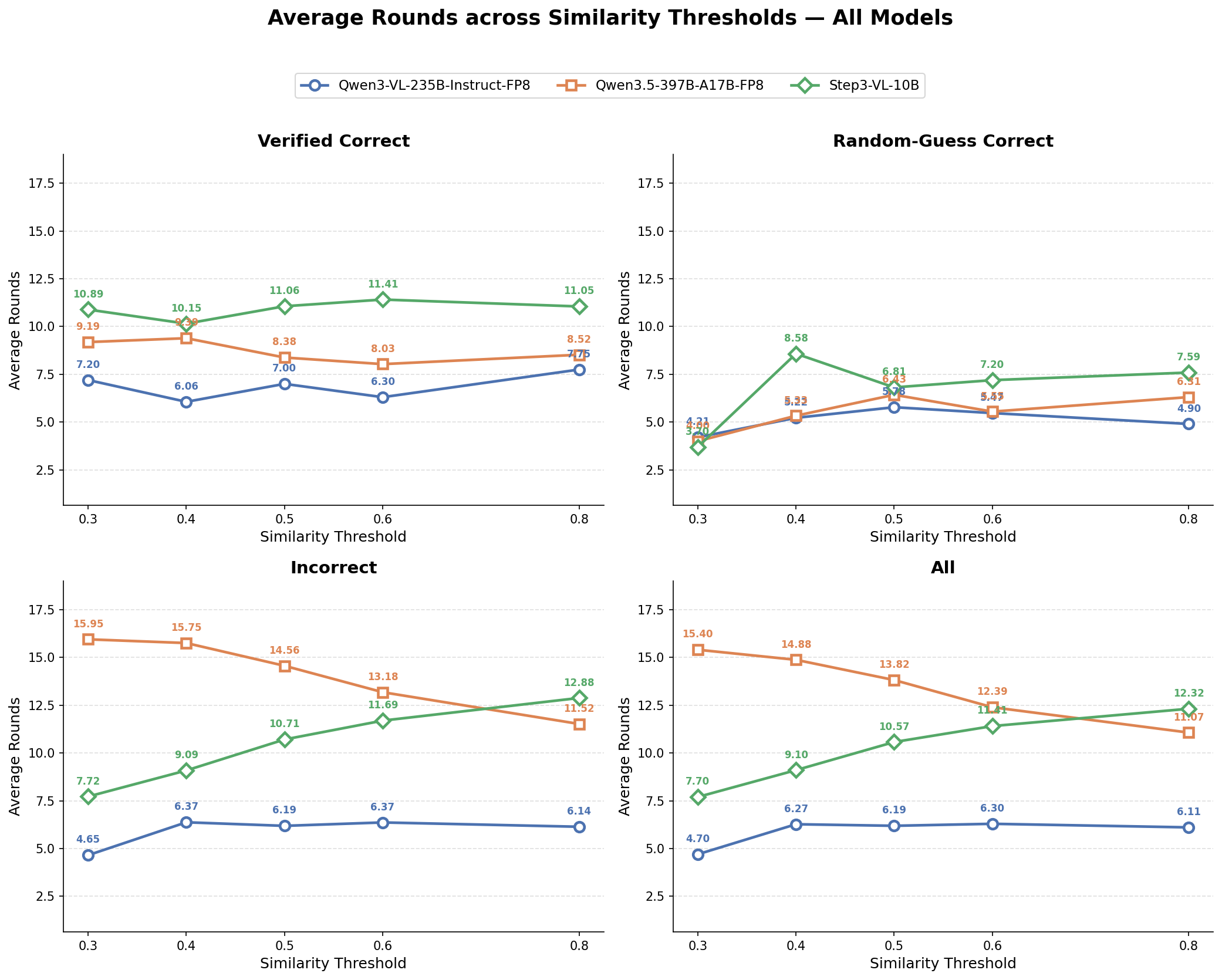
The image displays four line charts arranged in a 2x2 grid, analyzing model performance across similarity thresholds (0.3–0.8) for four scenarios: Verified Correct, Random Guess Correct, Incorrect, and All. Three models are compared using distinct line styles and colors.
### Components/Axes
- **X-axis**: Similarity Threshold (0.3, 0.4, 0.5, 0.6, 0.8).
- **Y-axis**: Average Rounds (0–17.5, in increments of 2.5).
- **Legend**: Located in the top-left of the main chart, with three entries:
- Blue circle: Gwen3-VL-235B-Instruct-FP8.
- Orange square: Gwen3.5-397B-A17B-FP8.
- Green diamond: Step3-VL-10B.
### Detailed Analysis
#### Verified Correct
- **Trend**:
- Gwen3-VL-235B (blue): Slight upward trend (7.20 → 7.75).
- Gwen3.5 (orange): Peaks at 0.4 (9.39), then declines to 8.52 at 0.8.
- Step3-VL-10B (green): Rises from 10.89 to 11.41 at 0.6, then slightly drops to 11.05 at 0.8.
- **Key Values**:
- Gwen3-VL-235B: 7.20 (0.3) → 7.75 (0.8).
- Gwen3.5: 9.19 (0.3) → 8.38 (0.5) → 8.03 (0.6) → 8.52 (0.8).
- Step3-VL-10B: 10.89 (0.3) → 10.15 (0.4) → 11.06 (0.5) → 11.41 (0.6) → 11.05 (0.8).
#### Random Guess Correct
- **Trend**:
- Gwen3-VL-235B: Peaks at 0.5 (5.78), then drops to 4.90 at 0.8.
- Gwen3.5: Rises to 6.43 at 0.5, then declines to 6.31 at 0.8.
- Step3-VL-10B: Sharp rise to 8.58 at 0.4, then gradual decline to 7.59 at 0.8.
- **Key Values**:
- Gwen3-VL-235B: 4.21 (0.3) → 5.22 (0.4) → 5.78 (0.5) → 5.43 (0.6) → 4.90 (0.8).
- Gwen3.5: 4.60 (0.3) → 6.81 (0.5) → 5.43 (0.6) → 6.31 (0.8).
- Step3-VL-10B: 3.80 (0.3) → 8.58 (0.4) → 6.43 (0.5) → 7.20 (0.6) → 7.59 (0.8).
#### Incorrect
- **Trend**:
- Gwen3-VL-235B: Stable at ~6.1–6.4.
- Gwen3.5: Declines steadily (15.95 → 11.52).
- Step3-VL-10B: Rises consistently (7.72 → 12.88).
- **Key Values**:
- Gwen3-VL-235B: 4.65 (0.3) → 6.37 (0.4) → 6.19 (0.5) → 6.37 (0.6) → 6.14 (0.8).
- Gwen3.5: 15.95 (0.3) → 15.75 (0.4) → 14.56 (0.5) → 13.18 (0.6) → 11.52 (0.8).
- Step3-VL-10B: 7.72 (0.3) → 9.09 (0.4) → 10.71 (0.5) → 11.69 (0.6) → 12.88 (0.8).
#### All
- **Trend**:
- Gwen3-VL-235B: Fluctuates between 6.1–6.4.
- Gwen3.5: Declines from 15.40 to 11.07.
- Step3-VL-10B: Increases from 7.70 to 12.32.
- **Key Values**:
- Gwen3-VL-235B: 4.70 (0.3) → 6.27 (0.4) → 6.19 (0.5) → 6.30 (0.6) → 6.11 (0.8).
- Gwen3.5: 15.40 (0.3) → 14.88 (0.4) → 13.82 (0.5) → 12.39 (0.6) → 11.07 (0.8).
- Step3-VL-10B: 7.70 (0.3) → 9.10 (0.4) → 10.57 (0.5) → 11.41 (0.6) → 12.32 (0.8).
### Key Observations
1. **Model Performance**:
- Gwen3.5 models generally require more rounds in "Verified Correct" and "All" scenarios, suggesting thorough processing.
- Step3-VL-10B excels in "Incorrect" and "All" scenarios, indicating robustness in error handling.
- Gwen3-VL-235B maintains moderate performance across all scenarios.
2. **Threshold Correlation**:
- Higher similarity thresholds (0.6–0.8) correlate with increased rounds for "Verified Correct" and "All," implying greater computational effort for higher-confidence tasks.
- Step3-VL-10B shows a peak in "Random Guess Correct" at 0.4, potentially indicating overcommitment to low-confidence tasks.
3. **Anomalies**:
- Gwen3.5's sharp decline in "Verified Correct" after 0.4 may reflect inefficiency or saturation at high thresholds.
- Step3-VL-10B's spike in "Random Guess Correct" at 0.4 contrasts with its strong performance in "Incorrect" rounds, suggesting divergent strategies for different error types.
### Interpretation
The data highlights model-specific behaviors:
- **Gwen3.5 models** prioritize depth, with Gwen3.5-397B-A17B-FP8 requiring the most rounds for "Verified Correct" and "All" tasks. This could indicate over-optimization for accuracy at the cost of efficiency.
- **Step3-VL-10B** balances performance, excelling in error handling ("Incorrect") and overall rounds ("All") while maintaining lower computational load for "Verified Correct." Its spike in "Random Guess Correct" at 0.4 might suggest a cautious approach to low-confidence tasks.
- **Gwen3-VL-235B** demonstrates stability but lacks the specialization of the other models. Its performance aligns with mid-tier efficiency, making it suitable for balanced workloads.
The trends emphasize the trade-off between computational effort and task specificity, with Step3-VL-10B emerging as the most versatile model across scenarios.