## Flowchart: Music Transcription Process
### Overview
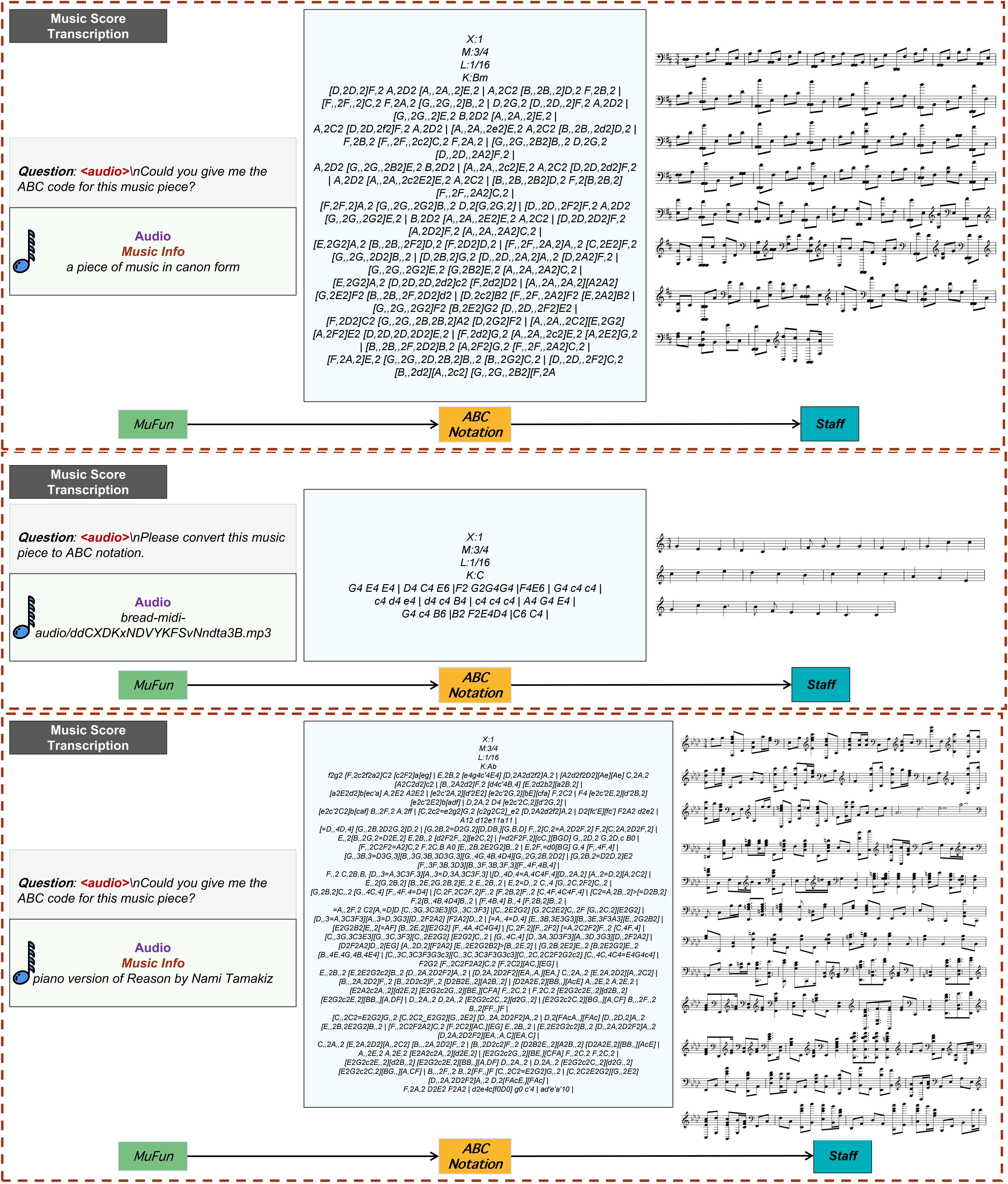
The image depicts a three-section flowchart illustrating the conversion of audio files into musical notation using ABC notation. Each section demonstrates a distinct audio input (canon form piece, bread midi file, piano version of "Reason by Nami Tamakiz") processed through MuFun software to generate ABC notation, which is then translated into standard musical staff notation.
### Components/Axes
1. **Question Box**: Contains user queries about ABC code generation for specific audio files.
2. **Audio Box**: Provides metadata about input files (e.g., "a piece of music in canon form," file paths like `audio/ddCXDxkNDVYKFSvNndta3B.mp3`).
3. **MuFun**: Central processing component (green box) that converts audio to ABC notation.
4. **ABC Notation**: Intermediate output (orange box) containing musical symbols and letter-based notation.
5. **Staff**: Final output (blue box) showing standard musical notation.
6. **Legend**: Color-coded elements (green=MuFun, orange=ABC Notation, blue=Staff).
### Detailed Analysis
#### Section 1: Canon Form Piece
- **Audio Info**: "a piece of music in canon form"
- **ABC Notation**: Contains complex letter-number combinations (e.g., `[D,2D]2[F,2,A,2D2]`, `[F,2F]2[F,2,A,2D2]`).
- **Staff Notation**: Five-line staff with notes like `D2`, `F2`, and `G2`.
#### Section 2: Bread Midi File
- **Audio Info**: File path `audio/ddCXDxkNDVYKFSvNndta3B.mp3`
- **ABC Notation**: Simplified notation (e.g., `G4 E4 E4 | D4 C4 E6 | F2 G2G4G4 | F4E6`).
- **Staff Notation**: Five-line staff with notes like `G4`, `E4`, and `D4`.
#### Section 3: Piano Version of "Reason"
- **Audio Info**: "piano version of Reason by Nami Tamakiz"
- **ABC Notation**: Dense letter-number sequences (e.g., `[F,2E2]2[F,2,A,2D2]`, `[E,2E2]2[E,2,A,2D2]`).
- **Staff Notation**: Five-line staff with notes like `F2`, `E2`, and `D2`.
### Key Observations
1. **Process Flow**: All sections follow the same structure: user question → MuFun processing → ABC notation → Staff notation.
2. **Notation Complexity**: Canon form transcription shows the most complex ABC notation, while the piano version has dense, repetitive patterns.
3. **File Formats**: Audio files vary between descriptive labels ("canon form") and technical paths (e.g., `.mp3`).
### Interpretation
This flowchart demonstrates a music transcription pipeline where MuFun acts as a bridge between raw audio and symbolic notation. The ABC notation serves as an intermediate step, translating audio patterns into a compact, text-based format that can then be rendered into standard staff notation. The examples highlight the software's ability to handle diverse musical styles (canon, midi, piano) and its output consistency across different audio types. The lack of numerical data suggests this is a conceptual diagram rather than a quantitative analysis.