## Diagram: LLM Trustworthiness
### Overview
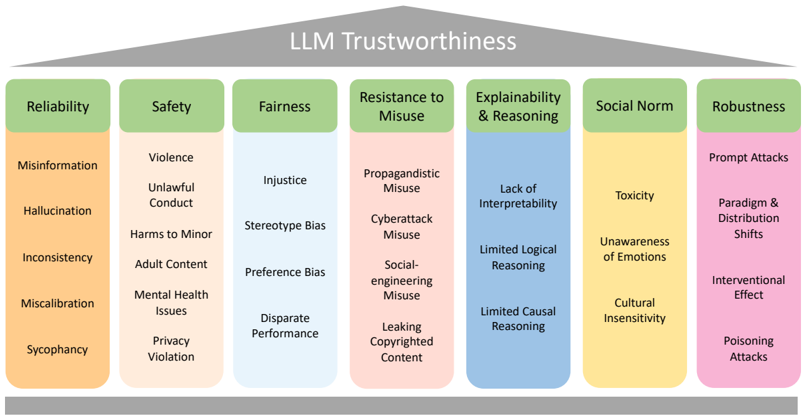
The image is a diagram illustrating the concept of LLM (Large Language Model) Trustworthiness. It breaks down trustworthiness into seven key components: Reliability, Safety, Fairness, Resistance to Misuse, Explainability & Reasoning, Social Norm, and Robustness. Each component is further detailed with specific issues or challenges associated with it. The diagram uses a house-like structure to visually represent the interconnectedness of these components.
### Components/Axes
* **Title:** LLM Trustworthiness (located at the top, acting as the roof of the house structure)
* **Main Categories (Pillars of the House):**
* Reliability (Leftmost pillar, colored orange)
* Safety (Second pillar from the left, colored light green)
* Fairness (Third pillar from the left, colored light blue)
* Resistance to Misuse (Fourth pillar from the left, colored light red/pink)
* Explainability & Reasoning (Fifth pillar from the left, colored light blue)
* Social Norm (Sixth pillar from the left, colored light yellow)
* Robustness (Rightmost pillar, colored light pink)
### Detailed Analysis
Each main category has a list of sub-categories or specific issues associated with it.
* **Reliability (Orange):**
* Misinformation
* Hallucination
* Inconsistency
* Miscalibration
* Sycophancy
* **Safety (Light Green):**
* Violence
* Unlawful Conduct
* Harms to Minor
* Adult Content
* Mental Health Issues
* Privacy Violation
* **Fairness (Light Blue):**
* Injustice
* Stereotype Bias
* Preference Bias
* Disparate Performance
* **Resistance to Misuse (Light Red/Pink):**
* Propagandistic Misuse
* Cyberattack Misuse
* Social-engineering Misuse
* Leaking Copyrighted Content
* **Explainability & Reasoning (Light Blue):**
* Lack of Interpretability
* Limited Logical Reasoning
* Limited Causal Reasoning
* **Social Norm (Light Yellow):**
* Toxicity
* Unawareness of Emotions
* Cultural Insensitivity
* **Robustness (Light Pink):**
* Prompt Attacks
* Paradigm & Distribution Shifts
* Interventional Effect
* Poisoning Attacks
### Key Observations
* The diagram uses color-coding to visually group related concepts.
* The "house" structure implies that all components are essential for overall LLM Trustworthiness.
* Each category has a varying number of sub-categories, suggesting different levels of complexity or concern for each aspect of trustworthiness.
### Interpretation
The diagram provides a structured overview of the multifaceted nature of LLM Trustworthiness. It highlights that trustworthiness is not a single, easily defined concept, but rather a combination of several interconnected factors. The categorization helps in identifying specific areas where LLMs might fall short and where improvements are needed. The "house" metaphor emphasizes that a weakness in any one of these areas can compromise the overall trustworthiness of the LLM. The specific issues listed under each category provide concrete examples of the challenges involved in building trustworthy LLMs.