## Flow Diagram: Language Understanding Research
### Overview
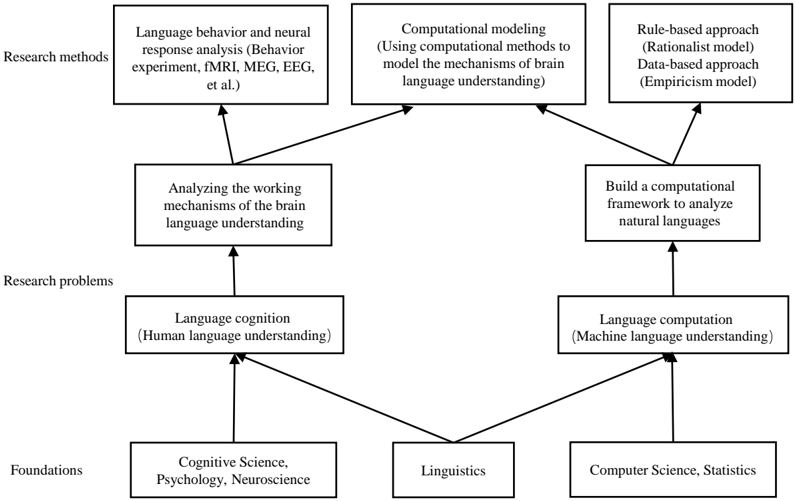
The image is a flow diagram illustrating the relationships between different research methods, research problems, and foundational disciplines in the field of language understanding. It shows how various approaches and fields contribute to the analysis and computation of language, both from a human and machine perspective.
### Components/Axes
* **Title:** There is no overall title for the diagram.
* **Categories:** The diagram is divided into three categories:
* Research methods
* Research problems
* Foundations
* **Nodes:** The diagram consists of rectangular nodes containing text, connected by arrows indicating the flow of influence or contribution.
### Detailed Analysis
* **Research Methods (Top Row):**
* **Left:** "Language behavior and neural response analysis (Behavior experiment, fMRI, MEG, EEG, et al.)"
* **Center:** "Computational modeling (Using computational methods to model the mechanisms of brain language understanding)"
* **Right:** "Rule-based approach (Rationalist model) Data-based approach (Empiricism model)"
* **Research Problems (Middle Row):**
* **Left:** "Analyzing the working mechanisms of the brain language understanding"
* **Right:** "Build a computational framework to analyze natural languages"
* **Research Problems (Second Row):**
* **Left:** "Language cognition (Human language understanding)"
* **Right:** "Language computation (Machine language understanding)"
* **Foundations (Bottom Row):**
* **Left:** "Cognitive Science, Psychology, Neuroscience"
* **Center:** "Linguistics"
* **Right:** "Computer Science, Statistics"
* **Arrows:**
* The "Language behavior and neural response analysis" node connects to "Analyzing the working mechanisms of the brain language understanding".
* The "Computational modeling" node connects to both "Analyzing the working mechanisms of the brain language understanding" and "Build a computational framework to analyze natural languages".
* The "Rule-based approach" node connects to "Build a computational framework to analyze natural languages".
* The "Analyzing the working mechanisms of the brain language understanding" node connects to "Language cognition".
* The "Build a computational framework to analyze natural languages" node connects to "Language computation".
* The "Cognitive Science, Psychology, Neuroscience" node connects to "Language cognition".
* The "Linguistics" node connects to both "Language cognition" and "Language computation".
* The "Computer Science, Statistics" node connects to "Language computation".
### Key Observations
* The diagram illustrates a hierarchical structure, with foundations informing research problems, which in turn are addressed by various research methods.
* Computational modeling appears to be a central research method, influencing both the analysis of brain language understanding and the building of computational frameworks.
* Linguistics serves as a foundational discipline for both human and machine language understanding.
### Interpretation
The diagram provides a high-level overview of the interdisciplinary nature of language understanding research. It highlights how cognitive science, linguistics, and computer science converge to address the complex problems of human and machine language comprehension. The flow of information suggests that foundational knowledge in these disciplines informs the development of research methods, which are then applied to analyze and model language processing. The diagram emphasizes the importance of both cognitive and computational approaches in advancing our understanding of language.