\n
## Diagram: Interdisciplinary Approaches to Language Understanding
### Overview
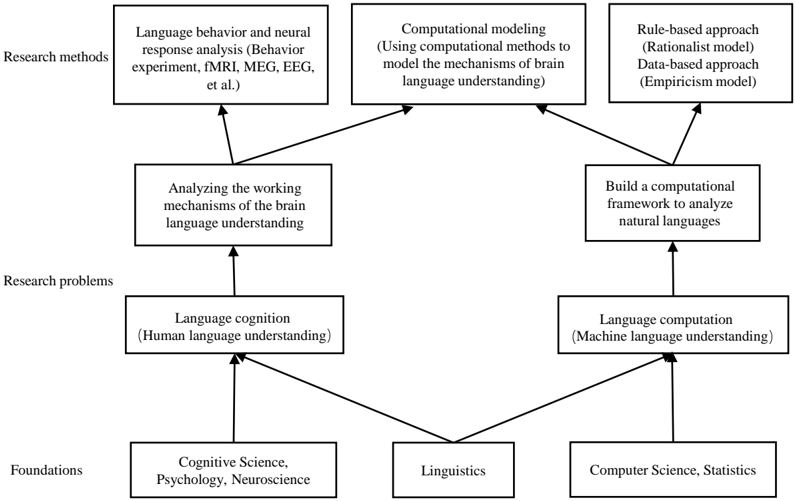
This diagram illustrates the interdisciplinary nature of research into language understanding, mapping foundational disciplines to research problems and ultimately to research methods. It depicts a flow of influence from the bottom (Foundations) upwards to the top (Research Methods), with branching paths representing different approaches. The diagram uses boxes connected by arrows to show relationships between concepts.
### Components/Axes
The diagram is structured into three horizontal layers:
* **Foundations:** Cognitive Science, Psychology, Neuroscience; Linguistics; Computer Science, Statistics.
* **Research Problems:** Language cognition (Human language understanding); Language computation (Machine language understanding).
* **Research Methods:** Language behavior and neural response analysis (Behavior experiment, fMRI, MEG, EEG, et al.); Computational modeling (Using computational methods to model the mechanisms of brain language understanding); Rule-based approach (Rationalist model) Data-based approach (Empiricism model).
Arrows indicate the direction of influence or dependency. The diagram is oriented vertically, with Foundations at the bottom and Research Methods at the top.
### Detailed Analysis or Content Details
**Foundations Layer:**
* **Left:** Cognitive Science, Psychology, Neuroscience.
* **Center:** Linguistics.
* **Right:** Computer Science, Statistics.
**Research Problems Layer:**
* **Left:** Language cognition (Human language understanding). An arrow originates from "Cognitive Science, Psychology, Neuroscience" and points to this box.
* **Right:** Language computation (Machine language understanding). An arrow originates from "Linguistics" and "Computer Science, Statistics" and points to this box.
**Research Methods Layer:**
* **Left:** Language behavior and neural response analysis (Behavior experiment, fMRI, MEG, EEG, et al.). Arrows originate from "Language cognition" and point to this box.
* **Center:** Computational modeling (Using computational methods to model the mechanisms of brain language understanding). Arrows originate from "Language cognition" and "Language computation" and point to this box.
* **Right:** Rule-based approach (Rationalist model) Data-based approach (Empiricism model). Arrows originate from "Language computation" and point to this box.
The diagram shows a convergence of approaches. "Computational modeling" receives input from both "Language cognition" and "Language computation". "Language behavior and neural response analysis" receives input solely from "Language cognition". "Rule-based approach" receives input solely from "Language computation".
### Key Observations
The diagram highlights the interplay between understanding human language and building machines that can process language. It emphasizes that both areas draw from similar foundational disciplines, but diverge in their primary research problems and methods. The diagram suggests that a comprehensive approach to language understanding requires integrating insights from all three layers.
### Interpretation
The diagram represents a conceptual map of the field of language understanding. It illustrates that the study of language is not confined to a single discipline but requires a collaborative effort from cognitive science, psychology, neuroscience, linguistics, computer science, and statistics. The branching structure suggests that there are multiple pathways to investigate language, each with its own strengths and limitations.
The distinction between "Language cognition" and "Language computation" is crucial. "Language cognition" focuses on how humans understand language, employing methods like behavioral experiments and neuroimaging. "Language computation" focuses on building machines that can understand and process language, utilizing computational modeling and rule-based or data-based approaches.
The diagram implicitly acknowledges the historical tension between rationalist (rule-based) and empiricist (data-based) approaches to artificial intelligence and language processing. The diagram suggests that both approaches are valuable and can contribute to a more complete understanding of language. The convergence on "Computational modeling" suggests that this is a key area for integrating these different perspectives.