## Conceptual Framework Diagram: Interdisciplinary Foundations of Language Understanding Research
### Overview
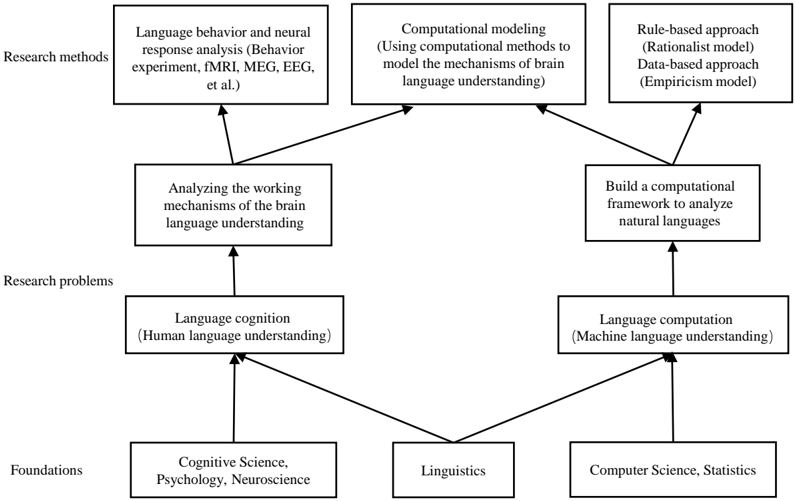
The image displays a structured flowchart or conceptual framework diagram illustrating the interdisciplinary relationships between foundational academic fields, core research problems, and specific research methods in the study of language understanding. The diagram is organized into three horizontal layers, with arrows indicating the flow of influence or contribution from the bottom layer (Foundations) upwards to the top layer (Research methods).
### Components/Axes
The diagram is segmented into three distinct horizontal layers, labeled on the left side:
1. **Foundations** (Bottom Layer)
2. **Research problems** (Middle Layer)
3. **Research methods** (Top Layer)
Each layer contains rectangular boxes with text. Arrows connect boxes between layers, showing directional relationships.
**Detailed Box Content & Spatial Layout:**
* **Foundations Layer (Bottom):**
* **Left Box:** "Cognitive Science, Psychology, Neuroscience"
* **Center Box:** "Linguistics"
* **Right Box:** "Computer Science, Statistics"
* **Research Problems Layer (Middle):**
* **Left Box:** "Language cognition (Human language understanding)"
* **Right Box:** "Language computation (Machine language understanding)"
* **Research Methods Layer (Top):**
* **Left Box:** "Language behavior and neural response analysis (Behavior experiment, fMRI, MEG, EEG, et al.)"
* **Center Box:** "Computational modeling (Using computational methods to model the mechanisms of brain language understanding)"
* **Right Box:** "Rule-based approach (Rationalist model) Data-based approach (Empiricism model)"
**Connection Flow (Arrows):**
* From **Foundations** to **Research Problems**:
* "Cognitive Science, Psychology, Neuroscience" and "Linguistics" both point to "Language cognition (Human language understanding)".
* "Linguistics" and "Computer Science, Statistics" both point to "Language computation (Machine language understanding)".
* From **Research Problems** to **Research Methods**:
* "Language cognition (Human language understanding)" points to both "Language behavior and neural response analysis..." and "Computational modeling...".
* "Language computation (Machine language understanding)" points to both "Computational modeling..." and "Rule-based approach... Data-based approach...".
### Detailed Analysis
The diagram presents a hierarchical and interconnected model.
1. **Foundational Disciplines:** The base consists of three pillars: the cognitive/neuro sciences, linguistics, and computational/statistical sciences.
2. **Core Research Problems:** These foundations feed into two primary, parallel research problems:
* **Language Cognition:** Focused on *human* language understanding.
* **Language Computation:** Focused on *machine* language understanding.
3. **Methodological Approaches:** The research problems are addressed by three methodological categories at the top:
* **Empirical/Neuroscientific Methods:** Involves direct experimentation and measurement of behavior and brain activity (e.g., fMRI, EEG).
* **Computational Modeling:** A central, bridging method that uses computational techniques to model the *mechanisms* of brain-based language understanding. It receives input from both the "Language cognition" and "Language computation" problems.
* **Theoretical/Algorithmic Approaches:** Encompasses both rule-based (rationalist) and data-driven (empiricist) paradigms for machine understanding.
### Key Observations
* **Linguistics as a Central Hub:** The "Linguistics" box is the only foundational element that contributes directly to *both* core research problems (human cognition and machine computation), highlighting its pivotal role.
* **Computational Modeling as a Convergence Point:** The "Computational modeling" method is the only one that receives direct input from both the "Language cognition" and "Language computation" research problems, positioning it as a key interdisciplinary synthesis point.
* **Dual Pathways to Methods:** The "Language cognition" problem leads to one purely empirical method (neural/behavioral analysis) and one modeling method. The "Language computation" problem leads to the same modeling method and a set of theoretical/algorithmic approaches.
* **Methodological Spectrum:** The top-right box explicitly contrasts two philosophical approaches to machine language understanding: the "Rule-based approach (Rationalist model)" and the "Data-based approach (Empiricism model)."
### Interpretation
This diagram maps the intellectual landscape of modern language understanding research. It argues that progress in this field is inherently interdisciplinary, requiring synthesis from cognitive science, linguistics, and computer science.
The framework suggests two main investigative paths: one inward-facing, seeking to understand the biological and cognitive mechanisms of human language (leading to empirical and modeling methods), and one outward-facing, seeking to engineer artificial language understanding (leading to computational and algorithmic methods). The central placement of "Computational modeling" indicates it is viewed as a critical bridge between understanding the human brain and building artificial systems, potentially using insights from one domain to inform the other.
The inclusion of both rationalist and empiricist models under machine understanding acknowledges a fundamental philosophical and methodological debate in AI and computational linguistics. Overall, the diagram presents a structured view where foundational knowledge informs specific research questions, which in turn are addressed by a diverse toolkit of methods, with computational modeling serving as a key integrative discipline.