## Flowchart: Interdisciplinary Framework for Language Understanding Research
### Overview
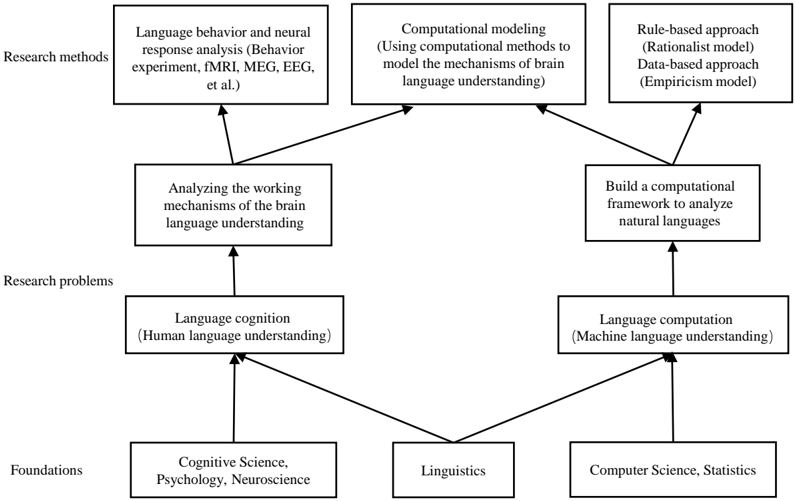
This flowchart illustrates the hierarchical relationship between research methods, research problems, and foundational disciplines in the study of language understanding. It emphasizes the interplay between human cognition, computational modeling, and empirical approaches, with bidirectional connections between theoretical and applied domains.
### Components/Axes
1. **Top Tier (Research Methods)**:
- Language behavior and neural response analysis (Behavior experiment, fMRI, MEG, EEG, et al.)
- Computational modeling (Modeling brain mechanisms of language understanding)
- Rule-based approach (Rationalist model) and Data-based approach (Empiricism model)
2. **Middle Tier (Research Problems)**:
- Analyzing the working mechanisms of the brain language understanding
- Build a computational framework to analyze natural languages
3. **Bottom Tier (Foundations)**:
- Cognitive Science, Psychology, Neuroscience
- Linguistics
- Computer Science, Statistics
4. **Connecting Nodes**:
- Language cognition (Human language understanding)
- Language computation (Machine language understanding)
### Detailed Analysis
- **Research Methods**:
- Experimental methods (fMRI, MEG, EEG) focus on neural correlates of language behavior.
- Computational modeling bridges neural data and theoretical frameworks.
- Rule-based (Rationalist) and data-driven (Empiricism) approaches represent competing paradigms in language processing.
- **Research Problems**:
- The first problem ("Analyzing brain mechanisms") connects experimental neuroscience to cognitive theory.
- The second problem ("Building a computational framework") links empirical data to machine learning and natural language processing (NLP).
- **Foundations**:
- Cognitive Science and Neuroscience underpin human language understanding.
- Linguistics provides theoretical frameworks for syntax, semantics, and pragmatics.
- Computer Science and Statistics enable algorithmic modeling and data-driven analysis.
### Key Observations
1. **Bidirectional Flow**: Arrows indicate reciprocal relationships (e.g., computational models inform brain mechanism analysis, and empirical data refine computational frameworks).
2. **Disciplinary Integration**: Foundations span biological, theoretical, and computational domains, reflecting the interdisciplinary nature of language research.
3. **Dual Focus**: The diagram distinguishes between human language understanding (cognitive) and machine language understanding (computational), yet shows their interdependence.
### Interpretation
This framework highlights the convergence of neuroscience, cognitive theory, and computational methods in advancing language understanding. The bidirectional arrows suggest iterative refinement: experimental data validate computational models, while model-driven hypotheses guide experimental design. The separation of "human" and "machine" language understanding underscores the field's dual goals—decoding biological mechanisms and engineering artificial systems. The inclusion of both Rationalist (rule-based) and Empiricism (data-based) models acknowledges ongoing debates in linguistics and AI about innate vs. learned language structures. Overall, the diagram advocates for an integrated approach where biological insights inform AI development, and computational advances test neuroscientific theories.