# Technical Document: LLM Function Calling and Conversation Architecture
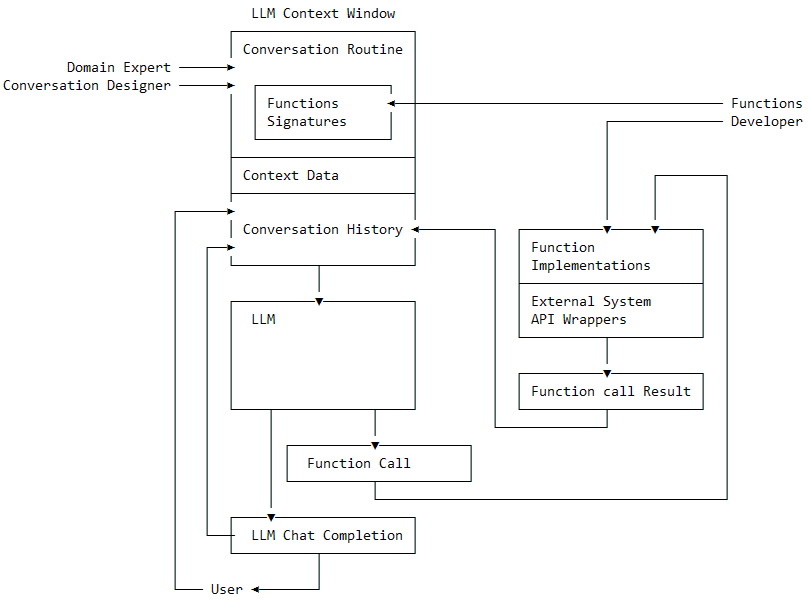
This document provides a detailed extraction and analysis of the provided architectural diagram, which outlines the flow of information between a Large Language Model (LLM), developers, designers, and end-users within a function-calling framework.
## 1. Component Isolation
The diagram is structured into three primary functional regions:
* **Region A: LLM Context Window (Top Left):** Defines the static and dynamic data provided to the model.
* **Region B: Execution & Processing (Center/Bottom):** The core LLM logic and output generation.
* **Region C: Backend Implementation (Right):** The technical infrastructure supporting function execution.
---
## 2. Detailed Component Transcription
### Region A: LLM Context Window
This is the primary container for the model's immediate memory and instructions.
* **Header Label:** `LLM Context Window`
* **Sub-components:**
* **Conversation Routine:** The top-level instructional framework.
* **Nested Box:** `Functions Signatures` (The definitions of available tools).
* **Context Data:** Static or retrieved information relevant to the session.
* **Conversation History:** The log of previous turns in the dialogue.
### Region B: Execution & Processing
* **LLM:** The central processing unit of the diagram.
* **Function Call:** A specific output generated by the LLM when it determines a tool is needed.
* **LLM Chat Completion:** The final natural language response generated for the user.
### Region C: Backend Implementation
* **Function Implementations:** The actual code (e.g., Python/JavaScript) that executes the logic.
* **External System API Wrappers:** The interface used to communicate with outside services.
* **Function call Result:** The data returned after the function has been executed.
### External Actors (Input/Output)
* **Domain Expert:** Provides input to the Conversation Routine.
* **Conversation Designer:** Provides input to the Conversation Routine.
* **Functions Developer:** Provides input to both the `Functions Signatures` and the `Function Implementations`.
* **User:** The end-point receiving the `LLM Chat Completion` and providing input back into the `Conversation History`.
---
## 3. Flow and Logic Analysis
The diagram illustrates a cyclical and interconnected workflow:
### Design & Development Phase
1. **Domain Experts** and **Conversation Designers** define the **Conversation Routine**.
2. The **Functions Developer** defines the **Functions Signatures** (what the LLM sees) and writes the **Function Implementations** (what the server executes).
### Execution Phase (The Loop)
1. **Input:** The **LLM** receives data from the **LLM Context Window** (Routine, Signatures, Context Data, and History).
2. **Decision:** The **LLM** can produce two types of outputs:
* **Direct Path:** It generates an **LLM Chat Completion** directly.
* **Action Path:** It generates a **Function Call**.
3. **Function Execution:**
* The **Function Call** triggers the **Function Implementations**.
* This interacts with **External System API Wrappers**.
* The result is captured in **Function call Result**.
4. **Feedback Loop:**
* The **Function call Result** is fed back into the **Conversation History**.
* The **LLM Chat Completion** is sent to the **User**.
* The **User's** subsequent response is fed back into the **Conversation History**, restarting the cycle.
---
## 4. Summary of Textual Elements
| Category | Extracted Text |
| :--- | :--- |
| **Main Containers** | LLM Context Window, LLM |
| **Context Elements** | Conversation Routine, Functions Signatures, Context Data, Conversation History |
| **Output Elements** | Function Call, LLM Chat Completion, Function call Result |
| **Backend Elements** | Function Implementations, External System API Wrappers |
| **Actors** | Domain Expert, Conversation Designer, Functions Developer, User |