## Code Snippet: Theorem Definition
### Overview
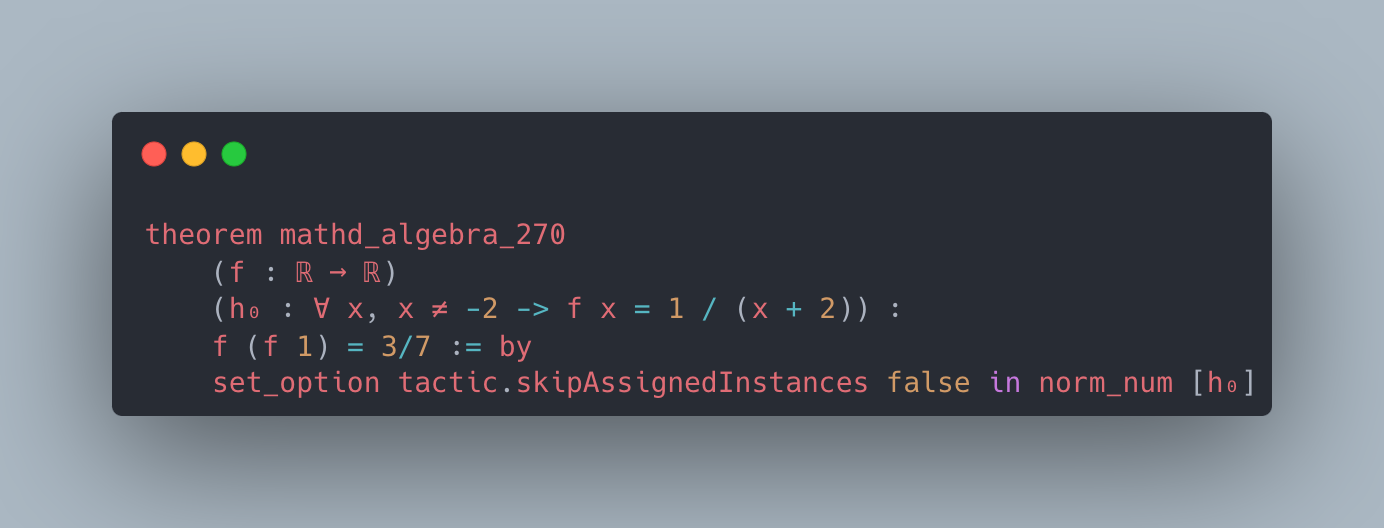
The image shows a code snippet defining a theorem related to algebra. It defines a function `f` from real numbers to real numbers and provides a condition on its behavior. It then states that `f(f(1)) = 3/7` and uses a tactic to prove this statement.
### Components/Axes
* **Header:** The top of the code snippet includes three colored circles (red, yellow, green), likely for window control.
* **Theorem Definition:** The core of the snippet defines a theorem named `mathd_algebra_270`.
* **Function Definition:** Defines a function `f` that maps real numbers to real numbers (`f: R -> R`).
* **Hypothesis:** States a hypothesis `h0` that for all `x` not equal to -2, `f(x) = 1 / (x + 2)`.
* **Assertion:** Asserts that `f(f(1)) = 3/7`.
* **Tactic:** Uses a tactic `set_option tactic.skipAssignedInstances false in norm_num [h0]` to prove the assertion.
### Detailed Analysis or ### Content Details
The code snippet contains the following information:
* `theorem mathd_algebra_270`
* `(f : R -> R)`
* `(h0 : ∀ x, x ≠ -2 -> f x = 1 / (x + 2)) :`
* `f (f 1) = 3/7 := by`
* `set_option tactic.skipAssignedInstances false in norm_num [h0]`
### Key Observations
* The theorem defines a function `f` with a specific property.
* The hypothesis `h0` defines the function's behavior for all `x` except -2.
* The assertion `f(f(1)) = 3/7` is a specific claim about the function's value.
* The tactic is used to automatically prove the assertion, likely using the hypothesis `h0`.
### Interpretation
The code snippet defines a theorem and attempts to prove it using automated tactics. The theorem states that if a function `f` maps real numbers to real numbers and satisfies the condition `f(x) = 1 / (x + 2)` for all `x` not equal to -2, then `f(f(1))` must equal `3/7`. The tactic `norm_num` likely simplifies the expression `f(f(1))` using the hypothesis `h0` to arrive at the value `3/7`. The `set_option` command likely configures the tactic to skip assigned instances during the normalization process.