\n
## Screenshot: Mathematical Theorem Definition
### Overview
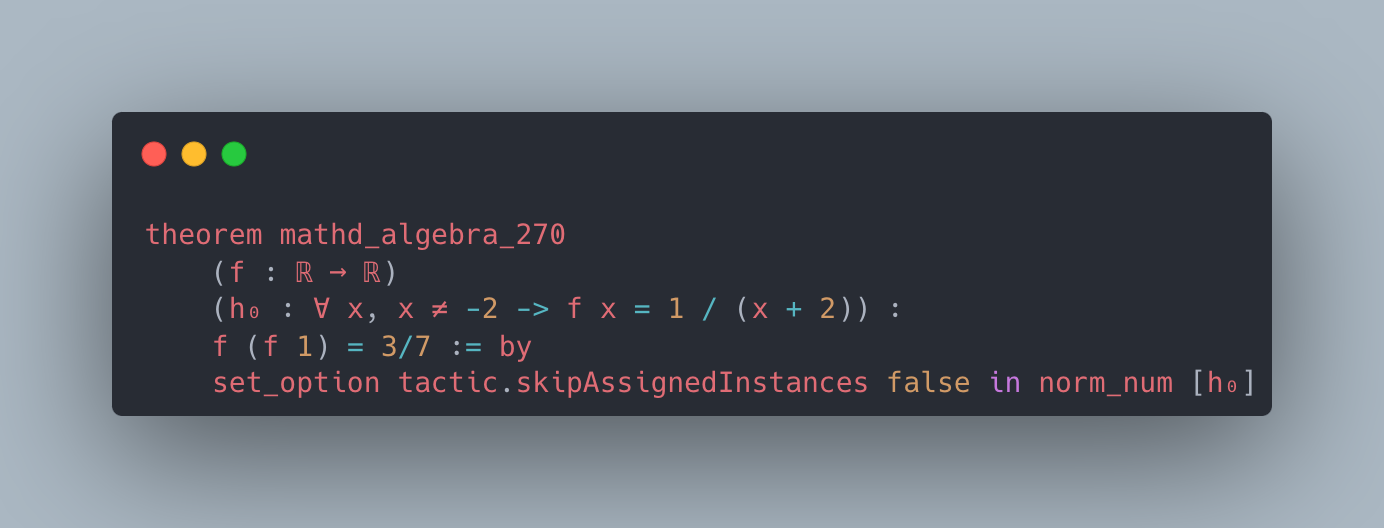
The image is a screenshot of a code editor or terminal window displaying a mathematical theorem definition, likely written in a formal proof language like Lean. The theorem concerns a function `f` mapping real numbers to real numbers and a condition involving its value at a specific point.
### Components/Axes
There are no axes or traditional chart components. The screenshot consists of text and three colored dots in the top-left corner (red, yellow, green). These dots appear to be status indicators.
### Detailed Analysis or Content Details
The text content is as follows:
```
theorem mathd_algebra_270
(f : ℝ → ℝ)
(h₀ : ∀ x, x ≠ -2 → f x = 1 / (x + 2)) :
f (1) = 3/7 := by
set_option tactic.skipAssignedInstances false in norm_num [h₀]
```
Breaking down the content:
* `theorem mathd_algebra_270`: This declares a theorem named "mathd\_algebra\_270".
* `(f : ℝ → ℝ)`: This defines a function `f` that takes a real number (ℝ) as input and returns a real number (ℝ).
* `(h₀ : ∀ x, x ≠ -2 → f x = 1 / (x + 2))`: This introduces a hypothesis `h₀`. It states that for all real numbers `x` not equal to -2, the function `f` evaluated at `x` is equal to 1 divided by (x + 2). The symbol `∀` represents "for all", `≠` means "not equal to", and `→` represents "implies".
* `: f (1) = 3/7 := by`: This is the conclusion of the theorem. It states that `f` evaluated at 1 is equal to 3/7. The `:= by` indicates the start of the proof.
* `set_option tactic.skipAssignedInstances false in norm_num [h₀]`: This line appears to be a command to the proof assistant (likely Lean) to normalize numbers using the hypothesis `h₀`. `set_option` configures the proof environment, `tactic.skipAssignedInstances false` disables a specific optimization, and `norm_num [h₀]` applies a normalization tactic using the hypothesis `h₀`.
### Key Observations
The theorem defines a function `f` with a specific property and then proves that `f(1)` equals 3/7. The proof uses a normalization tactic and a hypothesis about the function's behavior. The theorem is named `mathd_algebra_270`, suggesting it's part of a larger collection of mathematical definitions or proofs.
### Interpretation
This screenshot represents a formal statement and proof within a mathematical context. The theorem establishes a relationship between a function and its value at a specific point, given a general condition on the function's behavior. The use of formal notation and a proof assistant indicates a rigorous approach to mathematical reasoning. The `norm_num` tactic suggests the proof involves simplification or manipulation of numerical expressions. The theorem likely serves as a building block for more complex mathematical arguments. The colored dots in the top-left corner likely indicate the status of the editor or the compilation process (e.g., red for error, yellow for warning, green for success).