\n
## Code Snippet: Lean Theorem Proof
### Overview
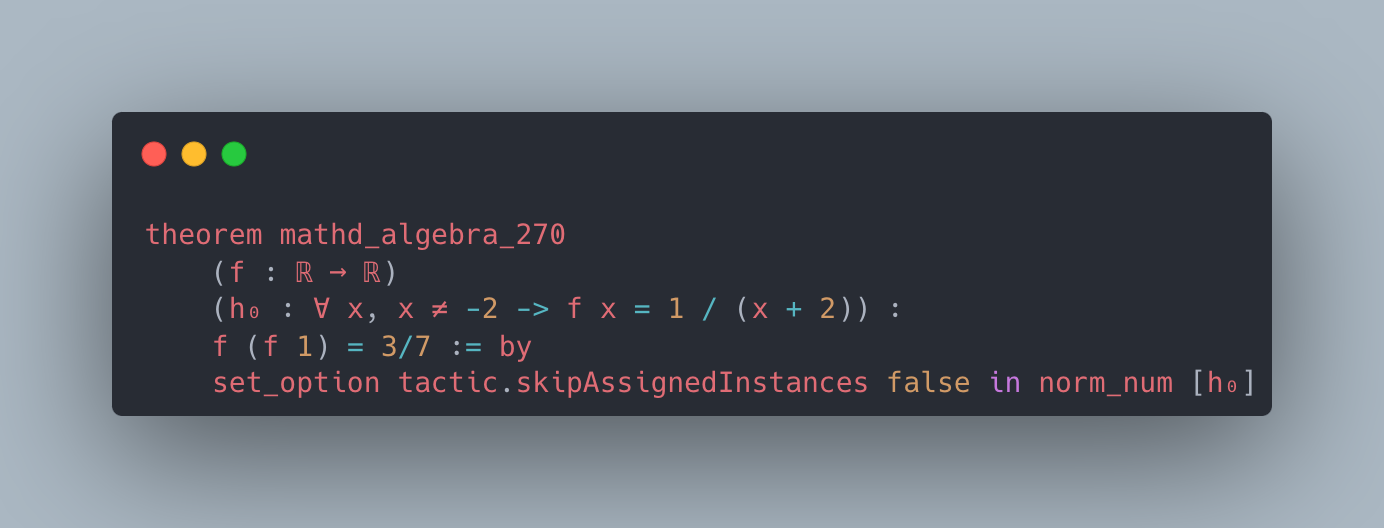
The image is a screenshot of a code editor window (likely on macOS, indicated by the three colored window control dots in the top-left corner) displaying a theorem and its proof written in the Lean theorem prover language. The code is presented with syntax highlighting on a dark background.
### Components/Axes
This is not a chart or diagram with axes. The components are the lines of code within the editor window.
**Window Elements:**
* **Top-left corner:** Three circular window control buttons (red, yellow, green).
* **Main content area:** A block of code with syntax highlighting. The text colors are part of the theme and help distinguish language elements.
### Detailed Analysis / Content Details
The following text is present in the image, transcribed exactly as it appears, including syntax highlighting colors noted descriptively:
1. **Line 1 (Pink text):** `theorem mathd_algebra_270`
* This declares a theorem named `mathd_algebra_270`.
2. **Line 2 (Mixed colors):** ` (f : ℝ → ℝ)`
* This is a parameter declaration. It states that `f` is a function from the real numbers (`ℝ`) to the real numbers (`ℝ`). The symbol `ℝ` is rendered in a distinct color (likely blue or cyan).
3. **Line 3 (Mixed colors):** ` (h₀ : ∀ x, x ≠ -2 → f x = 1 / (x + 2)) :`
* This declares a hypothesis named `h₀`.
* The hypothesis states: "For all `x`, if `x` is not equal to `-2`, then `f x` equals `1 / (x + 2)`."
* Symbols: `∀` (for all), `≠` (not equal), `→` (implies), `ℝ` (real numbers) are present.
4. **Line 4 (Mixed colors):** ` f (f 1) = 3/7 := by`
* This is the goal of the theorem: to prove that `f (f 1)` equals `3/7`.
* The `:= by` indicates the start of the proof.
5. **Line 5 (Mixed colors):** ` set_option tactic.skipAssignedInstances false in norm_num [h₀]`
* This is the proof tactic.
* It first sets an option (`tactic.skipAssignedInstances`) to `false`.
* Then it uses the `norm_num` tactic, providing the hypothesis `h₀` as a parameter in square brackets `[h₀]`.
### Key Observations
* **Language:** The code is written in Lean, a formal proof management system and functional programming language.
* **Structure:** The code follows a standard Lean theorem structure: `theorem name : statement := by proof`.
* **Mathematical Content:** The theorem defines a function `f` with a specific rational expression and asks to compute the value of its composition at a point (`f(f(1))`).
* **Proof Method:** The proof relies on the `norm_num` tactic, which is used for normalizing numerical expressions, and it explicitly uses the given hypothesis `h₀`.
### Interpretation
This image captures a formal mathematical statement and its verification within a computer-assisted proof system.
* **What the data suggests:** The code represents a solved problem, likely from a mathematics competition or textbook (suggested by the name `mathd_algebra_270`). It demonstrates the use of a theorem prover to verify an algebraic computation.
* **How elements relate:** The hypothesis `h₀` defines the function `f`. The goal is a specific numerical claim about `f`. The proof tactic `norm_num` uses the definition in `h₀` to compute the value `f(1) = 1/(1+2) = 1/3`, and then `f(f(1)) = f(1/3) = 1/(1/3 + 2) = 1/(7/3) = 3/7`, thereby proving the goal.
* **Notable aspects:** The use of `set_option tactic.skipAssignedInstances false` is a technical detail specific to the Lean tactic state, indicating a precise control over how the `norm_num` tactic behaves in this context. The entire snippet is a self-contained, machine-checkable proof of a simple algebraic identity.