## Problem Solving Approach Comparison: Logic-LM vs. SymPro-LM
### Overview
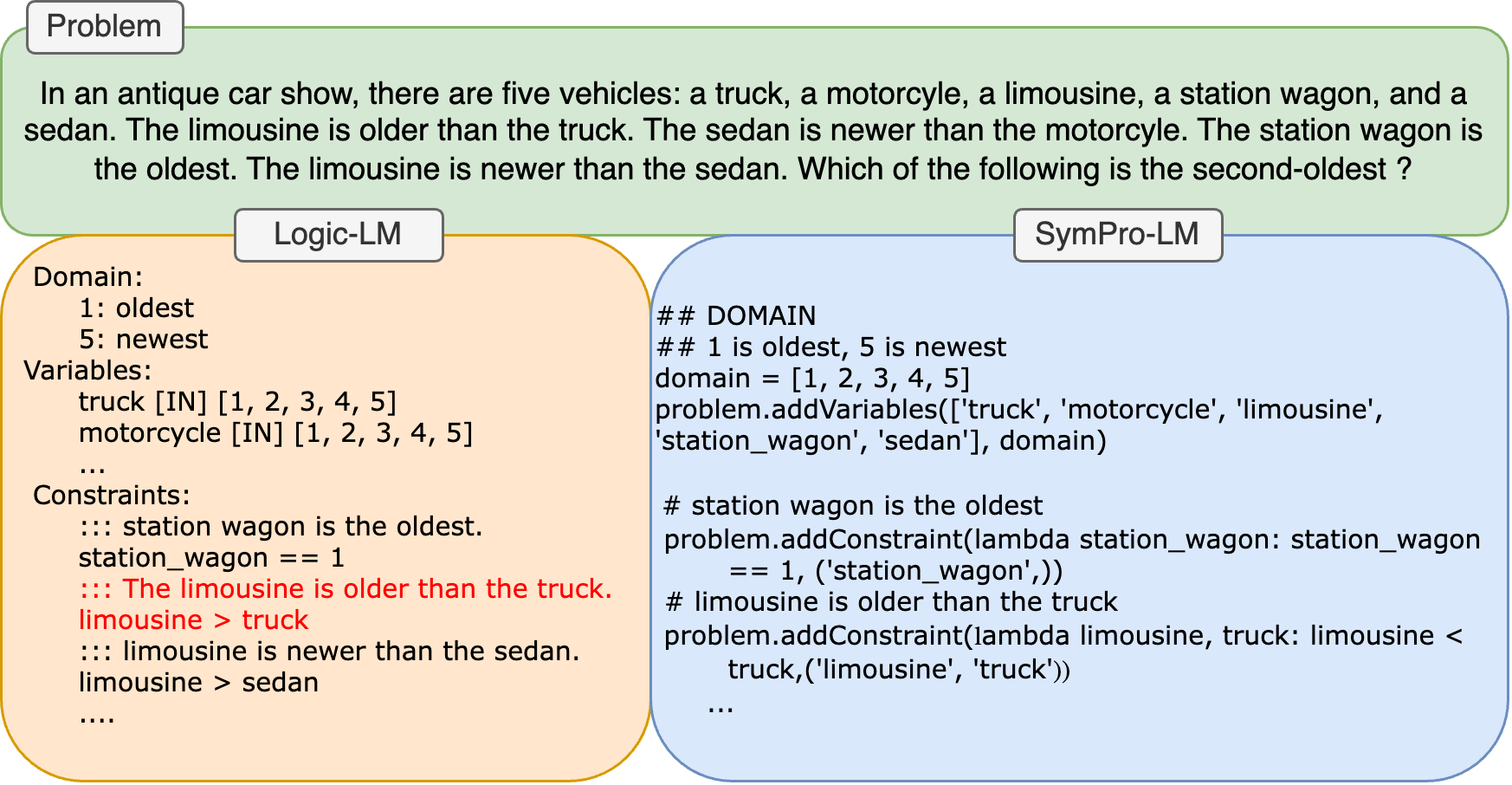
The image presents a problem involving the relative ages of five vehicles (truck, motorcycle, limousine, station wagon, and sedan) and compares two different approaches (Logic-LM and SymPro-LM) to represent and solve the problem. The problem is stated at the top, followed by the Logic-LM approach on the left and the SymPro-LM approach on the right.
### Components/Axes
* **Problem Statement:** A textual description of the problem.
* **Logic-LM:** An approach to represent the problem using a domain, variables, and constraints.
* **Domain:** Defines the range of possible values (1 to 5), where 1 represents the oldest and 5 represents the newest.
* **Variables:** Declares the vehicles as variables, each with a possible value from the domain (1 to 5).
* **Constraints:** Defines the relationships between the vehicles' ages based on the problem statement.
* **SymPro-LM:** An approach to represent the problem using code.
* **Domain:** Defines the range of possible values (1 to 5), where 1 represents the oldest and 5 represents the newest.
* **Variables:** Declares the vehicles as variables, each with a possible value from the domain (1 to 5).
* **Constraints:** Defines the relationships between the vehicles' ages based on the problem statement using code.
### Detailed Analysis or ### Content Details
**Problem Statement:**
"In an antique car show, there are five vehicles: a truck, a motorcyle, a limousine, a station wagon, and a sedan. The limousine is older than the truck. The sedan is newer than the motorcyle. The station wagon is the oldest. The limousine is newer than the sedan. Which of the following is the second-oldest?"
**Logic-LM:**
* **Domain:**
* 1: oldest
* 5: newest
* **Variables:**
* truck [IN] \[1, 2, 3, 4, 5]
* motorcycle [IN] \[1, 2, 3, 4, 5]
* ... (The other vehicles are implied to be defined similarly)
* **Constraints:**
* ::: station wagon is the oldest.
* station\_wagon == 1
* ::: The limousine is older than the truck.
* limousine > truck
* ::: limousine is newer than the sedan.
* limousine > sedan
* ....
**SymPro-LM:**
* `## DOMAIN`
* `## 1 is oldest, 5 is newest`
* `domain = [1, 2, 3, 4, 5]`
* `problem.addVariables(['truck', 'motorcycle', 'limousine', 'station_wagon', 'sedan'], domain)`
* `# station wagon is the oldest`
* `problem.addConstraint(lambda station_wagon: station_wagon == 1, ('station_wagon',))`
* `# limousine is older than the truck`
* `problem.addConstraint(lambda limousine, truck: limousine < truck, ('limousine', 'truck'))`
### Key Observations
* Both Logic-LM and SymPro-LM aim to represent the same problem and constraints.
* Logic-LM uses a more declarative approach, defining the domain, variables, and constraints in a structured format.
* SymPro-LM uses a more programmatic approach, defining the domain, variables, and constraints using code.
* The constraints in Logic-LM are represented using symbolic notation (e.g., `limousine > truck`), while in SymPro-LM, they are represented using code (e.g., `lambda limousine, truck: limousine < truck`).
### Interpretation
The image illustrates two different methods for representing and solving a constraint satisfaction problem. Logic-LM provides a more abstract and human-readable representation, while SymPro-LM offers a more concrete and executable representation. The choice between these approaches depends on the specific application and the desired level of abstraction. The problem is to determine the second-oldest vehicle given the constraints. The Logic-LM and SymPro-LM sections show how the problem and constraints can be formalized for automated reasoning or solving.