## Textual Problem with Programmatic Solutions: Antique Car Show Age Ranking
### Overview
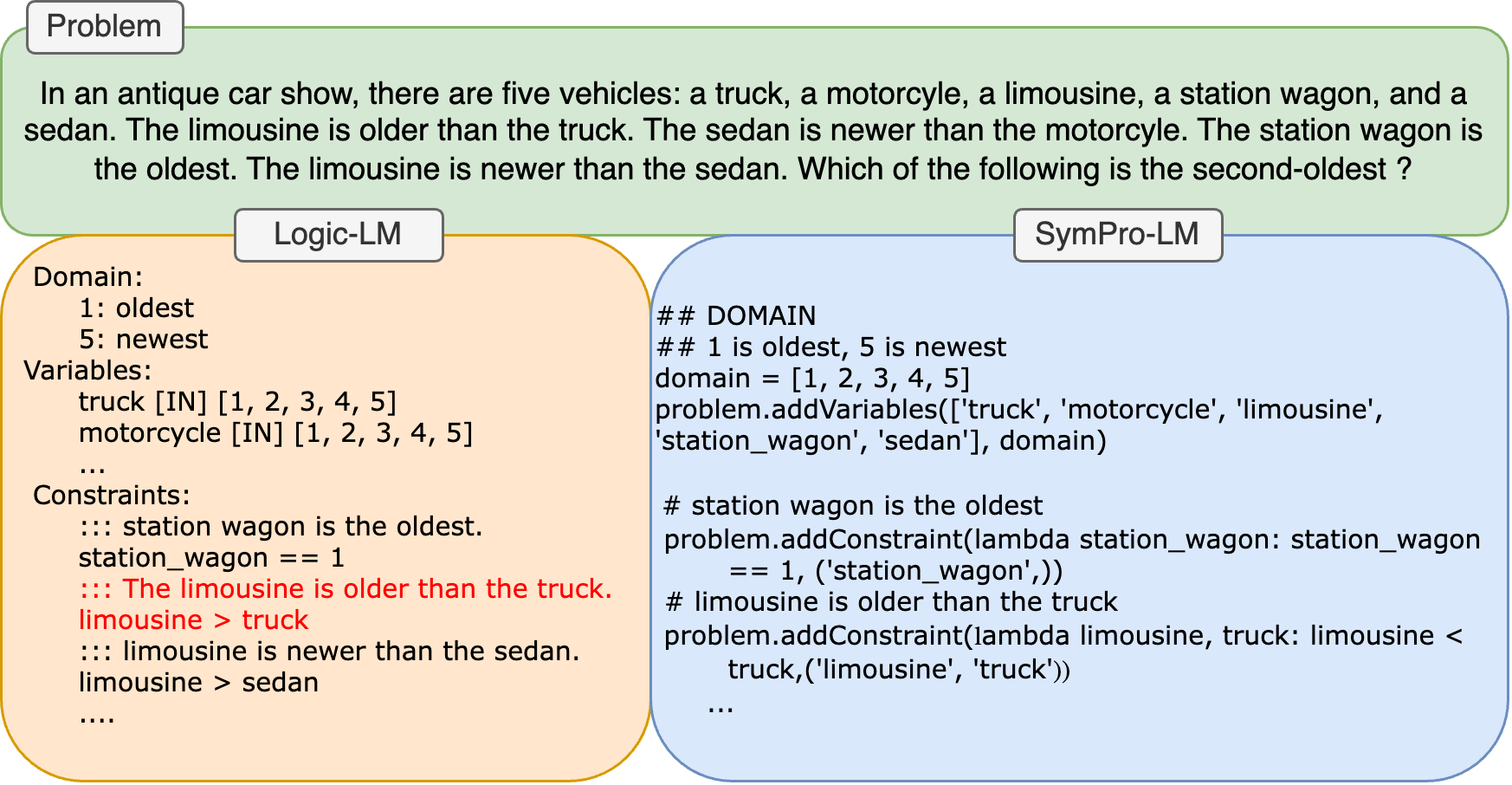
The image presents a logic puzzle about ranking five antique vehicles by age, followed by two programmatic representations (Logic-LM and SymPro-LM) for solving it. The problem involves deductive reasoning to determine the second-oldest vehicle among a truck, motorcycle, limousine, station wagon, and sedan.
### Components/Axes
1. **Problem Section (Green Box)**
- **Text**: Describes five vehicles and their age relationships:
- Station wagon is the oldest
- Limousine > truck
- Limousine < sedan
- Sedan > motorcycle
- Limousine is not the second-oldest
2. **Logic-LM Section (Orange Box)**
- **Domain**: Integer values 1 (oldest) to 5 (newest)
- **Variables**:
- `truck [IN] [1,2,3,4,5]`
- `motorcycle [IN] [1,2,3,4,5]`
- (Implied variables for limousine, station_wagon, sedan)
- **Constraints**:
- `station_wagon == 1` (oldest)
- `limousine > truck` (limousine is older than truck)
- `limousine > sedan` (limousine is newer than sedan)
3. **SymPro-LM Section (Blue Box)**
- **Domain**: Same as Logic-LM but with commented numbering
- **Variables**: Explicitly listed as `['truck', 'motorcycle', 'limousine', 'station_wagon', 'sedan']`
- **Constraints**:
- `station_wagon == 1`
- `limousine < truck` (written as `limousine < truck` in lambda notation)
- `limousine < sedan` (implied by `limousine > sedan` in Logic-LM)
### Detailed Analysis
**Problem Section**
- Vehicles: Truck, motorcycle, limousine, station wagon, sedan
- Age relationships:
1. Station wagon is oldest (position 1)
2. Limousine > truck (limousine is older than truck)
3. Limousine < sedan (limousine is newer than sedan)
4. Sedan > motorcycle (sedan is older than motorcycle)
5. Limousine is not second-oldest
**Logic-LM Structure**
- Uses integer domains (1-5) for age ranking
- Explicit constraints:
- `station_wagon == 1`
- `limousine > truck`
- `limousine > sedan`
**SymPro-LM Structure**
- Uses commented domain numbering (#1=oldest, #5=newest)
- Implements constraints via lambda functions:
- `lambda station_wagon: station_wagon == 1`
- `lambda limousine, truck: limousine < truck`
### Key Observations
1. **Contradiction in Constraints**:
- Logic-LM states `limousine > sedan` while SymPro-LM uses `limousine < sedan` - this appears to be a transcription error in one of the implementations.
2. **Positional Logic**:
- Station wagon is fixed at position 1 (oldest)
- Limousine must be older than both truck and sedan
- Sedan must be older than motorcycle
- Limousine cannot be second-oldest
3. **Implementation Differences**:
- Logic-LM uses direct inequality constraints
- SymPro-LM uses lambda functions for constraint definition
- SymPro-LM includes commented domain numbering
### Interpretation
The problem requires determining the second-oldest vehicle through logical deduction. The programmatic solutions attempt to model this using constraint satisfaction:
1. **Logical Deduction**:
- Station wagon (1st)
- Limousine must be older than truck and sedan but not second-oldest
- Possible positions for limousine: 3rd or 4th
- Sedan must be older than motorcycle
- Truck must be younger than limousine
2. **Programmatic Approach**:
- Both implementations use integer domains for age ranking
- Logic-LM uses direct constraints while SymPro-LM uses functional programming constructs
- The contradiction in limousine/sedan ordering suggests a potential error in one implementation
3. **Solution Path**:
- Valid ranking must satisfy:
- 1: station_wagon
- 2: Not limousine
- 3-5: Remaining vehicles ordered by constraints
- Second-oldest must be either sedan or motorcycle based on constraints
This represents a classic logic puzzle that can be solved through constraint programming, though the conflicting limousine/sedan constraints in the implementations highlight the importance of careful constraint formulation.