TECHNICAL ASSET FINGERPRINT
853b38dd2f30c8a0ae668652
Click to view fullscreen
Press ESC or click to close
FOUND IN PAPERS
EXPERT: gemini-2.0-flash VERSION 1
RUNTIME: nugit/gemini/gemini-2.0-flash
INTEL_VERIFIED
## Diagram: Integrated Information Theory (IIT) Equations
### Overview
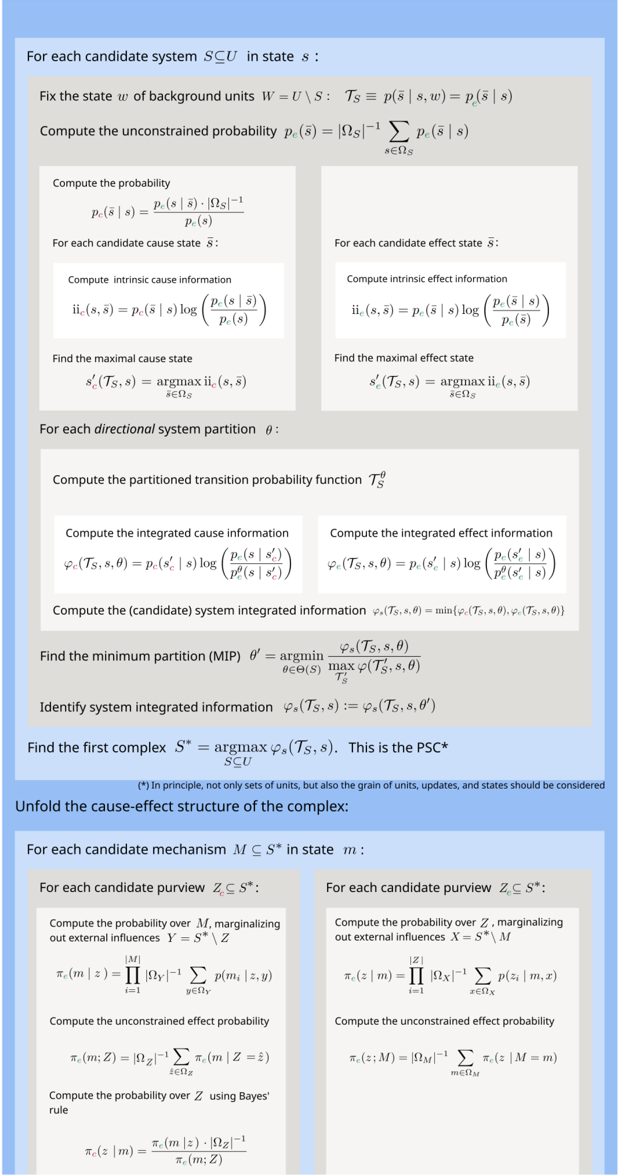
The image presents a series of equations and steps outlining a process, likely related to Integrated Information Theory (IIT). It describes how to calculate various probabilities and information measures to identify a "first complex" (S*) within a system. The process involves considering candidate systems, cause-effect relationships, and system partitions.
### Components/Axes
The image is structured into several sections, each addressing a specific aspect of the calculation:
1. **For each candidate system S ⊆ U in state s:** This section focuses on defining the initial conditions and calculating unconstrained probabilities.
2. **For each directional system partition θ:** This section deals with partitioning the system and calculating integrated information measures.
3. **Unfold the cause-effect structure of the complex:** This section details how to analyze the cause-effect structure by considering candidate mechanisms and purviews.
### Detailed Analysis
**1. Candidate System Analysis:**
* **Initial Setup:**
* For each candidate system *S* which is a subset of *U* in state *s*.
* Fix the state *w* of background units *W = U \ S*: *T<sub>S</sub> = p(s̄ | s, w) = p<sub>e</sub>(s̄ | s)*
* Compute the unconstrained probability: *p<sub>e</sub>(s̄) = |Ω<sub>S</sub>|<sup>-1</sup> Σ<sub>s∈Ω<sub>S</sub></sub> p(s̄ | s)*
* **Cause-Effect Analysis:**
* Compute the probability: *p<sub>c</sub>(s̄ | s) = p<sub>e</sub>(s | s̄) ⋅ |Ω<sub>S</sub>|<sup>-1</sup> / p<sub>e</sub>(s)*
* For each candidate cause state *s̄*:
* Compute intrinsic cause information: *ii<sub>c</sub>(s, s̄) = p<sub>c</sub>(s̄ | s) log(p<sub>c</sub>(s̄ | s) / p<sub>e</sub>(s̄))*
* Find the maximal cause state: *s'<sub>c</sub>(T<sub>S</sub>, s) = argmax<sub>s̄∈Ω<sub>S</sub></sub> ii<sub>c</sub>(s, s̄)*
* For each candidate effect state *s̄*:
* Compute intrinsic effect information: *ii<sub>e</sub>(s, s̄) = p<sub>e</sub>(s̄ | s) log(p<sub>e</sub>(s̄ | s) / p<sub>e</sub>(s̄))*
* Find the maximal effect state: *s'<sub>e</sub>(T<sub>S</sub>, s) = argmax<sub>s̄∈Ω<sub>S</sub></sub> ii<sub>e</sub>(s, s̄)*
**2. Directional System Partition Analysis:**
* **Partitioned Transition Probability:** Compute the partitioned transition probability function *T<sup>θ</sup><sub>S</sub>*.
* **Integrated Information:**
* Compute the integrated cause information: *φ<sub>c</sub>(T<sub>S</sub>, s, θ) = p<sub>c</sub>(s'<sub>c</sub> | s) log(p<sub>c</sub>(s | s'<sub>c</sub>) / p<sup>θ</sup><sub>c</sub>(s | s'<sub>c</sub>))*
* Compute the integrated effect information: *φ<sub>e</sub>(T<sub>S</sub>, s, θ) = p<sub>e</sub>(s'<sub>e</sub> | s) log(p<sub>e</sub>(s | s'<sub>e</sub>) / p<sup>θ</sup><sub>e</sub>(s | s'<sub>e</sub>))*
* Compute the (candidate) system integrated information: *φ<sub>s</sub>(T<sub>S</sub>, s, θ) = min{φ<sub>c</sub>(T<sub>S</sub>, s, θ), φ<sub>e</sub>(T<sub>S</sub>, s, θ)}*
* **Minimum Partition (MIP):** Find the minimum partition *θ' = argmin<sub>θ∈Θ(S)</sub> max<sub>T<sup>θ</sup><sub>S</sub></sub> φ<sub>s</sub>(T<sub>S</sub>, s, θ)*
* **System Integrated Information:** Identify system integrated information *φ<sub>s</sub>(T<sub>S</sub>, s) := φ<sub>s</sub>(T<sub>S</sub>, s, θ')*
* **First Complex:** Find the first complex *S*<sup>*</sup> = argmax<sub>S⊆U</sub> *φ<sub>s</sub>(T<sub>S</sub>, s)*. This is the PSC*.
**3. Cause-Effect Structure Analysis:**
* **Candidate Mechanism and Purview:**
* For each candidate mechanism *M ⊆ S*<sup>*</sup> in state *m*:
* Compute the probability over *M*, marginalizing out external influences *Y = S*<sup>*</sup> \ Z*: *π<sub>e</sub>(m | z) = ∏<sub>i=1</sub><sup>|M|</sup> |Ω<sub>Y</sub>|<sup>-1</sup> Σ<sub>y∈Ω<sub>Y</sub></sub> p(m<sub>i</sub> | z, y)*
* Compute the unconstrained effect probability: *π<sub>e</sub>(m; Z) = |Ω<sub>Z</sub>|<sup>-1</sup> Σ<sub>z∈Ω<sub>Z</sub></sub> π<sub>e</sub>(m | Z = ẑ)*
* Compute the probability over *Z* using Bayes' rule: *π<sub>e</sub>(z | m) = π<sub>e</sub>(m | z) ⋅ |Ω<sub>Z</sub>|<sup>-1</sup> / π<sub>e</sub>(m; Z)*
* For each candidate purview *Z ⊆ S*<sup>*</sup>:
* Compute the probability over *Z*, marginalizing out external influences *X = S*<sup>*</sup> \ M*: *π<sub>e</sub>(z | m) = ∏<sub>i=1</sub><sup>|Z|</sup> |Ω<sub>X</sub>|<sup>-1</sup> Σ<sub>x∈Ω<sub>X</sub></sub> p(z<sub>i</sub> | m, x)*
* Compute the unconstrained effect probability: *π<sub>e</sub>(z; M) = |Ω<sub>M</sub>|<sup>-1</sup> Σ<sub>m∈Ω<sub>M</sub></sub> π<sub>e</sub>(z | M = m)*
### Key Observations
* The equations involve probabilities, conditional probabilities, and logarithmic functions, suggesting information-theoretic calculations.
* The process aims to identify a specific complex (S*) based on integrated information.
* Marginalization is used to account for external influences when calculating probabilities.
### Interpretation
The image describes a computational process for identifying a "first complex" (S*) within a system, likely representing a core set of interacting elements that exhibit high integrated information. This process is central to Integrated Information Theory (IIT), which aims to quantify consciousness by measuring the amount of integrated information a system possesses.
The equations detail how to calculate various probabilities and information measures, considering candidate systems, cause-effect relationships, and system partitions. By finding the minimum partition (MIP) and maximizing integrated information, the algorithm identifies the most integrated complex within the system.
The cause-effect structure analysis further refines the understanding of the complex by considering candidate mechanisms and purviews, accounting for external influences through marginalization. This detailed analysis provides a framework for quantifying the integrated information of a system and identifying its core components.
DECODING INTELLIGENCE...
EXPERT: nemotron-free VERSION 1
RUNTIME: free/nvidia/nemotron-nano-12b-v2-vl:free
INTEL_VERIFIED
## Flowchart Diagram: Technical Process for Evaluating Systems and Mechanisms
### Overview
The image depicts a structured flowchart outlining a technical process for evaluating candidate systems and mechanisms. It involves probabilistic computations, causal analysis, and information integration, likely within a theoretical framework (e.g., Bayesian inference or Integrated Information Theory). The diagram is divided into two main sections: **candidate system evaluation** (left) and **candidate mechanism evaluation** (right), with shared computational principles.
---
### Components/Axes
#### Left Section: Candidate System Evaluation (`S ⊆ U` in state `s`)
1. **State Fixing**:
- Fix background state `w` via `W = U \ S`.
- Compute unconstrained probability:
`p(s) = |Ωs|⁻¹ Σ_{s∈Ωs} p(s|s)`.
- Compute probability:
`p(s|s) = p(s|s, Ωs)^-1 / p(s)`.
2. **Cause-Effect Analysis**:
- For each candidate cause state `s̃`:
- Compute intrinsic cause information:
`ii(s, s̃) = p(s|s) log(p(s|s) / p(s))`.
- Find maximal cause state:
`s'_c(TS, s) = argmax_{s̃∈Ωs} ii(s, s̃)`.
3. **Directional System Partition**:
- For each partition `θ`:
- Compute partitioned transition probability:
`TS^θ`.
- Compute integrated cause/effect information:
`φ_c(TS, s, s') = p(s|s) log(p(s|s) / p'(s|s'))`.
- Compute system integrated information:
`φ_s(TS, s, θ) = min(φ_c(TS, s, θ), φ_c(TS, s, θ))`.
4. **Minimal Partition Identification**:
- Find minimal partition (MIP):
`θ' = argmin_{θ∈(S)} max_{TS} φ(TS, s, θ)`.
5. **System Integrated Information**:
- `φ_s(TS, s) = φ_s(TS, s, θ')`.
6. **Complex Identification**:
- `S* = argmax_{S⊆U} φ_s(TS, s)`.
- Labeled as "PSC*" (possibly a specific model or algorithm).
#### Right Section: Candidate Mechanism Evaluation (`M ⊆ S*` in state `m`)
1. **Purview Analysis**:
- For each candidate purview `Z ⊆ S*`:
- Compute probability over `M`, marginalizing external influences:
`π(m|z) = Π_{i=1}^|M| [β_i]^{-1} Σ_{y∈Y} p(m_i|z, y)`.
- Compute unconstrained effect probability:
`π(m|z) = |Ωz|⁻¹ Σ_{z∈Ωz} π(m|Z = z)`.
- Compute probability over `Z` using Bayes' rule:
`π(z|m) = p(z|m) · |Ωz|⁻¹ / π(m|z)`.
2. **Effect Analysis**:
- For each candidate purview `Z ⊆ S*`:
- Compute probability over `Z`, marginalizing external influences:
`π(z|m) = Π_{i=1}^|Z| [β_i]^{-1} Σ_{x∈X} p(z_i|m, x)`.
- Compute unconstrained effect probability:
`π(z|m) = |Ωz|⁻¹ Σ_{z∈Ωz} π(z|Z = z)`.
- Compute probability over `Z` using Bayes' rule:
`π(z|m) = p(z|m) · |Ωz|⁻¹ / π(m|z)`.
---
### Detailed Analysis
#### Left Section: Candidate System Evaluation
- **Probabilistic Foundations**:
The process begins by fixing the background state `w` and computing the unconstrained probability `p(s)` using a uniform distribution over `Ωs`. The conditional probability `p(s|s)` is derived by normalizing `p(s|s, Ωs)`.
- **Causal Inference**:
For each candidate cause state `s̃`, intrinsic cause information (`ii(s, s̃)`) is calculated using KL divergence. The maximal cause state `s'_c` is identified via maximization.
- **Partitioned Dynamics**:
The system is partitioned into directional components (`θ`), and transition probabilities (`TS^θ`) are computed. Integrated cause/effect information (`φ_c`) is derived for each partition, leading to system-level integrated information (`φ_s`).
- **Minimal Partition Selection**:
The minimal partition (`θ'`) is identified by minimizing the maximum integrated information across partitions.
- **Complex Identification**:
The optimal system `S*` is determined by maximizing `φ_s(TS, s)`, labeled as "PSC*" (possibly a reference to a specific theoretical construct).
#### Right Section: Candidate Mechanism Evaluation
- **Purview-Specific Dynamics**:
Mechanisms (`M`) are evaluated within purviews (`Z ⊆ S*`). Probabilities are computed by marginalizing over external influences (`Y` and `X`), using Bayesian updates.
- **Unconstrained Probabilities**:
Unconstrained effect probabilities (`π(m|z)` and `π(z|m)`) are derived by averaging over purview states.
- **Bayesian Updates**:
Bayes' rule is applied to compute posterior probabilities (`π(z|m)` and `π(m|z)`), integrating prior knowledge (`β_i`) and likelihoods.
---
### Key Observations
1. **Symmetry in Structure**:
Both sections follow analogous steps (probability computation, cause-effect analysis, partition evaluation) but differ in focus (systems vs. mechanisms).
2. **Mathematical Rigor**:
The process relies heavily on probabilistic and information-theoretic formulas, suggesting a formal, axiomatic approach.
3. **Terminology**:
Terms like "integrated information" and "Bayes' rule" imply connections to theories such as Integrated Information Theory (IIT) or Bayesian networks.
4. **Note on Unfolding**:
The final note emphasizes considering "units, grain, updates, and states" when unfolding the cause-effect structure, hinting at practical implementation challenges.
---
### Interpretation
This flowchart outlines a **theoretical framework** for evaluating systems (`S`) and mechanisms (`M`) within a probabilistic and causal context. Key elements include:
- **System Evaluation**: Identifying optimal systems (`S*`) via integrated information maximization, akin to IIT's Φ (phi) metric.
- **Mechanism Evaluation**: Assessing mechanisms (`M`) within purviews (`Z`) using Bayesian inference, balancing prior knowledge (`β_i`) and observed data.
- **Causal Hierarchy**: The process distinguishes between *cause* (intrinsic information) and *effect* (external influences), reflecting a dualistic view of agency and environment.
The "PSC*" label suggests a specific algorithm or model for system identification, though its exact nature is not clarified. The emphasis on minimal partitions (`θ'`) and unconstrained probabilities indicates a focus on parsimony and robustness in the evaluation process.
The diagram likely serves as a blueprint for implementing a theoretical model in computational systems, with applications in areas like artificial intelligence, neuroscience, or complex systems analysis.
DECODING INTELLIGENCE...