## Diagram: Integrated Information Theory (IIT) Equations
### Overview
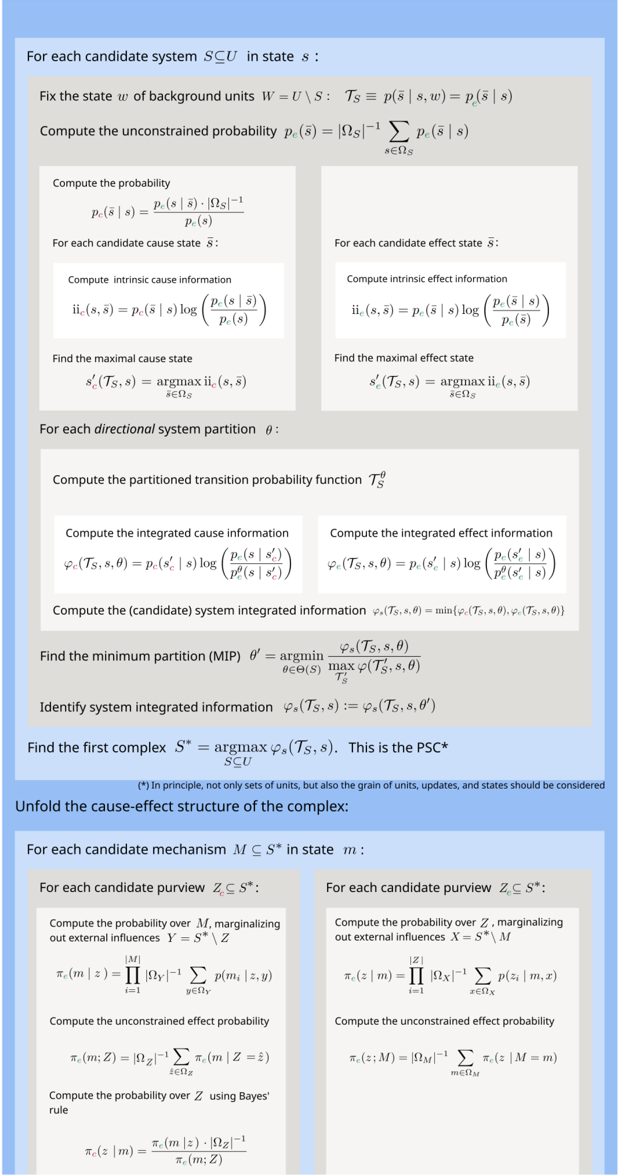
The image presents a series of equations and steps outlining a process, likely related to Integrated Information Theory (IIT). It describes how to calculate various probabilities and information measures to identify a "first complex" (S*) within a system. The process involves considering candidate systems, cause-effect relationships, and system partitions.
### Components/Axes
The image is structured into several sections, each addressing a specific aspect of the calculation:
1. **For each candidate system S ⊆ U in state s:** This section focuses on defining the initial conditions and calculating unconstrained probabilities.
2. **For each directional system partition θ:** This section deals with partitioning the system and calculating integrated information measures.
3. **Unfold the cause-effect structure of the complex:** This section details how to analyze the cause-effect structure by considering candidate mechanisms and purviews.
### Detailed Analysis
**1. Candidate System Analysis:**
* **Initial Setup:**
* For each candidate system *S* which is a subset of *U* in state *s*.
* Fix the state *w* of background units *W = U \ S*: *T<sub>S</sub> = p(s̄ | s, w) = p<sub>e</sub>(s̄ | s)*
* Compute the unconstrained probability: *p<sub>e</sub>(s̄) = |Ω<sub>S</sub>|<sup>-1</sup> Σ<sub>s∈Ω<sub>S</sub></sub> p(s̄ | s)*
* **Cause-Effect Analysis:**
* Compute the probability: *p<sub>c</sub>(s̄ | s) = p<sub>e</sub>(s | s̄) ⋅ |Ω<sub>S</sub>|<sup>-1</sup> / p<sub>e</sub>(s)*
* For each candidate cause state *s̄*:
* Compute intrinsic cause information: *ii<sub>c</sub>(s, s̄) = p<sub>c</sub>(s̄ | s) log(p<sub>c</sub>(s̄ | s) / p<sub>e</sub>(s̄))*
* Find the maximal cause state: *s'<sub>c</sub>(T<sub>S</sub>, s) = argmax<sub>s̄∈Ω<sub>S</sub></sub> ii<sub>c</sub>(s, s̄)*
* For each candidate effect state *s̄*:
* Compute intrinsic effect information: *ii<sub>e</sub>(s, s̄) = p<sub>e</sub>(s̄ | s) log(p<sub>e</sub>(s̄ | s) / p<sub>e</sub>(s̄))*
* Find the maximal effect state: *s'<sub>e</sub>(T<sub>S</sub>, s) = argmax<sub>s̄∈Ω<sub>S</sub></sub> ii<sub>e</sub>(s, s̄)*
**2. Directional System Partition Analysis:**
* **Partitioned Transition Probability:** Compute the partitioned transition probability function *T<sup>θ</sup><sub>S</sub>*.
* **Integrated Information:**
* Compute the integrated cause information: *φ<sub>c</sub>(T<sub>S</sub>, s, θ) = p<sub>c</sub>(s'<sub>c</sub> | s) log(p<sub>c</sub>(s | s'<sub>c</sub>) / p<sup>θ</sup><sub>c</sub>(s | s'<sub>c</sub>))*
* Compute the integrated effect information: *φ<sub>e</sub>(T<sub>S</sub>, s, θ) = p<sub>e</sub>(s'<sub>e</sub> | s) log(p<sub>e</sub>(s | s'<sub>e</sub>) / p<sup>θ</sup><sub>e</sub>(s | s'<sub>e</sub>))*
* Compute the (candidate) system integrated information: *φ<sub>s</sub>(T<sub>S</sub>, s, θ) = min{φ<sub>c</sub>(T<sub>S</sub>, s, θ), φ<sub>e</sub>(T<sub>S</sub>, s, θ)}*
* **Minimum Partition (MIP):** Find the minimum partition *θ' = argmin<sub>θ∈Θ(S)</sub> max<sub>T<sup>θ</sup><sub>S</sub></sub> φ<sub>s</sub>(T<sub>S</sub>, s, θ)*
* **System Integrated Information:** Identify system integrated information *φ<sub>s</sub>(T<sub>S</sub>, s) := φ<sub>s</sub>(T<sub>S</sub>, s, θ')*
* **First Complex:** Find the first complex *S*<sup>*</sup> = argmax<sub>S⊆U</sub> *φ<sub>s</sub>(T<sub>S</sub>, s)*. This is the PSC*.
**3. Cause-Effect Structure Analysis:**
* **Candidate Mechanism and Purview:**
* For each candidate mechanism *M ⊆ S*<sup>*</sup> in state *m*:
* Compute the probability over *M*, marginalizing out external influences *Y = S*<sup>*</sup> \ Z*: *π<sub>e</sub>(m | z) = ∏<sub>i=1</sub><sup>|M|</sup> |Ω<sub>Y</sub>|<sup>-1</sup> Σ<sub>y∈Ω<sub>Y</sub></sub> p(m<sub>i</sub> | z, y)*
* Compute the unconstrained effect probability: *π<sub>e</sub>(m; Z) = |Ω<sub>Z</sub>|<sup>-1</sup> Σ<sub>z∈Ω<sub>Z</sub></sub> π<sub>e</sub>(m | Z = ẑ)*
* Compute the probability over *Z* using Bayes' rule: *π<sub>e</sub>(z | m) = π<sub>e</sub>(m | z) ⋅ |Ω<sub>Z</sub>|<sup>-1</sup> / π<sub>e</sub>(m; Z)*
* For each candidate purview *Z ⊆ S*<sup>*</sup>:
* Compute the probability over *Z*, marginalizing out external influences *X = S*<sup>*</sup> \ M*: *π<sub>e</sub>(z | m) = ∏<sub>i=1</sub><sup>|Z|</sup> |Ω<sub>X</sub>|<sup>-1</sup> Σ<sub>x∈Ω<sub>X</sub></sub> p(z<sub>i</sub> | m, x)*
* Compute the unconstrained effect probability: *π<sub>e</sub>(z; M) = |Ω<sub>M</sub>|<sup>-1</sup> Σ<sub>m∈Ω<sub>M</sub></sub> π<sub>e</sub>(z | M = m)*
### Key Observations
* The equations involve probabilities, conditional probabilities, and logarithmic functions, suggesting information-theoretic calculations.
* The process aims to identify a specific complex (S*) based on integrated information.
* Marginalization is used to account for external influences when calculating probabilities.
### Interpretation
The image describes a computational process for identifying a "first complex" (S*) within a system, likely representing a core set of interacting elements that exhibit high integrated information. This process is central to Integrated Information Theory (IIT), which aims to quantify consciousness by measuring the amount of integrated information a system possesses.
The equations detail how to calculate various probabilities and information measures, considering candidate systems, cause-effect relationships, and system partitions. By finding the minimum partition (MIP) and maximizing integrated information, the algorithm identifies the most integrated complex within the system.
The cause-effect structure analysis further refines the understanding of the complex by considering candidate mechanisms and purviews, accounting for external influences through marginalization. This detailed analysis provides a framework for quantifying the integrated information of a system and identifying its core components.