## Diagram: Irreducible Distinctions in a System
### Overview
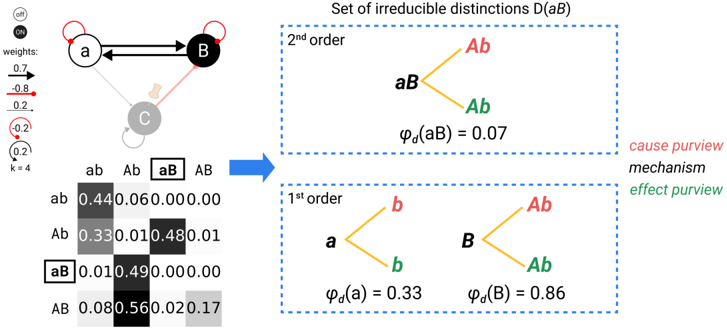
The image presents a diagram illustrating the concept of irreducible distinctions within a system, likely related to information theory or integrated information theory (IIT). It includes a network of interacting elements (a, B, C), a matrix representing state transition probabilities, and a decomposition of distinctions into first and second order components. The diagram aims to visualize how distinctions arise and contribute to the overall system's integrated information.
### Components/Axes
* **Top-Left:**
* "off" and "ON" buttons.
* Network diagram with nodes labeled "a", "B", and "C". Node B is black, node a is white, and node C is gray.
* Arrows indicate connections between nodes, with associated weights.
* Weights:
* a -> B: 0.7 (black arrow)
* B -> a: -0.8 (red arrow)
* C -> B: 0.2 (gray arrow)
* Self-loop on C: -0.2 (red arrow)
* Self-loop on C: 0.2, k=4 (gray arrow)
* **Bottom-Left:**
* 4x4 Matrix representing state transition probabilities.
* Rows and columns are labeled: "ab", "Ab", "aB", "AB".
* The "aB" column and row are highlighted with a black border.
* **Right:**
* Title: "Set of irreducible distinctions D(aB)"
* Two boxes, each with a dashed blue border, representing 2nd order and 1st order distinctions.
* 2nd order:
* Nodes: "aB", "Ab" (red), "Ab" (green)
* Value: φd(aB) = 0.07
* 1st order:
* Left: Nodes "a", "b" (red), "b" (green)
* Value: φd(a) = 0.33
* Right: Nodes "B", "b" (red), "b" (green)
* Value: φd(B) = 0.86
* Legend (right side):
* "cause purview" (red)
* "mechanism" (black)
* "effect purview" (green)
### Detailed Analysis
* **Network Diagram:**
* Node "a" has a strong positive influence on "B" (weight 0.7).
* Node "B" has a strong negative influence on "a" (weight -0.8).
* Node "C" has a weaker positive influence on "B" (weight 0.2) and a negative self-influence (-0.2).
* Node "C" also has a positive self-influence (0.2).
* **State Transition Matrix:**
* The matrix shows the probabilities of transitioning between different states of the system.
* The states are represented by combinations of "a" and "b" (lowercase) and "A" and "B" (uppercase), likely representing binary states of the nodes.
* The matrix values are:
* ab -> ab: 0.440
* ab -> Ab: 0.060
* ab -> aB: 0.000
* ab -> AB: 0.000
* Ab -> ab: 0.330
* Ab -> Ab: 0.010
* Ab -> aB: 0.480
* Ab -> AB: 0.010
* aB -> ab: 0.010
* aB -> Ab: 0.490
* aB -> aB: 0.000
* aB -> AB: 0.000
* AB -> ab: 0.080
* AB -> Ab: 0.560
* AB -> aB: 0.020
* AB -> AB: 0.170
* **Irreducible Distinctions:**
* The diagram decomposes the distinctions within the system into different orders.
* The 2nd order distinction D(aB) has a value of 0.07.
* The 1st order distinctions D(a) and D(B) have values of 0.33 and 0.86, respectively.
* The red color indicates "cause purview", the black color indicates "mechanism", and the green color indicates "effect purview".
### Key Observations
* The network diagram shows a strong reciprocal relationship between nodes "a" and "B".
* The state transition matrix indicates that certain state transitions are more probable than others.
* The irreducible distinctions diagram quantifies the amount of integrated information associated with different elements and combinations of elements in the system.
* The 1st order distinction of B (0.86) is significantly higher than that of a (0.33).
### Interpretation
The diagram illustrates a simplified model of a system with interacting elements and their associated distinctions. The network diagram and state transition matrix define the system's structure and dynamics. The irreducible distinctions diagram quantifies the integrated information within the system, providing insights into how the elements contribute to the system's overall complexity and functionality. The higher value of φd(B) compared to φd(a) suggests that element B plays a more significant role in the system's integrated information. The decomposition into cause, mechanism, and effect purviews provides further insights into the roles of different elements in shaping the system's behavior.