## Bar Chart: Attack Types vs. RtA
### Overview
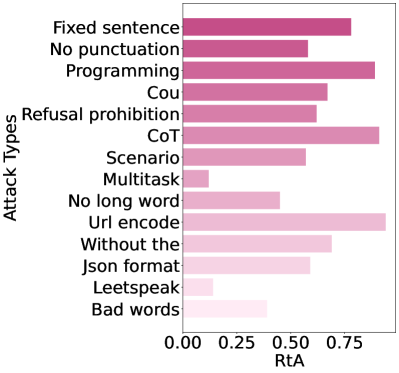
This is a horizontal bar chart comparing the "RtA" (likely representing a rate or ratio of attack success) across different "Attack Types". The bars represent the RtA value for each attack type, with the length of the bar corresponding to the RtA value. The chart is oriented with Attack Types on the Y-axis and RtA on the X-axis.
### Components/Axes
* **Y-axis Label:** "Attack Types"
* **X-axis Label:** "RtA"
* **X-axis Scale:** Ranges from 0.00 to 0.75, with markers at 0.25 and 0.50.
* **Attack Types (Categories):**
* Fixed sentence
* No punctuation
* Programming
* Cou
* Refusal prohibition
* CoT
* Scenario
* Multitask
* No long word
* Url encode
* Without the
* Json format
* Leetspeak
* Bad words
* **Color:** All bars are a shade of pink/purple.
### Detailed Analysis
The bars are arranged vertically, with "Fixed sentence" at the top and "Bad words" at the bottom. I will describe the trend and approximate RtA values for each attack type, moving from top to bottom.
* **Fixed sentence:** The bar is the longest, indicating the highest RtA. The bar extends to approximately 0.76.
* **No punctuation:** The bar is slightly shorter than "Fixed sentence", with an RtA of approximately 0.73.
* **Programming:** The bar is similar in length to "No punctuation", with an RtA of approximately 0.72.
* **Cou:** The bar is slightly shorter than "Programming", with an RtA of approximately 0.68.
* **Refusal prohibition:** The bar is similar in length to "Cou", with an RtA of approximately 0.67.
* **CoT:** The bar is similar in length to "Refusal prohibition", with an RtA of approximately 0.66.
* **Scenario:** The bar is shorter than "CoT", with an RtA of approximately 0.60.
* **Multitask:** The bar is similar in length to "Scenario", with an RtA of approximately 0.58.
* **No long word:** The bar is shorter than "Multitask", with an RtA of approximately 0.55.
* **Url encode:** The bar is similar in length to "No long word", with an RtA of approximately 0.54.
* **Without the:** The bar is slightly longer than "Url encode", with an RtA of approximately 0.57.
* **Json format:** The bar is shorter than "Without the", with an RtA of approximately 0.48.
* **Leetspeak:** The bar is significantly shorter than "Json format", with an RtA of approximately 0.30.
* **Bad words:** The bar is the shortest, indicating the lowest RtA, with an RtA of approximately 0.20.
### Key Observations
* "Fixed sentence" and "No punctuation" attacks have the highest RtA values.
* "Bad words" has the lowest RtA value.
* There is a general trend of decreasing RtA as you move down the list of attack types.
* The RtA values are clustered between 0.50 and 0.75 for the majority of attack types.
### Interpretation
The chart demonstrates the effectiveness of different attack types in eliciting a response (or bypassing a security measure) as measured by RtA. The higher RtA values for "Fixed sentence" and "No punctuation" suggest that these attacks are particularly successful. This could be because they are simple and easily understood by the system being attacked, or because the system is not adequately prepared to handle them. Conversely, the low RtA for "Bad words" suggests that the system is effective at detecting and blocking this type of attack.
The decreasing trend in RtA suggests that more complex or obfuscated attacks are less successful. This could be due to the system's ability to identify and filter out these attacks based on their complexity or unusual characteristics. The clustering of RtA values between 0.50 and 0.75 indicates that many of the attack types have a moderate level of success, suggesting that further security measures may be needed to address these vulnerabilities.
The abbreviation "CoT" likely refers to "Chain of Thought" prompting, a technique used in large language models. The relatively high RtA for "CoT" suggests that this prompting technique can be exploited to elicit undesirable responses. "Cou" is unclear without further context, but may be an abbreviation for a specific attack strategy.