\n
## Diagram: Knowledge Graph Construction Pipeline
### Overview
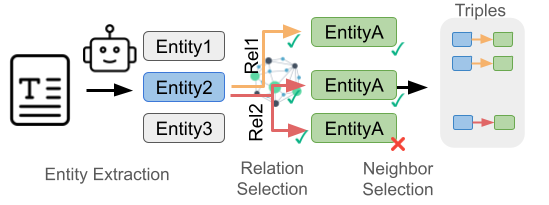
The image depicts a simplified pipeline for constructing a knowledge graph from text data. The pipeline consists of three main stages: Entity Extraction, Relation Selection, and Neighbor Selection, culminating in the formation of Triples representing the knowledge graph.
### Components/Axes
The diagram is structured horizontally, with a clear flow from left to right. The stages are labeled as follows:
* **Entity Extraction:** Represented by a document icon and a robot icon.
* **Relation Selection:** A network graph with connections between entities.
* **Neighbor Selection:** A filtering stage.
* **Triples:** The final output, represented as pairs of connected rectangles.
The entities are labeled:
* Entity1 (blue rectangle)
* Entity2 (blue rectangle)
* Entity3 (blue rectangle)
* EntityA (green rectangle)
The relations are labeled:
* Rel1 (orange arrow)
* Rel2 (red arrow)
The final output is labeled "Triples".
### Detailed Analysis or Content Details
1. **Entity Extraction:** A document icon on the far left feeds into a robot icon, which then outputs three entities: Entity1, Entity2, and Entity3. These entities are represented as blue rectangles.
2. **Relation Selection:** The entities are then fed into a network graph. This graph shows connections between the entities and EntityA. The connections are represented by arrows.
* Rel1 (orange arrow) connects to EntityA and is marked with a green checkmark, indicating a valid relation.
* Rel2 (red arrow) connects to EntityA and is marked with a red 'X', indicating an invalid relation.
3. **Neighbor Selection:** EntityA is shown three times, each connected to a different relation. Two of these connections are marked with green checkmarks, and one is marked with a red 'X'. This suggests a filtering process based on relation validity.
4. **Triples:** The final output consists of three pairs of connected rectangles, representing the triples.
* The first triple consists of a blue rectangle and a green rectangle, connected by an orange line.
* The second triple consists of a blue rectangle and a green rectangle, connected by an orange line.
* The third triple consists of a blue rectangle and a green rectangle, connected by a red line.
### Key Observations
* The pipeline demonstrates a process of filtering relations to ensure the quality of the knowledge graph.
* The red 'X' symbols indicate that not all relations are considered valid or relevant.
* The final triples represent the extracted knowledge in a structured format.
* The diagram does not provide any quantitative data, but illustrates a conceptual process.
### Interpretation
The diagram illustrates a common approach to knowledge graph construction. It begins with identifying entities from text, then determining the relationships between those entities. A crucial step is filtering these relationships to ensure accuracy and relevance. The final output, the triples, represents the core building blocks of the knowledge graph – subject, predicate (relation), and object. The use of checkmarks and 'X' symbols highlights the importance of relation validation in building a high-quality knowledge graph. The diagram suggests a process where the system attempts to link entities, but not all links are deemed valid, and only the valid ones are incorporated into the final knowledge representation. The diagram is a conceptual illustration and does not contain specific data points or numerical values. It focuses on the flow and logic of the process.