## Diagram: Non-Linear Operator Executing Time Comparison
### Overview
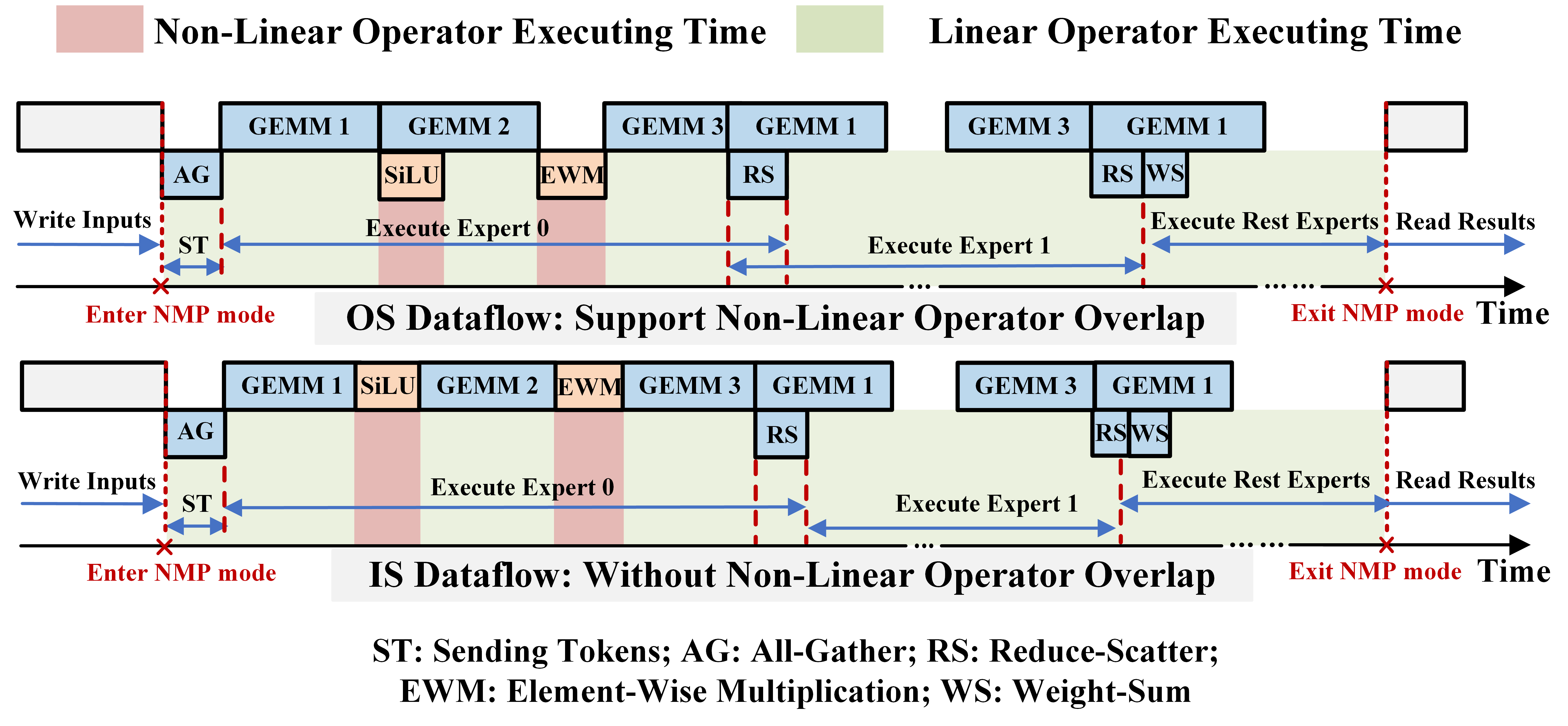
The image compares two computational dataflows for executing machine learning operations:
1. **OS Dataflow**: Supports non-linear operator overlap (red-shaded regions).
2. **IS Dataflow**: Processes operations sequentially without overlap (no red shading).
Both workflows include stages like input writing, token sending, expert execution, and result reading, with timing marked by red dashed lines.
### Components/Axes
- **X-axis**: Time progression (left to right).
- **Y-axis**: Two dataflows (OS Dataflow at top, IS Dataflow at bottom).
- **Legend**:
- **Red**: Non-linear operator executing time.
- **Green**: Linear operator executing time.
- **Key Labels**:
- **AG**: All-Gather (blue).
- **SiLU**: Sigmoid Linear Unit (orange).
- **GEMM**: General Matrix Multiply (blue).
- **EWM**: Element-Wise Multiplication (orange).
- **RS**: Reduce-Scatter (blue).
- **WS**: Weight-Sum (blue).
- **ST**: Sending Tokens (blue arrows).
### Detailed Analysis
#### OS Dataflow (Top Section)
1. **Non-Linear Overlap**:
- Red-shaded regions (SiLU, EWM) overlap with green-shaded GEMM operations.
- Example: SiLU (non-linear) overlaps with GEMM 2 (linear) during "Execute Expert 0."
2. **Flow Sequence**:
- Inputs → AG → SiLU → GEMM 1 → GEMM 2 → EWM → GEMM 3 → RS → Execute Experts → Read Results.
3. **NMP Mode**:
- "Enter NMP mode" (red X) marks the start, and "Exit NMP mode" marks the end of non-linear operations.
#### IS Dataflow (Bottom Section)
1. **No Overlap**:
- Red-shaded regions (SiLU, EWM) are isolated from green-shaded GEMM operations.
- Example: SiLU (non-linear) executes fully before GEMM 1 (linear) begins.
2. **Flow Sequence**:
- Inputs → AG → SiLU → GEMM 1 → GEMM 2 → EWM → GEMM 3 → RS → Execute Experts → Read Results.
3. **NMP Mode**:
- Same entry/exit markers as OS Dataflow but no overlapping execution.
### Key Observations
- **Overlap Impact**: OS Dataflow reduces total execution time by overlapping non-linear (red) and linear (green) operations.
- **Sequential Bottlenecks**: IS Dataflow avoids overlap but may increase latency due to strict sequential processing.
- **Component Roles**:
- GEMM operations dominate linear execution (green).
- SiLU and EWM introduce non-linear complexity (red).
- **Token Flow**: Blue arrows (ST) indicate token transmission between stages.
### Interpretation
The diagram illustrates a trade-off between computational efficiency and simplicity:
- **OS Dataflow** optimizes time by overlapping non-linear and linear operations, critical for real-time systems.
- **IS Dataflow** prioritizes simplicity by isolating operations, potentially useful for debugging or latency-insensitive tasks.
- **Non-Linear Overlap**: The red-shaded regions in OS Dataflow highlight how modern frameworks exploit parallelism to accelerate training/inference.
- **NMP Mode**: Likely a "Non-Linear Mode" enabling concurrent execution of mixed operation types.
The image emphasizes the importance of operator overlap in reducing end-to-end latency, a key consideration in distributed machine learning systems.