## Decision Tree: Question Answering Process
### Overview
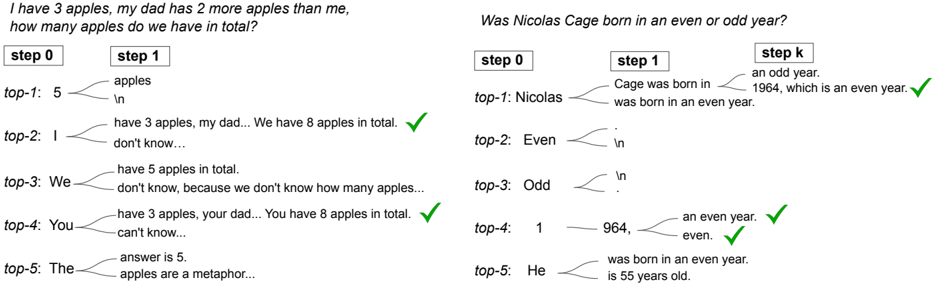
The image presents two decision trees illustrating the reasoning process for answering two different questions. The first question is a simple arithmetic problem, and the second is a question about Nicolas Cage's birth year. Each tree shows the steps taken to arrive at the answer, along with alternative paths and their corresponding conclusions.
### Components/Axes
**Left Tree (Apple Problem):**
* **Question:** "I have 3 apples, my dad has 2 more apples than me, how many apples do we have in total?"
* **Steps:**
* Step 0
* Step 1
* **Nodes:** Each node is labeled as "top-n", where n ranges from 1 to 5.
* **Branches:** Each branch represents a possible reasoning path.
* **Outcomes:** Each path leads to a conclusion, some of which are marked with a green checkmark indicating a correct or satisfactory answer.
**Right Tree (Nicolas Cage Problem):**
* **Question:** "Was Nicolas Cage born in an even or odd year?"
* **Steps:**
* Step 0
* Step 1
* Step k
* **Nodes:** Each node is labeled as "top-n", where n ranges from 1 to 5.
* **Branches:** Each branch represents a possible reasoning path.
* **Outcomes:** Each path leads to a conclusion, some of which are marked with a green checkmark indicating a correct or satisfactory answer.
### Detailed Analysis or Content Details
**Left Tree (Apple Problem):**
* **top-1:**
* Step 0: "5"
* Step 1: "apples \n"
* **top-2:**
* Step 0: "I"
* Step 1: "have 3 apples, my dad... We have 8 apples in total." (Green checkmark)
* **top-3:**
* Step 0: "We"
* Step 1: "have 5 apples in total. don't know, because we don't know how many apples..."
* **top-4:**
* Step 0: "You"
* Step 1: "have 3 apples, your dad... You have 8 apples in total." (Green checkmark)
* **top-5:**
* Step 0: "The"
* Step 1: "answer is 5. apples are a metaphor..."
**Right Tree (Nicolas Cage Problem):**
* **top-1:**
* Step 0: "Nicolas"
* Step 1: "Cage was born in was born in an even year."
* Step k: "an odd year. 1964, which is an even year." (Green checkmark)
* **top-2:**
* Step 0: "Even"
* Step 1: "\n"
* **top-3:**
* Step 0: "Odd"
* Step 1: "\n"
* **top-4:**
* Step 0: "1"
* Step 1: "964, an even year. even." (Green checkmark)
* **top-5:**
* Step 0: "He"
* Step 1: "was born in an even year. is 55 years old."
### Key Observations
* Both trees demonstrate a step-by-step reasoning process.
* The apple problem has multiple paths leading to the correct answer (8 apples).
* The Nicolas Cage problem correctly identifies that he was born in an even year (1964).
* Some paths in both trees lead to incomplete or incorrect conclusions.
### Interpretation
The decision trees illustrate how different approaches can be taken to solve a problem. The presence of multiple "top-n" nodes suggests that various reasoning paths are explored, some more successful than others. The green checkmarks indicate the paths that lead to a correct or satisfactory answer. The trees highlight the importance of considering different possibilities and refining the reasoning process to arrive at the correct conclusion. The Nicolas Cage problem demonstrates the use of factual knowledge (his birth year) to answer the question. The apple problem demonstrates the use of arithmetic to solve the question.