## Diagram: Reasoning Process Visualization
### Overview
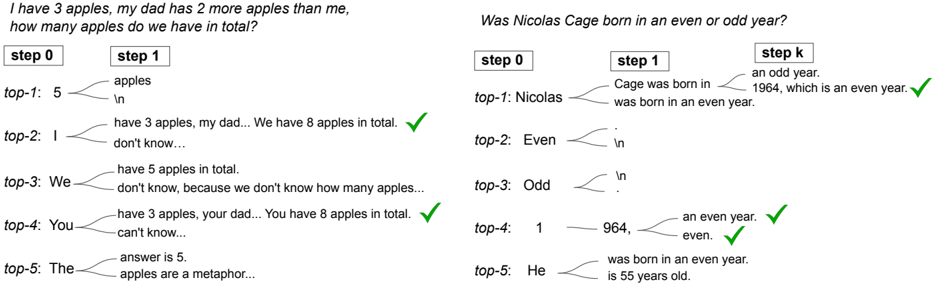
The image presents two diagrams illustrating a reasoning process, likely from a large language model. The diagrams show a step-by-step thought process to answer two different questions: one about apples and one about Nicolas Cage's birth year. Each step is labeled "step 0", "step 1", and "step k". The diagrams use a branching structure to represent different lines of thought, with some branches marked with a green checkmark indicating a correct or relevant path. The diagrams also include "top-*" labels, presumably indicating the model's confidence or ranking of each thought.
### Components/Axes
Each diagram consists of:
* **Step Labels:** "step 0", "step 1", "step k" positioned horizontally across the top.
* **Top Labels:** "top-1", "top-2", "top-3", "top-4", "top-5" positioned vertically on the left side.
* **Thought Bubbles:** Text within connected bubbles representing the model's reasoning.
* **Connecting Lines:** Lines connecting the thought bubbles, showing the flow of reasoning.
* **Checkmarks:** Green checkmarks indicating a correct or relevant line of reasoning.
### Detailed Analysis or Content Details
**Diagram 1: Apple Problem**
* **Question:** "I have 3 apples, my dad has 2 more apples than me, how many apples do we have in total?"
* **Step 0:** "5" and "in"
* **Step 1:** "apples" and "vn"
* **top-1:** "5" connected to "apples" and "in".
* **top-2:** "I have 3 apples, my dad... We have 8 apples in total." and "don't know..."
* **top-3:** "We have 5 apples in total." and "don't know, because we don't know how many apples..."
* **top-4:** "You have 3 apples, your dad... You have 8 in total." and "can't know..."
* **top-5:** "The answer is 5." and "apples are a metaphor..."
* **Checkmarks:** Present on the paths leading to "We have 8 apples in total" (top-2) and "You have 8 in total" (top-4).
**Diagram 2: Nicolas Cage Problem**
* **Question:** "Was Nicolas Cage born in an even or odd year?"
* **Step 0:** "Nicolas" and "in"
* **Step 1:** "Cage was born in 1964, was born in an even year." and "an odd year."
* **Step k:** "1964, which is an even year."
* **top-1:** "Nicolas" connected to "Cage was born in 1964, was born in an even year."
* **top-2:** "Even" connected to "in".
* **top-3:** "Odd" connected to "in".
* **top-4:** "1964" connected to "an even year." and "even".
* **top-5:** "He is 55 years old." and "was born in an even year."
* **Checkmarks:** Present on the paths leading to "Cage was born in 1964, was born in an even year" (top-1), "an even year" (top-4), and "was born in an even year" (top-5).
### Key Observations
* The diagrams demonstrate a branching thought process, exploring multiple possibilities before converging on an answer.
* The checkmarks highlight the paths that the model deems most relevant or correct.
* The "top-*" labels suggest a ranking of the model's confidence in each thought.
* The diagrams show the model sometimes explores irrelevant or incorrect paths (e.g., "apples are a metaphor..." in the apple problem).
* The diagrams show the model can perform basic arithmetic and date calculations.
### Interpretation
These diagrams provide insight into the internal reasoning process of a large language model. They illustrate how the model breaks down a problem into smaller steps, explores different lines of thought, and ultimately arrives at an answer. The checkmarks suggest a mechanism for self-evaluation, where the model identifies and prioritizes the most relevant information. The "top-*" labels indicate a level of uncertainty or confidence associated with each thought. The presence of irrelevant or incorrect paths suggests that the model's reasoning is not always perfect and can sometimes be influenced by extraneous information. The diagrams demonstrate a form of "chain of thought" reasoning, where the model explicitly outlines the steps it takes to reach a conclusion. This is a key technique for improving the transparency and interpretability of large language models. The diagrams are a visualization of the model's internal state during problem-solving, offering a glimpse into its cognitive processes.