## Diagram: LLM Task Processing
### Overview
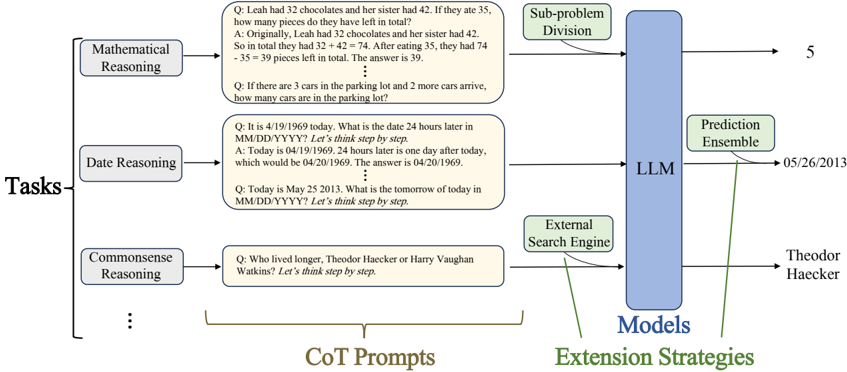
The image is a diagram illustrating how a Large Language Model (LLM) processes different types of tasks using Chain-of-Thought (CoT) prompts and various extension strategies. The diagram shows tasks being fed into the LLM, which then outputs the final answer.
### Components/Axes
* **Tasks:** This is the input to the system, categorized into:
* Mathematical Reasoning
* Date Reasoning
* Commonsense Reasoning
* (Indicated by ellipsis)
* **CoT Prompts:** These are prompts designed to encourage the LLM to think step-by-step.
* **Models:** This refers to the LLM itself, which is the core processing unit.
* **Extension Strategies:** These are methods used to enhance the LLM's capabilities, including:
* Sub-problem Division
* Prediction Ensemble
* External Search Engine
* **LLM:** A blue rectangle in the center of the diagram.
### Detailed Analysis or ### Content Details
**1. Tasks and CoT Prompts:**
* **Mathematical Reasoning:**
* Question 1: "Q: Leah had 32 chocolates and her sister had 42. If they ate 35, how many pieces do they have left in total? A: Originally, Leah had 32 chocolates and her sister had 42. So in total they had 32 + 42 = 74. After eating 35, they had 74 - 35 = 39 pieces left in total. The answer is 39."
* Question 2: "Q: If there are 3 cars in the parking lot and 2 more cars arrive, how many cars are in the parking lot?"
* **Date Reasoning:**
* Question 1: "Q: It is 4/19/1969 today. What is the date 24 hours later in MM/DD/YYYY? Let's think step by step. A: Today is 04/19/1969. 24 hours later is one day after today, which would be 04/20/1969. The answer is 04/20/1969."
* Question 2: "Q: Today is May 25 2013. What is the tomorrow of today in MM/DD/YYYY? Let's think step by step."
* **Commonsense Reasoning:**
* Question: "Q: Who lived longer, Theodor Haecker or Harry Vaughan Watkins? Let's think step by step."
**2. Extension Strategies:**
* **Sub-problem Division:** Connected to the Mathematical Reasoning task.
* **Prediction Ensemble:** Connected to the Date Reasoning task.
* **External Search Engine:** Connected to the Commonsense Reasoning task.
**3. LLM Processing:**
* The LLM (represented by a blue rectangle) receives input from the tasks and extension strategies.
* The LLM processes the information and generates an output.
**4. Outputs:**
* Mathematical Reasoning output: "5"
* Date Reasoning output: "05/26/2013"
* Commonsense Reasoning output: "Theodor Haecker"
### Key Observations
* The diagram illustrates a pipeline where different types of reasoning tasks are processed by an LLM.
* CoT prompts are used to guide the LLM's reasoning process.
* Different extension strategies are employed based on the type of task.
* The outputs are the final answers to the questions posed in the tasks.
### Interpretation
The diagram demonstrates how an LLM can be used to solve various types of problems by leveraging CoT prompting and different extension strategies. The choice of extension strategy appears to be tailored to the specific type of task. For example, sub-problem division is used for mathematical reasoning, while an external search engine is used for commonsense reasoning. This suggests a modular approach where the LLM's capabilities are augmented based on the demands of the task at hand. The diagram highlights the importance of both the LLM's core reasoning abilities and the external tools and techniques that can be used to enhance its performance.