\n
## Diagram: Huffman Block Data Structure Comparison
### Overview
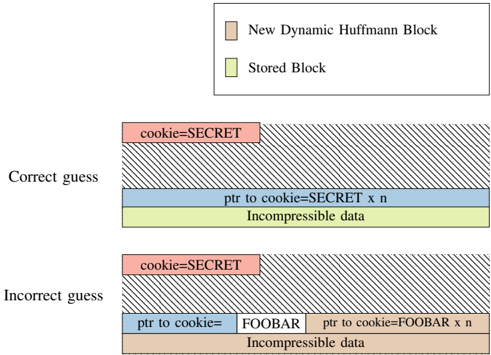
The image is a technical diagram illustrating two different data storage scenarios labeled "Correct guess" and "Incorrect guess." It visually compares how data is structured in memory or a data stream when a specific value (a cookie) is correctly identified versus when it is not. The diagram uses color-coded blocks and patterns to represent different types of data blocks.
### Components/Axes
* **Legend (Top-Right):** A box containing two entries:
* A light red/salmon-colored box labeled "New Dynamic Huffman Block".
* A light green/yellow-green box labeled "Stored Block".
* **Main Diagram Structure:** The diagram is divided into two horizontal sections, each representing a scenario.
* **Top Section:** Labeled "Correct guess" on the left.
* **Bottom Section:** Labeled "Incorrect guess" on the left.
* **Data Block Types (as per legend):**
* **Red/Salmon Blocks:** Represent "New Dynamic Huffman Block".
* **Green/Yellow-Green Blocks:** Represent "Stored Block".
* **Blue Blocks:** Not explicitly defined in the legend, but appear to represent pointer or reference data.
* **Hatched Pattern (Diagonal Lines):** Represents a background or filler area, likely indicating uncompressed or raw data space.
### Detailed Analysis
**1. "Correct guess" Scenario (Top Section):**
* **Top Row:** A red block containing the text `cookie=SECRET`. This is positioned at the top-left of the hatched area.
* **Middle Row:** A blue block spanning the width of the hatched area below the red block. It contains the text `ptr to cookie=SECRET x n`. This suggests a pointer or reference to the `cookie=SECRET` data, repeated `n` times.
* **Bottom Row:** A green block labeled `Incompressible data`. This is a "Stored Block" as per the legend.
* **Spatial Relationship:** The red block (`cookie=SECRET`) is placed above the blue pointer block, which in turn is above the green incompressible data block. All are contained within a larger hatched background area.
**2. "Incorrect guess" Scenario (Bottom Section):**
* **Top Row:** Identical to the correct guess scenario: a red block with `cookie=SECRET`.
* **Middle Row (Split):** This row is now divided into two adjacent blue blocks:
* **Left Blue Block:** Contains the text `ptr to cookie=`.
* **Right Blue Block:** Contains the text `FOOBAR`.
* **Bottom Row (Split):** This row is also divided:
* **Left Blue Block:** Contains the text `ptr to cookie=FOOBAR x n`.
* **Right Green Block:** Contains the text `Incompressible data`. This is the "Stored Block".
* **Spatial Relationship:** The structure is more fragmented. The `cookie=SECRET` block remains at the top. The middle layer is split, with a partial pointer (`ptr to cookie=`) next to the value `FOOBAR`. The bottom layer shows a new pointer referencing `FOOBAR` (`ptr to cookie=FOOBAR x n`) next to the incompressible data block.
### Key Observations
* **Structural Divergence:** The core difference between the two scenarios is the structure of the data blocks below the initial `cookie=SECRET` block.
* **Correct Guess Efficiency:** In the "Correct guess" scenario, a single, wide blue block efficiently references the known secret (`SECRET`) multiple times (`x n`).
* **Incorrect Guess Overhead:** The "Incorrect guess" scenario introduces fragmentation. It requires storing the incorrect guess value (`FOOBAR`) explicitly and then creating a new pointer block that references this incorrect value (`ptr to cookie=FOOBAR x n`).
* **Color Consistency:** The red block (`New Dynamic Huffman Block`) and green block (`Stored Block`) maintain their color coding and general purpose (storing data) across both scenarios. The blue blocks, while not legend-defined, consistently represent pointer/reference information.
* **Pattern Use:** The diagonal hatched background is consistent across both main sections, framing the active data blocks.
### Interpretation
This diagram likely illustrates a concept in data compression, memory management, or a security side-channel attack (such as a compression oracle attack like BREACH or CRIME).
* **What it demonstrates:** It shows how the structure of compressed or stored data changes based on the correctness of a guess about secret content.
* **Relationship between elements:** The "Correct guess" leads to a more compact representation where multiple references (`x n`) point to a single instance of the secret. The "Incorrect guess" forces the system to store the guess itself (`FOOBAR`) and create new references to it, resulting in a different, potentially more verbose or patternable data layout.
* **Underlying Principle:** The key insight is that an observer who can influence or observe the data structure (e.g., by measuring compressed size or memory layout) might infer whether a guess about secret data is correct based on whether the resulting structure matches the efficient "Correct guess" pattern or the fragmented "Incorrect guess" pattern. This is the foundational principle behind certain types of adaptive compression-based attacks. The diagram visually explains why correct guesses lead to different, and often more efficient, data organization than incorrect ones.