\n
## Diagram: Directed Acyclic Graph
### Overview
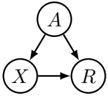
The image depicts a directed acyclic graph (DAG) with three nodes labeled 'A', 'X', and 'R'. Arrows indicate the direction of relationships between the nodes.
### Components/Axes
The diagram consists of:
* **Nodes:** A, X, R
* **Edges (Directed Arrows):**
* A -> X
* A -> R
* X -> R
### Detailed Analysis or Content Details
The diagram shows a hierarchical relationship. Node 'A' has two outgoing edges, one to 'X' and one to 'R'. Node 'X' has one outgoing edge to 'R'. There are no cycles in the graph.
### Key Observations
The graph structure suggests that 'A' influences both 'X' and 'R', and 'X' influences 'R'. 'R' is dependent on both 'A' and 'X'.
### Interpretation
This diagram likely represents a causal or dependency relationship between the elements A, X, and R. 'A' could be a root cause or initial condition, 'X' and 'R' are intermediate or resulting states. The structure implies that 'R' is dependent on both 'A' and 'X', and 'X' is dependent on 'A'. This could be a simplified model of a process, system, or network where the arrows represent flow or influence. Without further context, the specific meaning of A, X, and R is unknown, but the diagram clearly illustrates their interdependencies.