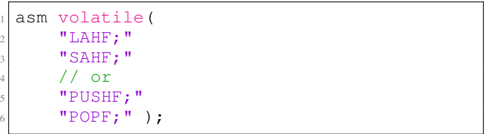
## Code Snippet: `asm volatile` Function Definition
### Overview
The image shows a code snippet defining an `asm volatile` block, likely in a low-level programming context (e.g., assembly or inline assembly in C/C++). The block contains four string literals and a comment, with syntax highlighting applied to distinguish keywords, strings, and comments.
### Components/Axes
- **Function Declaration**:
- `asm volatile(`: Keyword `asm` in black, `volatile` in magenta, parentheses in black.
- **String Literals**:
- `"LAHF";` (Line 2): String in purple, semicolon in black.
- `"SAHF";` (Line 3): String in purple, semicolon in black.
- `"PUSHF";` (Line 5): String in purple, semicolon in black.
- `"POPF";` (Line 6): String in purple, semicolon in black.
- **Comment**:
- `// or` (Line 4): Comment in green, indicating an alternative or optional path.
### Detailed Analysis
- **Line Numbers**: Left-aligned numeric labels (1–6) in gray.
- **Syntax Highlighting**:
- Keywords (`asm`, `volatile`) in black/magenta.
- Strings (`"LAHF"`, `"SAHF"`, `"PUSHF"`, `"POPF"`) in purple.
- Comment (`// or`) in green.
- **Structure**:
- The `asm volatile` block is enclosed in parentheses, with each string literal on a separate line.
- The comment `// or` appears between `"SAHF";` and `"PUSHF";`, suggesting an alternative implementation or configuration.
### Key Observations
1. **Volatile Keyword**: The `volatile` qualifier ensures the compiler does not optimize away the assembly instructions, critical for hardware interactions where side effects must be preserved.
2. **Hardware Instructions**: The strings `"LAHF"`, `"SAHF"`, `"PUSHF"`, and `"POPF"` correspond to x86 assembly instructions for loading/storing flags and pushing/popping the flags register.
3. **Comment Ambiguity**: The `// or` comment lacks context, leaving the relationship between the instructions unclear (e.g., whether `"PUSHF"`/`"POPF"` are alternatives to `"LAHF"`/`"SAHF"`).
### Interpretation
This code snippet defines a volatile inline assembly block, likely used to execute hardware-specific instructions without compiler optimization. The presence of `"LAHF"`/`"SAHF"` (Load/Store All Flags) and `"PUSHF"`/`"POPF"` (Push/Pop Flags) suggests manipulation of processor flags, which are critical for controlling interrupt handling, arithmetic operations, and other low-level system states.
The comment `// or` implies a choice between two implementations, but without additional context, it is unclear whether the alternatives are mutually exclusive or combinable. The use of `volatile` emphasizes the need for precise execution order, which is essential in scenarios like atomic operations or direct hardware register manipulation.
The code’s structure and syntax highlighting confirm it is part of a low-level programming environment, such as embedded systems or performance-critical applications where direct hardware access is required.