\n
## Code Snippet: Inline Assembly
### Overview
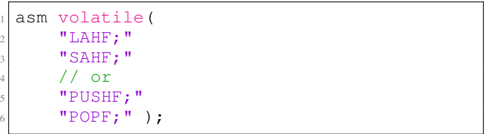
The image presents a snippet of C/C++ code containing inline assembly instructions. The code appears to be related to manipulating the processor's flags register.
### Components/Axes
There are no axes or legends in this image. The content is purely textual code. Line numbers are present on the left side, ranging from 1 to 6.
### Detailed Analysis or Content Details
The code snippet consists of the following lines:
1. `asm volatile (`
2. `"LAHF;"`
3. `"SAHF;"`
4. `// or`
5. `"PUSHF;"`
6. `"POPF;" ) ;`
The `asm volatile` keyword indicates an inline assembly block. The instructions within the double quotes are assembly language instructions.
* `LAHF`: Load AH with Flags. This instruction copies the flags register into the AH register.
* `SAHF`: Store AH into Flags. This instruction copies the AH register into the flags register.
* `PUSHF`: Push Flags onto the stack. This instruction pushes the current value of the flags register onto the stack.
* `POPF`: Pop Flags from the stack. This instruction pops a value from the stack into the flags register.
The comment `// or` suggests that either the `LAHF`/`SAHF` pair or the `PUSHF`/`POPF` pair can be used, depending on the specific context.
### Key Observations
The code snippet provides two alternative methods for manipulating the flags register: direct transfer using `LAHF` and `SAHF`, or using the stack with `PUSHF` and `POPF`. The `volatile` keyword suggests that the compiler should not optimize this code block, as it has side effects that are not apparent from the code itself.
### Interpretation
This code snippet likely serves to save and restore the processor's flags register. This is a common practice when calling functions that might modify the flags register, to ensure that the flags are restored to their original state after the function returns. The choice between using `LAHF`/`SAHF` and `PUSHF`/`POPF` might depend on performance considerations or the specific architecture. The `volatile` keyword is crucial to prevent the compiler from reordering or optimizing the assembly instructions, which could lead to incorrect behavior.