## Code Snippet: Inline Assembly for CPU Flags Manipulation
### Overview
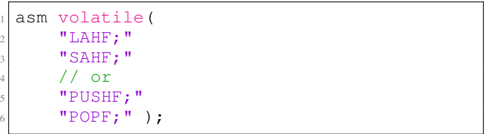
The image displays a code snippet of inline assembly within a C/C++-like syntax. The code is presented in a text editor or IDE view with line numbers and syntax highlighting. The snippet demonstrates two alternative methods for saving and restoring the CPU's flags register.
### Components/Axes
* **Line Numbers:** A vertical gutter on the left displays line numbers from 1 to 6.
* **Code Block:** The main content is a single `asm volatile` statement spanning multiple lines.
* **Syntax Highlighting:**
* Keywords (`asm`, `volatile`) are highlighted in purple.
* String literals (the assembly instructions) are highlighted in red.
* A comment (`// or`) is highlighted in green.
* Punctuation (parentheses, semicolons) is in black.
* **Background:** The code area has a white background, enclosed by a light gray border.
### Content Details
The precise textual content of the code is as follows:
```c
1 asm volatile(
2 "LAHF;"
3 "SAHF;"
4 // or
5 "PUSHF;"
6 "POPF;" );
```
**Line-by-Line Transcription:**
1. `asm volatile(` - Begins an inline assembly statement with the `volatile` qualifier, preventing the compiler from optimizing or moving this assembly block.
2. `"LAHF;"` - An x86 assembly instruction: **L**oad **A**ccounts from **H**igh byte of Flags into the AH register.
3. `"SAHF;"` - An x86 assembly instruction: **S**tore **A**ccounts into **H**igh byte of Flags from the AH register.
4. `// or` - A single-line comment indicating that the instructions on lines 2-3 are an alternative to the instructions on lines 5-6.
5. `"PUSHF;"` - An x86 assembly instruction: **PUSH** the **F**lags register onto the stack.
6. `"POPF;" );` - An x86 assembly instruction: **POP** the **F**lags register from the stack. The `);` closes the `asm volatile` statement.
### Key Observations
* **Two Distinct Methods:** The code presents two functionally similar but technically different pairs of instructions for preserving and restoring the CPU flags.
* **Instruction Scope:** `LAHF`/`SAHF` operate only on the high byte of the flags register (bits 8-15), which contains flags like the sign, zero, and parity flags. `PUSHF`/`POPF` operate on the entire 16-bit (or 32/64-bit in protected/long mode) flags register.
* **Comment as Logic:** The comment `// or` is critical. It explicitly states that the two instruction pairs are alternatives, not a sequential sequence. This is a logic-check for the reader.
* **Visual Structure:** The code is cleanly formatted with each instruction on its own line within the string literal, enhancing readability.
### Interpretation
This code snippet is a technical example, likely from documentation or a tutorial, illustrating how to save and restore CPU state within inline assembly. The `volatile` keyword is essential here, as it tells the compiler that this assembly block has side effects (modulating the flags register) and must not be removed or reordered.
The choice between the two methods has implications:
* **`LAHF`/`SAHF`:** A more lightweight, potentially faster method if only the status flags (like Zero Flag, Sign Flag) need to be preserved. It leaves the control flags (like Interrupt Flag, Direction Flag) untouched.
* **`PUSHF`/`POPF`:** A comprehensive method that saves and restores the entire flags register, including control flags. This is necessary if the subsequent code depends on or modifies flags like the interrupt enable flag.
The presence of the comment suggests the author is highlighting this design choice for the reader. The underlying message is that the programmer must understand the specific requirements of their code (which flags need preservation) to choose the correct, efficient method. This snippet serves as a concise reference for that decision point in low-level systems programming.