## Diagram: Explicit vs. Latent Reasoning
### Overview
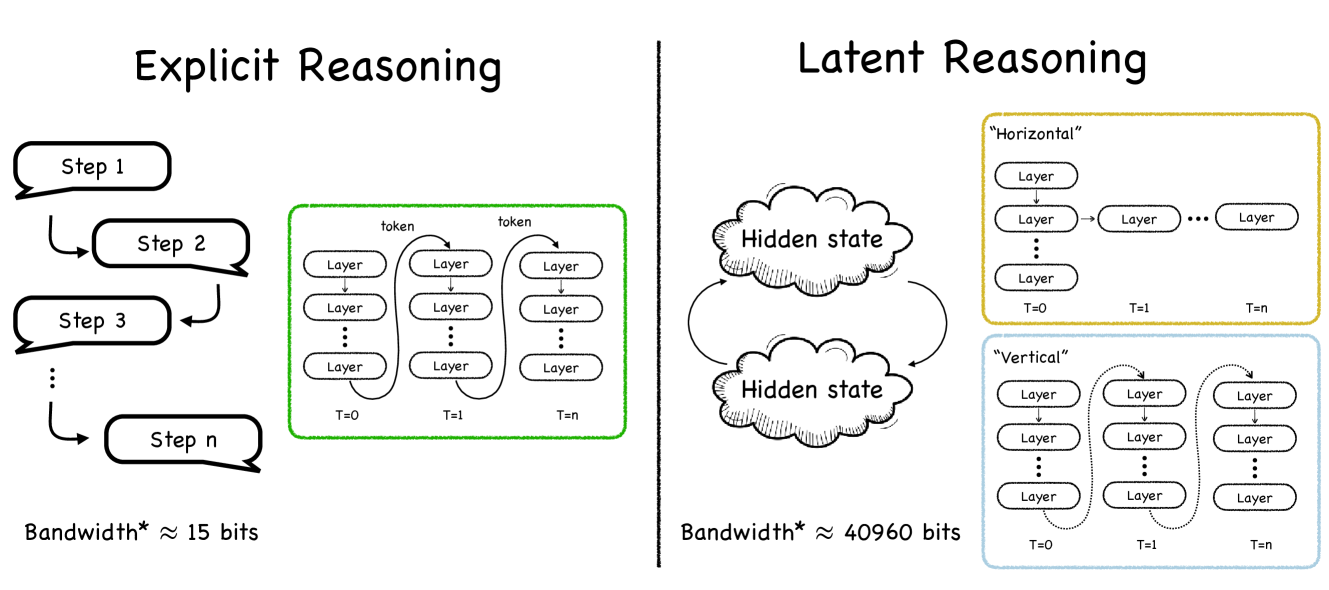
The image presents a comparative diagram illustrating "Explicit Reasoning" and "Latent Reasoning." It contrasts a sequential, step-by-step process with a more complex, layered approach involving hidden states and horizontal/vertical layer arrangements.
### Components/Axes
**Left Side: Explicit Reasoning**
* **Steps:** A series of connected steps labeled "Step 1," "Step 2," "Step 3," and "Step n." The steps are arranged vertically, with arrows indicating the flow from one step to the next.
* **Token Processing:** A green-bordered box containing three columns of "Layer" elements. Each column has three "Layer" boxes stacked vertically, with the middle layer represented by ellipsis (...). Arrows connect the layers within each column, and curved arrows connect the top layer of each column to the next column, labeled "token".
* **Time Indicators:** Below the token processing box, "T=0", "T=1", and "T=n" are indicated, representing time steps.
* **Bandwidth:** "Bandwidth* ≈ 15 bits" is noted below the explicit reasoning diagram.
**Right Side: Latent Reasoning**
* **Hidden States:** Two cloud-like shapes labeled "Hidden state" are present, with a two-way arrow connecting them.
* **Horizontal Layer Arrangement:** A yellow-bordered box labeled "Horizontal" contains a horizontal sequence of "Layer" elements. The layers are connected by arrows, with an ellipsis (...) indicating continuation.
* **Vertical Layer Arrangement:** A blue-bordered box labeled "Vertical" contains three columns of "Layer" elements. Each column has three "Layer" boxes stacked vertically, with the middle layer represented by ellipsis (...). Dotted arrows connect the layers within each column, and curved dotted arrows connect the top layer of each column to the next column.
* **Time Indicators:** Below both the horizontal and vertical layer arrangements, "T=0", "T=1", and "T=n" are indicated, representing time steps.
* **Bandwidth:** "Bandwidth* ≈ 40960 bits" is noted below the latent reasoning diagram.
### Detailed Analysis
**Explicit Reasoning:**
* The "Step" sequence represents a linear, sequential process.
* The token processing box shows a layered structure, with tokens flowing between layers at different time steps.
* The bandwidth is relatively low, approximately 15 bits.
**Latent Reasoning:**
* The "Hidden state" clouds suggest an internal, less directly observable process.
* The "Horizontal" layer arrangement shows a sequential flow of layers.
* The "Vertical" layer arrangement shows a more complex, interconnected structure.
* The bandwidth is significantly higher, approximately 40960 bits.
### Key Observations
* The diagram clearly contrasts two different approaches to reasoning: one explicit and sequential, the other latent and more complex.
* The bandwidth difference highlights the increased computational resources required for latent reasoning.
* The use of "Hidden state" and layered structures suggests a neural network or similar machine learning model.
### Interpretation
The diagram illustrates the fundamental differences between explicit and latent reasoning models. Explicit reasoning involves a clear, step-by-step process, while latent reasoning relies on hidden states and complex layer interactions. The higher bandwidth associated with latent reasoning suggests a greater capacity for processing information and learning complex patterns, but also a higher computational cost. The diagram likely aims to explain the trade-offs between these two approaches in the context of artificial intelligence or cognitive science.