\n
## Diagram: Explicit vs. Latent Reasoning
### Overview
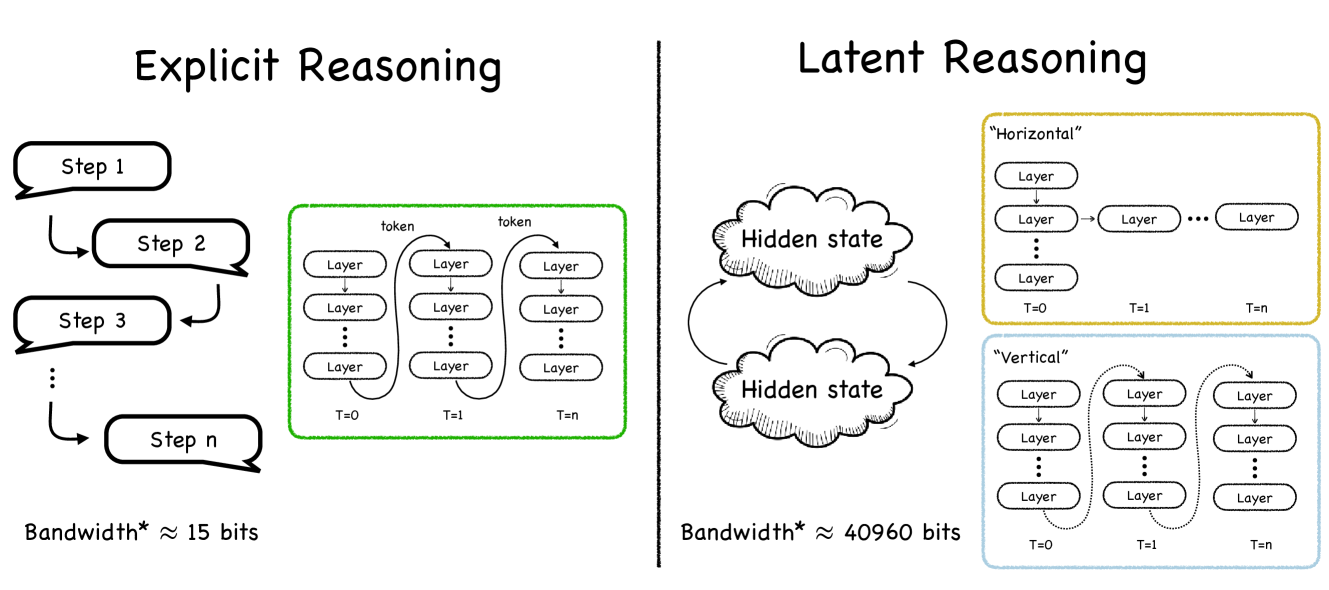
The image is a diagram comparing "Explicit Reasoning" and "Latent Reasoning" approaches. It visually represents the information flow and bandwidth associated with each method. The diagram uses boxes, arrows, and stylized representations of neural network layers to illustrate the concepts.
### Components/Axes
The diagram is divided into two main sections: "Explicit Reasoning" (left) and "Latent Reasoning" (right). Each section contains several labeled components:
* **Explicit Reasoning:**
* "Step 1", "Step 2", "Step 3", ... "Step n" - Representing sequential reasoning steps.
* Boxes containing layers labeled "Layer" at T=0, T=1, and T=n.
* "token" labels associated with connections between layers.
* "Bandwidth* ≈ 15 bits" - indicating the approximate bandwidth.
* **Latent Reasoning:**
* "Hidden state" - Represented by a stylized, cloud-like shape.
* "Horizontal" and "Vertical" labels indicating the orientation of the layers.
* Boxes containing layers labeled "Layer" at T=0, T=1, and T=n.
* "Bandwidth* ≈ 40960 bits" - indicating the approximate bandwidth.
### Detailed Analysis or Content Details
**Explicit Reasoning:**
The left side depicts a sequential process. The steps are numbered from 1 to n, suggesting an iterative process. Within each step, there are multiple layers labeled "Layer" at time points T=0, T=1, and T=n. Connections between layers are labeled "token". The bandwidth is approximately 15 bits.
**Latent Reasoning:**
The right side shows two parallel pathways, labeled "Horizontal" and "Vertical". Each pathway contains layers labeled "Layer" at time points T=0, T=1, and T=n. Both pathways are connected to a "Hidden state" represented by a complex, cloud-like shape. The bandwidth is approximately 40960 bits.
The "Horizontal" pathway has layers arranged horizontally, while the "Vertical" pathway has layers arranged vertically. The layers within each pathway are colored differently: green, yellow, and light purple.
### Key Observations
* The "Latent Reasoning" side has a significantly higher bandwidth (40960 bits) compared to the "Explicit Reasoning" side (15 bits).
* The "Latent Reasoning" side utilizes a "Hidden state" which is absent in the "Explicit Reasoning" side.
* The "Explicit Reasoning" side emphasizes sequential steps, while the "Latent Reasoning" side shows parallel pathways.
* The layers in the "Latent Reasoning" side are color-coded, potentially representing different aspects or features.
### Interpretation
The diagram illustrates a comparison between two reasoning approaches: explicit and latent. Explicit reasoning is depicted as a step-by-step process with limited bandwidth, where information is passed sequentially through layers as "tokens". Latent reasoning, on the other hand, utilizes a "Hidden state" and parallel pathways, resulting in a much higher bandwidth.
The higher bandwidth of latent reasoning suggests that it can process and represent more complex information. The "Hidden state" likely represents a compressed or abstracted representation of the input, allowing for more efficient reasoning. The parallel pathways indicate that latent reasoning can explore multiple possibilities simultaneously.
The diagram suggests that latent reasoning is a more powerful but potentially less interpretable approach compared to explicit reasoning. The explicit reasoning is more transparent, but limited in its capacity. The difference in bandwidth highlights the trade-off between expressiveness and efficiency. The diagram is likely used to explain the advantages of latent variable models or neural networks in machine learning and artificial intelligence.