## Chart: Convergence Rate Comparison
### Overview
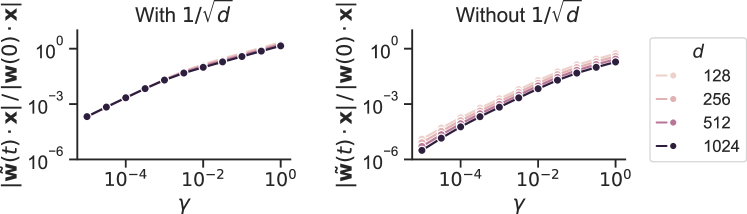
The image presents two charts comparing the convergence rate of a process under two conditions: "With 1/√d" and "Without 1/√d". Both charts plot the absolute difference between the current weight and the initial weight, normalized by the initial weight, against a parameter γ (gamma). The charts use different colors to represent different values of 'd'.
### Components/Axes
* **X-axis (both charts):** γ (gamma), with a logarithmic scale ranging from 10^-4 to 10^0.
* **Y-axis (both charts):** |w(t) - x| / |w(0) - x|, ranging from 10^-6 to 10^0, also on a logarithmic scale.
* **Title (left chart):** "With 1/√d"
* **Title (right chart):** "Without 1/√d"
* **Legend (right chart, top-right):**
* d = 128 (light pink)
* d = 256 (pink)
* d = 512 (reddish-pink)
* d = 1024 (purple)
### Detailed Analysis
**Left Chart: With 1/√d**
The left chart displays a single data series (purple, d=1024). The line slopes upward, indicating that the absolute difference decreases as γ increases.
* γ = 10^-4: |w(t) - x| / |w(0) - x| ≈ 0.0015 (1.5 x 10^-3)
* γ = 10^-3: |w(t) - x| / |w(0) - x| ≈ 0.004 (4 x 10^-3)
* γ = 10^-2: |w(t) - x| / |w(0) - x| ≈ 0.015 (1.5 x 10^-2)
* γ = 10^-1: |w(t) - x| / |w(0) - x| ≈ 0.06 (6 x 10^-2)
* γ = 10^0: |w(t) - x| / |w(0) - x| ≈ 0.25 (2.5 x 10^-1)
**Right Chart: Without 1/√d**
The right chart displays four data series, each corresponding to a different value of 'd'. All lines exhibit an upward slope, similar to the left chart, but with variations in their trajectories.
* **d = 128 (light pink):**
* γ = 10^-4: |w(t) - x| / |w(0) - x| ≈ 0.002 (2 x 10^-3)
* γ = 10^-3: |w(t) - x| / |w(0) - x| ≈ 0.006 (6 x 10^-3)
* γ = 10^-2: |w(t) - x| / |w(0) - x| ≈ 0.02 (2 x 10^-2)
* γ = 10^-1: |w(t) - x| / |w(0) - x| ≈ 0.08 (8 x 10^-2)
* γ = 10^0: |w(t) - x| / |w(0) - x| ≈ 0.3 (3 x 10^-1)
* **d = 256 (pink):**
* γ = 10^-4: |w(t) - x| / |w(0) - x| ≈ 0.0018 (1.8 x 10^-3)
* γ = 10^-3: |w(t) - x| / |w(0) - x| ≈ 0.005 (5 x 10^-3)
* γ = 10^-2: |w(t) - x| / |w(0) - x| ≈ 0.018 (1.8 x 10^-2)
* γ = 10^-1: |w(t) - x| / |w(0) - x| ≈ 0.07 (7 x 10^-2)
* γ = 10^0: |w(t) - x| / |w(0) - x| ≈ 0.28 (2.8 x 10^-1)
* **d = 512 (reddish-pink):**
* γ = 10^-4: |w(t) - x| / |w(0) - x| ≈ 0.0016 (1.6 x 10^-3)
* γ = 10^-3: |w(t) - x| / |w(0) - x| ≈ 0.0045 (4.5 x 10^-3)
* γ = 10^-2: |w(t) - x| / |w(0) - x| ≈ 0.016 (1.6 x 10^-2)
* γ = 10^-1: |w(t) - x| / |w(0) - x| ≈ 0.065 (6.5 x 10^-2)
* γ = 10^0: |w(t) - x| / |w(0) - x| ≈ 0.26 (2.6 x 10^-1)
* **d = 1024 (purple):**
* γ = 10^-4: |w(t) - x| / |w(0) - x| ≈ 0.0015 (1.5 x 10^-3)
* γ = 10^-3: |w(t) - x| / |w(0) - x| ≈ 0.004 (4 x 10^-3)
* γ = 10^-2: |w(t) - x| / |w(0) - x| ≈ 0.015 (1.5 x 10^-2)
* γ = 10^-1: |w(t) - x| / |w(0) - x| ≈ 0.06 (6 x 10^-2)
* γ = 10^0: |w(t) - x| / |w(0) - x| ≈ 0.25 (2.5 x 10^-1)
### Key Observations
* In both charts, the absolute difference decreases as γ increases, indicating convergence.
* The convergence rate appears to be slower for smaller values of 'd' (without 1/√d).
* The inclusion of 1/√d (left chart) results in a faster convergence rate compared to the scenarios without it (right chart).
* The lines for different 'd' values in the "Without 1/√d" chart are relatively close together, suggesting that the impact of 'd' is less significant when 1/√d is not included.
### Interpretation
The charts demonstrate the impact of the term 1/√d on the convergence rate of a process. The "With 1/√d" chart shows a clear convergence trend, while the "Without 1/√d" chart exhibits a slower convergence, with the rate being influenced by the value of 'd'. This suggests that including 1/√d accelerates the convergence process. The parameter 'd' likely represents a dimensionality or size parameter, and the inclusion of 1/√d may be a technique to mitigate the curse of dimensionality, leading to faster convergence in higher-dimensional spaces. The logarithmic scales on both axes highlight the relative changes in the absolute difference and γ, emphasizing the exponential nature of the convergence process. The data suggests that the inclusion of 1/√d is beneficial for achieving faster convergence, particularly as γ increases.