## Heatmap: Syllogism Format Prediction Validity
### Overview
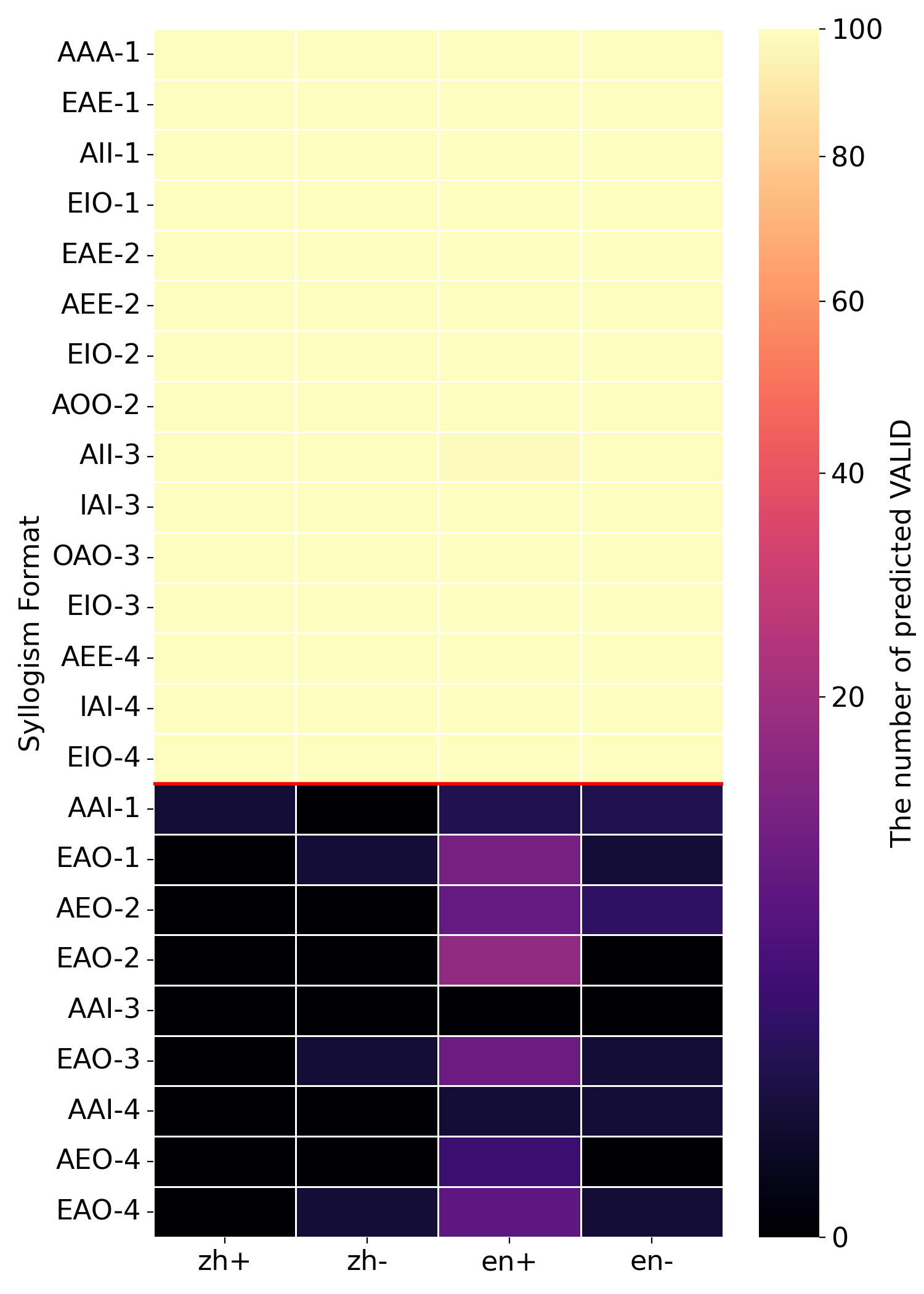
The image is a heatmap visualizing the number of predicted "VALID" outcomes for various syllogism formats across four different conditions. The data is presented in a grid where color intensity represents the count, with a clear separation between two distinct groups of syllogism formats.
### Components/Axes
* **Vertical Axis (Y-axis):** Labeled **"Syllogism Format"**. It lists 25 distinct categorical formats, grouped into two sections separated by a horizontal red line.
* **Top Section (Above Red Line):** AAA-1, EAE-1, AII-1, EIO-1, EAE-2, AEE-2, EIO-2, AOO-2, AII-3, IAI-3, OAO-3, EIO-3, AEE-4, IAI-4, EIO-4.
* **Bottom Section (Below Red Line):** AAI-1, EAO-1, AEO-2, EAO-2, AAI-3, EAO-3, AAI-4, AEO-4, EAO-4.
* **Horizontal Axis (X-axis):** Represents four conditions, likely related to language and polarity. The labels are:
* `zh+` (likely Chinese, positive condition)
* `zh-` (likely Chinese, negative condition)
* `en+` (likely English, positive condition)
* `en-` (likely English, negative condition)
* **Color Scale/Legend:** Located on the right side. It is a vertical gradient bar labeled **"The number of predicted VALID"**.
* **Scale:** Ranges from **0** (black/dark purple) to **100** (light yellow/cream).
* **Gradient:** Black (0) -> Dark Purple -> Purple -> Magenta -> Orange -> Light Yellow (100).
### Detailed Analysis
The heatmap reveals a stark dichotomy between the two groups of syllogism formats.
**1. Top Group (Above Red Line - 15 formats):**
* **Trend:** All cells in this group are a uniform, very light yellow color.
* **Data Points:** Based on the color scale, the value for every cell in this group is approximately **95-100**. There is no visible variation across the four conditions (`zh+`, `zh-`, `en+`, `en-`) for any of these formats. They consistently show the maximum number of predicted VALID outcomes.
**2. Bottom Group (Below Red Line - 9 formats):**
* **Trend:** This group shows significant variation and much lower values overall. The colors range from black to purple.
* **Data Points (Approximate by Row and Column):**
* **AAI-1:** `zh+` (~5, dark purple), `zh-` (~0, black), `en+` (~10, dark purple), `en-` (~5, dark purple).
* **EAO-1:** `zh+` (~0, black), `zh-` (~10, dark purple), `en+` (~30, purple), `en-` (~5, dark purple).
* **AEO-2:** `zh+` (~0, black), `zh-` (~0, black), `en+` (~25, purple), `en-` (~15, dark purple).
* **EAO-2:** `zh+` (~0, black), `zh-` (~0, black), `en+` (~35, magenta/purple), `en-` (~0, black).
* **AAI-3:** `zh+` (~0, black), `zh-` (~0, black), `en+` (~0, black), `en-` (~0, black).
* **EAO-3:** `zh+` (~0, black), `zh-` (~10, dark purple), `en+` (~30, purple), `en-` (~5, dark purple).
* **AAI-4:** `zh+` (~0, black), `zh-` (~0, black), `en+` (~10, dark purple), `en-` (~5, dark purple).
* **AEO-4:** `zh+` (~0, black), `zh-` (~0, black), `en+` (~20, purple), `en-` (~0, black).
* **EAO-4:** `zh+` (~0, black), `zh-` (~10, dark purple), `en+` (~30, purple), `en-` (~10, dark purple).
### Key Observations
1. **Binary Performance:** The red line acts as a perfect separator. Syllogism formats above it are predicted as VALID nearly 100% of the time across all tested conditions. Formats below it are predicted as VALID far less frequently.
2. **Condition Sensitivity in Low-Performance Group:** Within the bottom group, the `en+` (English, positive) condition consistently shows the highest values (brightest colors), suggesting the model is most likely to predict VALID for these problematic formats when presented with English positive statements.
3. **Near-Zero Performance:** Several cells, particularly for `zh+` and `zh-` in the bottom group, are black, indicating a value of 0 or very close to 0 predicted VALID outcomes.
4. **Format Patterns:** The bottom group consists exclusively of formats starting with "AAI", "EAO", or "AEO". The top group contains a wider variety, including "AAA", "EAE", "AII", etc.
### Interpretation
This heatmap likely illustrates the results of an experiment testing an AI model's ability to identify logically valid syllogisms. The "Syllogism Format" labels (e.g., AAA-1) are standard notation in categorical logic, where letters denote the type of proposition (A=Universal Affirmative, E=Universal Negative, I=Particular Affirmative, O=Particular Negative) and numbers denote the figure (arrangement of terms).
* **What the data suggests:** The model has a clear, binary understanding of syllogism validity. It correctly identifies a specific set of 15 formats (the top group) as almost always valid. Conversely, it struggles significantly with another set of 9 formats (the bottom group), rarely predicting them as valid.
* **How elements relate:** The separation by the red line is the most critical relationship. It implies a fundamental logical distinction between the two groups. In traditional logic, the top group likely contains all and only the **unconditionally valid** syllogism forms (e.g., AAA-1, EAE-1). The bottom group likely contains **conditionally valid** or **invalid** forms, which may only be valid under specific interpretations or not at all.
* **Notable anomaly/trend:** The model's performance on the "invalid" group is not uniformly zero. The relative success in the `en+` condition could indicate a bias in the model's training data or a linguistic cue in English positive statements that sometimes leads it to incorrectly validate these forms. The complete failure on `AAI-3` (all cells black) is a notable outlier within the low-performance group.
**In essence, the heatmap visualizes a model's sharp, logic-based dichotomy in judging syllogisms, with a secondary layer showing how language and polarity conditions can slightly modulate its errors on logically unsound forms.**