## Heatmap: Syllogism Format vs. Language Combinations
### Overview
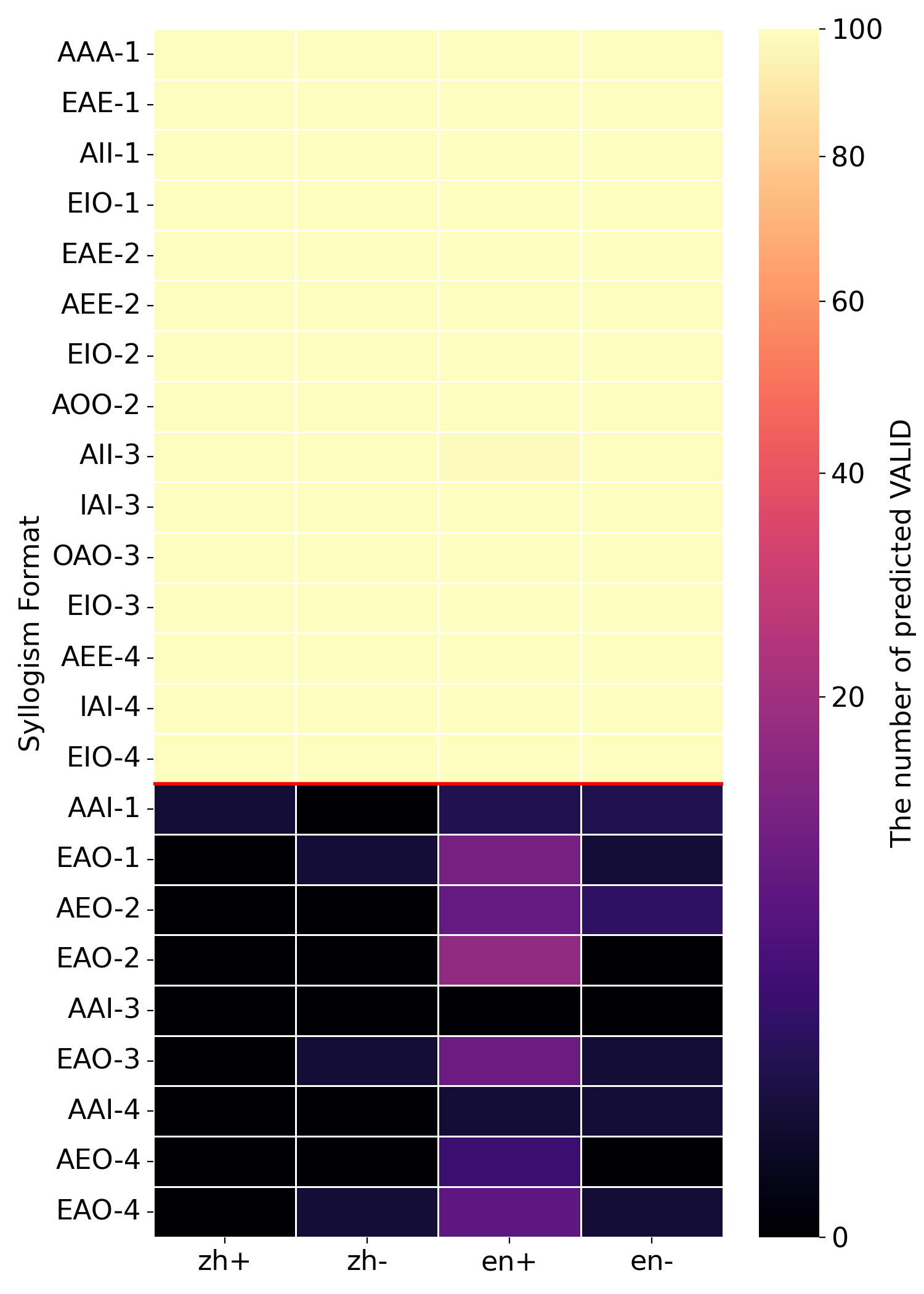
The image is a heatmap visualizing the relationship between syllogism formats (y-axis) and language combinations (x-axis), with color intensity representing the number of predicted VALID outcomes. The color scale ranges from black (0) to yellow (100), with a red horizontal line dividing the chart into two distinct regions.
### Components/Axes
- **Y-Axis (Syllogism Format)**:
- Categories: AAA-1, EAE-1, AII-1, EIO-1, EAE-2, AEE-2, EIO-2, AOO-2, AII-3, IAI-3, OAO-3, EIO-3, AEE-4, IAI-4, EIO-4, AAI-1, EAO-1, AEO-2, EAO-2, AAI-3, EAO-3, AAI-4, AEO-4, EAO-4.
- Spatial Positioning: Top-to-bottom, with the red line at the midpoint separating "high-value" (top) and "low-value" (bottom) regions.
- **X-Axis (Language Combinations)**:
- Categories: zh+ (Chinese positive), zh- (Chinese negative), en+ (English positive), en- (English negative).
- Spatial Positioning: Left-to-right, with equal spacing between categories.
- **Color Legend**:
- Scale: Black (0) → Purple (20) → Red (40) → Yellow (100).
- Position: Right side of the chart.
### Detailed Analysis
1. **Top Region (Above Red Line)**:
- **Dominant Colors**: Yellow (80-100) and light orange (60-80).
- **Key Data Points**:
- AAA-1: Yellow (95-100) across all x-axis categories.
- EAE-1: Yellow (90-95) for zh+ and en+; orange (80-85) for zh- and en-.
- AII-1: Yellow (90-95) for zh+ and en+; orange (80-85) for zh- and en-.
- EIO-1: Yellow (95-100) for zh+ and en+; orange (80-85) for zh- and en-.
- EAE-2: Yellow (90-95) for zh+ and en+; orange (80-85) for zh- and en-.
- AEE-2: Yellow (95-100) for zh+ and en+; orange (80-85) for zh- and en-.
- EIO-2: Yellow (90-95) for zh+ and en+; orange (80-85) for zh- and en-.
- AOO-2: Yellow (95-100) for zh+ and en+; orange (80-85) for zh- and en-.
- AII-3: Yellow (90-95) for zh+ and en+; orange (80-85) for zh- and en-.
- IAI-3: Yellow (95-100) for zh+ and en+; orange (80-85) for zh- and en-.
- OAO-3: Yellow (90-95) for zh+ and en+; orange (80-85) for zh- and en-.
- EIO-3: Yellow (95-100) for zh+ and en+; orange (80-85) for zh- and en-.
- AEE-4: Yellow (90-95) for zh+ and en+; orange (80-85) for zh- and en-.
- IAI-4: Yellow (95-100) for zh+ and en+; orange (80-85) for zh- and en-.
- EIO-4: Yellow (95-100) for zh+ and en+; orange (80-85) for zh- and en-.
2. **Bottom Region (Below Red Line)**:
- **Dominant Colors**: Black (0-20) and dark purple (20-40).
- **Key Data Points**:
- AAI-1: Black (0-5) for zh+ and zh-; dark purple (10-20) for en+ and en-.
- EAO-1: Black (0-5) for zh+ and zh-; dark purple (10-20) for en+ and en-.
- AEO-2: Black (0-5) for zh+ and zh-; dark purple (10-20) for en+ and en-.
- EAO-2: Black (0-5) for zh+ and zh-; dark purple (10-20) for en+ and en-.
- AAI-3: Black (0-5) for zh+ and zh-; dark purple (10-20) for en+ and en-.
- EAO-3: Black (0-5) for zh+ and zh-; dark purple (10-20) for en+ and en-.
- AAI-4: Black (0-5) for zh+ and zh-; dark purple (10-20) for en+ and en-.
- AEO-4: Black (0-5) for zh+ and zh-; dark purple (10-20) for en+ and en-.
- EAO-4: Black (0-5) for zh+ and zh-; dark purple (10-20) for en+ and en-.
### Key Observations
1. **Red Line Division**: The red line at the midpoint creates a clear dichotomy:
- **Top Region**: High validity (80-100) for most syllogism formats, especially with zh+ and en+.
- **Bottom Region**: Low validity (0-20) for most syllogism formats, with minimal variation across x-axis categories.
2. **Language Impact**:
- **zh+ and en+**: Consistently higher validity scores across all syllogism formats.
- **zh- and en-**: Lower validity scores, though still higher in the top region.
3. **Format-Specific Trends**:
- **Top Region Formats**: AAA-1, EAE-1, AII-1, EIO-1, EAE-2, AEE-2, EIO-2, AOO-2, AII-3, IAI-3, OAO-3, EIO-3, AEE-4, IAI-4, EIO-4 show strong performance.
- **Bottom Region Formats**: AAI-1, EAO-1, AEO-2, EAO-2, AAI-3, EAO-3, AAI-4, AEO-4, EAO-4 exhibit poor performance.
### Interpretation
The heatmap suggests that syllogism formats in the top region (e.g., AAA-1, EAE-1) are more robust in predicting VALID outcomes, particularly when combined with Chinese positive (zh+) or English positive (en+) language cues. The bottom region formats (e.g., AAI-1, EAO-1) perform poorly, indicating potential limitations in their structure or sensitivity to language polarity. The stark contrast between regions implies that language polarity (positive vs. negative) and syllogism complexity (e.g., AAA-1 vs. AAI-1) are critical factors in prediction validity. The red line may represent a threshold for acceptable performance, with formats above it being deemed "reliable" and those below "unreliable."