## Diagram: Raven's Progressive Matrices Grid Arrangement
### Overview
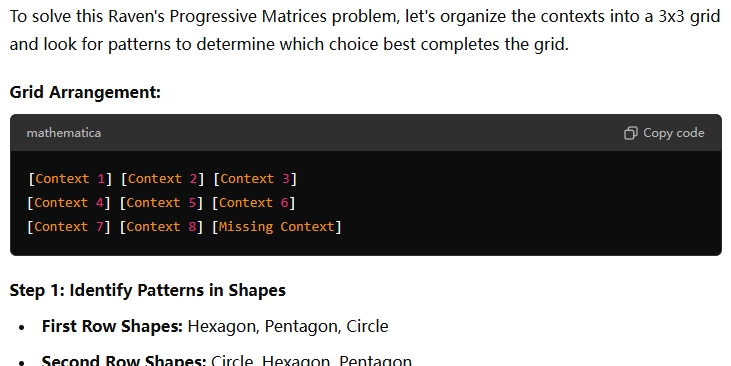
The image describes a method for solving Raven's Progressive Matrices problems by organizing contexts into a 3x3 grid to identify patterns. It presents a grid arrangement with labeled contexts and outlines a step to identify patterns in shapes.
### Components/Axes
* **Title:** To solve this Raven's Progressive Matrices problem, let's organize the contexts into a 3x3 grid and look for patterns to determine which choice best completes the grid.
* **Section Title:** Grid Arrangement:
* **Code Block Header:** mathematica, with a "Copy code" button on the right.
* **Grid Contents:** A 3x3 grid represented as a code block, with each cell containing a context label.
* **Step 1 Title:** Step 1: Identify Patterns in Shapes
* **Shape Patterns:**
* First Row Shapes: Hexagon, Pentagon, Circle
* Second Row Shapes: Circle, Hexagon, Pentagon
### Detailed Analysis
The image presents a 3x3 grid structure, where each cell is labeled as a "Context" followed by a number. The grid is arranged as follows:
* **Row 1:** \[Context 1], \[Context 2], \[Context 3]
* **Row 2:** \[Context 4], \[Context 5], \[Context 6]
* **Row 3:** \[Context 7], \[Context 8], \[Missing Context]
The "Missing Context" indicates the cell that needs to be determined based on the patterns in the other contexts.
The image also provides information about the shapes present in the first two rows:
* First Row Shapes: Hexagon, Pentagon, Circle
* Second Row Shapes: Circle, Hexagon, Pentagon
### Key Observations
* The grid is a visual representation of the problem's structure.
* The "Missing Context" highlights the objective of the problem.
* The shape patterns provide clues for solving the problem.
### Interpretation
The image illustrates a structured approach to solving Raven's Progressive Matrices problems. By organizing the contexts into a grid and identifying patterns, one can deduce the missing context. The shape patterns in the first two rows suggest a potential rule or sequence that can be used to determine the shape in the missing context. The arrangement of shapes in the first two rows suggests a cyclical pattern.