## Screenshot: Technical Problem-Solving Guide for Raven's Progressive Matrices
### Overview
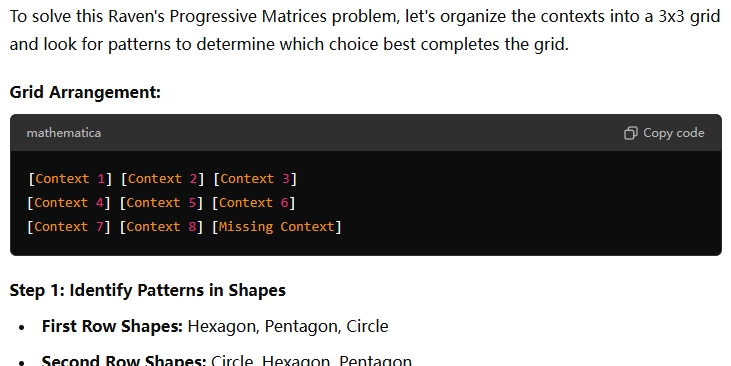
The image is a screenshot of a technical document or tutorial explaining the initial steps to solve a Raven's Progressive Matrices problem. It presents a structured approach, organizing the problem into a 3x3 grid and beginning to identify patterns in shapes across rows. The content is presented in English.
### Components/Axes
The image is composed of several distinct textual and UI elements arranged vertically:
1. **Header/Instructional Text:** A paragraph at the top explaining the task.
2. **Grid Arrangement Section:** A heading followed by a dark-themed code block.
* **Code Block Header:** Contains the label "mathematica" on the left and a "Copy code" button/icon on the right.
* **Code Block Content:** A 3x3 grid layout represented with bracketed placeholders.
3. **Step-by-Step Analysis Section:** A heading ("Step 1: Identify Patterns in Shapes") followed by a bulleted list.
* **Bullet Points:** Two visible points describing shapes in the first and second rows of the grid. The text for the second bullet point is cut off at the bottom of the image.
### Detailed Analysis
**Transcription of All Text:**
* **Top Paragraph:** "To solve this Raven's Progressive Matrices problem, let's organize the contexts into a 3x3 grid and look for patterns to determine which choice best completes the grid."
* **Section Heading:** "Grid Arrangement:"
* **Code Block Content:**
```
[Context 1] [Context 2] [Context 3]
[Context 4] [Context 5] [Context 6]
[Context 7] [Context 8] [Missing Context]
```
* **Step Heading:** "Step 1: Identify Patterns in Shapes"
* **Bullet Point 1:** "First Row Shapes: Hexagon, Pentagon, Circle"
* **Bullet Point 2 (Partial):** "Second Row Shapes: Circle, Hexagon, Pentagon"
**Spatial & Structural Details:**
* The instructional text is left-aligned at the top.
* The "Grid Arrangement:" heading is left-aligned below the first paragraph.
* The code block is visually distinct with a dark background. The "mathematica" label and "Copy code" button are in the header bar of this block.
* The grid within the code block is formatted as three lines of text, each containing three bracketed items, representing a matrix.
* The "Step 1" heading and subsequent bullet points are left-aligned below the code block.
* The image is cropped, cutting off the text after the second bullet point. The full list of shapes for the second row is not visible.
### Key Observations
1. **Structured Problem-Solving:** The document employs a clear, methodical approach: first defining the problem space (the 3x3 grid), then beginning a feature-by-feature analysis (starting with shapes).
2. **Placeholder Notation:** The grid uses abstract labels ("Context 1", "Missing Context") rather than actual shapes or symbols, indicating this is a meta-explanation of the solving *process*, not the specific problem instance.
3. **Pattern Recognition Initiation:** The analysis begins by listing the sequence of shapes in the first two rows. The visible data suggests a potential pattern of shape permutation or rotation across rows (e.g., the set {Hexagon, Pentagon, Circle} appears to be rearranged).
4. **Incomplete Data:** The critical information for the third row and the conclusion of the pattern analysis is missing due to the image crop.
### Interpretation
This screenshot captures the foundational phase of solving a visual logic puzzle. The "contexts" refer to the individual cells of the Raven's matrix. The guide is teaching the solver to:
1. **Abstract the Problem:** Represent the visual matrix as a textual grid of placeholders to focus on structure.
2. **Decompose Features:** Isolate one attribute (shape) for analysis across rows or columns.
3. **Hypothesize Rules:** The listed shapes imply the solver should look for a rule governing how the set {Hexagon, Pentagon, Circle} is distributed or transformed from one row to the next. Common rules in such matrices include:
* **Permutation:** Each row contains the same set of shapes in a different order.
* **Progression:** Shapes change according to a sequence (e.g., number of sides: 6→5→∞).
* **Operation:** Shapes in the third column result from an operation on the first two.
The missing text likely continues the pattern analysis for the third row and then deduces the rule to identify the "Missing Context." The document's purpose is pedagogical, breaking down an abstract reasoning task into concrete, repeatable steps. The use of a code block with a "mathematica" label suggests the original context might be from a computational or programming-oriented tutorial platform.