## Screenshot: Raven's Progressive Matrices Problem
### Overview
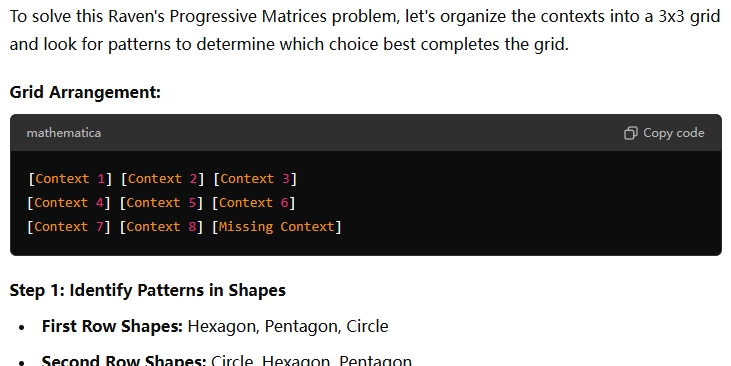
The image displays a Raven's Progressive Matrices problem interface. It includes a 3x3 grid labeled "Grid Arrangement" with contextual placeholders, a problem-solving instruction, and a step-by-step pattern identification guide. The grid contains labeled contexts (1-8) and a missing context, while the steps outline shape pattern analysis.
### Components/Axes
- **Grid Arrangement**:
- Labeled "mathematica" at the top with a "Copy code" button.
- 3x3 grid structure with contexts:
- Row 1: [Context 1], [Context 2], [Context 3]
- Row 2: [Context 4], [Context 5], [Context 6]
- Row 3: [Context 7], [Context 8], [Missing Context]
- **Text Elements**:
- Problem statement: "To solve this Raven's Progressive Matrices problem, let's organize the contexts into a 3x3 grid and look for patterns to determine which choice best completes the grid."
- Step 1: "Identify Patterns in Shapes"
- Sub-points:
- First Row Shapes: Hexagon, Pentagon, Circle
- Second Row Shapes: Circle, Hexagon, Pentagon
### Detailed Analysis
- **Grid Content**:
- All contexts are labeled sequentially (1-8) in orange brackets.
- The bottom-right cell is marked "[Missing Context]" in orange.
- **Shape Patterns**:
- First row shapes: Hexagon (6 sides), Pentagon (5 sides), Circle (0 sides).
- Second row shapes: Circle (0), Hexagon (6), Pentagon (5).
- Third row shapes: Context 7, Context 8, [Missing Context].
### Key Observations
1. **Row Pattern**:
- First row: 6 → 5 → 0 (decreasing by 1, then wrapping to 0).
- Second row: 0 → 6 → 5 (cyclical pattern).
- Third row: Context 7 and 8 precede the missing context, suggesting continuation of the cyclical pattern.
2. **Column Pattern**:
- Column 1: Hexagon (1), Circle (4), Context 7.
- Column 2: Pentagon (2), Hexagon (5), Context 8.
- Column 3: Circle (3), Pentagon (6), [Missing Context].
- Column 3 suggests a sequence: Circle (3) → Pentagon (6) → Hexagon (9), but the grid only has 8 contexts, implying a possible reset or alternative logic.
### Interpretation
The problem requires identifying a cyclical or rotational pattern in shapes across rows and columns. The first two rows exhibit a decreasing sequence (6 → 5 → 0) and a cyclical sequence (0 → 6 → 5), respectively. The third row's missing context likely follows the cyclical pattern observed in the second row, suggesting the missing shape could be a **Hexagon** (to complete the sequence 5 → 0 → 6 in the third row). However, columnar analysis implies a potential reset or alternative logic, as the third column's sequence (Circle → Pentagon → Hexagon) would require the missing context to be a Hexagon. The exact answer depends on whether the pattern prioritizes row-wise or column-wise logic.