## Heatmap: Unmasked Previous-Row Attention
### Overview
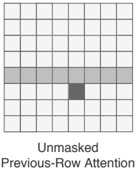
The image displays a 8x10 grid (8 rows, 10 columns) with two distinct shading patterns:
1. A fully shaded gray row (row 3 from top)
2. A single dark gray cell in row 5, column 6
All other cells are unshaded white. The title "Unmasked Previous-Row Attention" suggests this visualizes attention weights between rows in a sequence-processing model.
### Components/Axes
- **Grid Structure**:
- 8 rows (vertical axis)
- 10 columns (horizontal axis)
- No explicit axis labels or scales provided
- **Legend**:
- No explicit legend present
- Shading intensity likely encodes attention strength (darker = higher attention)
- **Title**:
- "Unmasked Previous-Row Attention" (bottom center)
### Detailed Analysis
- **Row 3**:
- Fully shaded gray (all 10 columns)
- Suggests uniform attention across all positions in this row
- **Row 5**:
- Single dark gray cell at column 6
- All other cells in this row are white
- Indicates concentrated attention on column 6
- **Other Rows**:
- Rows 1, 2, 4, 6-8: Entirely white
- No visible attention signals
### Key Observations
1. **Dominant Attention Patterns**:
- Row 3 shows maximal uniform attention (darkest gray)
- Row 5 exhibits sparse attention (single dark cell)
2. **Spatial Distribution**:
- Attention is localized to specific rows/columns rather than distributed evenly
3. **Intensity Gradient**:
- Dark gray (row 5, column 6) > Medium gray (row 3) > White (all others)
### Interpretation
This heatmap likely represents attention weights from a transformer-based model analyzing sequential data (e.g., text). The "Previous-Row" designation implies:
- Row 3's uniform attention may represent baseline context encoding
- Row 5's focused attention on column 6 suggests a critical dependency or salient feature at that position
- The absence of attention in other rows indicates the model ignores most positions when processing this sequence
The "Unmasked" label suggests this visualization reveals full attention patterns without masking mechanisms (common in autoregressive models). The stark contrast between uniform and sparse attention patterns highlights the model's selective focus on specific elements in the input sequence.