## Diagram: Cartesian Product of Two Edges
### Overview
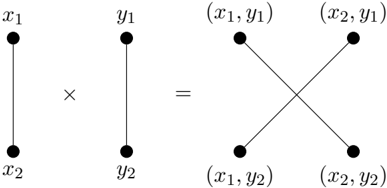
The image depicts the Cartesian product of two edges. It shows two separate edges, labeled with x1, x2 and y1, y2 respectively, and then illustrates the resulting graph after taking their Cartesian product, which results in a complete bipartite graph K2,2.
### Components/Axes
* **Left Edge:** A vertical line segment connecting two nodes labeled x1 (top) and x2 (bottom).
* **Middle Edge:** A vertical line segment connecting two nodes labeled y1 (top) and y2 (bottom).
* **Multiplication Symbol:** A "x" symbol between the two edges, indicating a Cartesian product operation.
* **Equals Symbol:** An "=" symbol indicating the result of the Cartesian product.
* **Resulting Graph:** A graph with four nodes labeled (x1, y1), (x2, y1), (x1, y2), and (x2, y2). There are edges connecting (x1, y1) to (x2, y2) and (x2, y1) to (x1, y2).
### Detailed Analysis
The diagram illustrates the Cartesian product of two edges. The first edge connects nodes x1 and x2. The second edge connects nodes y1 and y2. The Cartesian product results in a graph with nodes that are pairs of the original nodes: (x1, y1), (x1, y2), (x2, y1), and (x2, y2). The edges in the resulting graph connect (x1, y1) to (x2, y2) and (x2, y1) to (x1, y2).
### Key Observations
* The Cartesian product of two edges results in a complete bipartite graph.
* The nodes in the resulting graph are formed by pairing the nodes from the original edges.
* The edges in the resulting graph connect nodes with different x and y components.
### Interpretation
The diagram demonstrates how the Cartesian product operation combines two edges to create a new graph. The resulting graph's structure is determined by the connections in the original edges. This operation is fundamental in graph theory and has applications in various fields, including computer science and network analysis. The resulting graph is a complete bipartite graph K2,2.