## Diagram: Cartesian Product of Two Two-Element Sets
### Overview
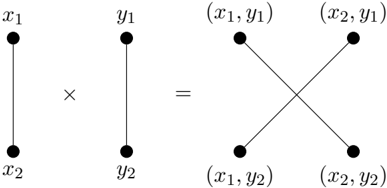
The image is a mathematical diagram illustrating the Cartesian product of two sets, each containing two elements. It visually demonstrates how the product operation combines elements from the first set with elements from the second set to form all possible ordered pairs.
### Components/Axes
The diagram is divided into three distinct parts, separated by mathematical operators.
1. **Left Component (First Set):**
* A vertical line segment with two endpoints.
* The top endpoint is labeled `x₁`.
* The bottom endpoint is labeled `x₂`.
2. **Middle Component (Second Set):**
* A vertical line segment with two endpoints, identical in form to the first.
* The top endpoint is labeled `y₁`.
* The bottom endpoint is labeled `y₂`.
* Between the first and second components is a multiplication symbol (`×`), indicating the Cartesian product operation.
3. **Right Component (Resulting Set):**
* An equals sign (`=`) separates the operation from its result.
* Four points are arranged in a square formation, representing the elements of the Cartesian product.
* The top-left point is labeled `(x₁, y₁)`.
* The top-right point is labeled `(x₂, y₁)`.
* The bottom-left point is labeled `(x₁, y₂)`.
* The bottom-right point is labeled `(x₂, y₂)`.
* Two diagonal lines cross in the center, connecting the points:
* One line connects `(x₁, y₁)` to `(x₂, y₂)`.
* The other line connects `(x₂, y₁)` to `(x₁, y₂)`.
### Detailed Analysis
The diagram explicitly maps the formation of the Cartesian product `X × Y`, where `X = {x₁, x₂}` and `Y = {y₁, y₂}`.
* **Process Flow:** The flow is from left to right. The two initial sets are presented, the product operation is applied, and the resulting set of four ordered pairs is displayed.
* **Element Mapping:** The diagonal lines in the result visually emphasize the combinatorial nature of the product. Each line connects pairs that share one common element from the original sets (e.g., the line from `(x₁, y₁)` to `(x₂, y₂)` connects pairs that share no common element, while the other line connects pairs that share either `x₂` or `y₁`).
* **Spatial Grounding:** The labels are placed directly adjacent to their corresponding points. The initial sets are vertically oriented, while the result is a 2x2 grid, highlighting the expansion from two linear sets to a planar set of combinations.
### Key Observations
1. **Complete Enumeration:** The diagram shows all four possible ordered pairs (`2 × 2 = 4`), confirming it is a complete representation of the Cartesian product for these finite sets.
2. **Symmetry:** The diagram is symmetric. The two initial sets are structurally identical, and the resulting grid is symmetric about both the vertical and horizontal axes.
3. **Visual Abstraction:** The lines connecting the initial points (`x₁` to `x₂`, `y₁` to `y₂`) are abstract representations of the sets themselves, not functions or mappings. The diagonal lines in the result are also abstract connectors showing the relationship between the output pairs.
### Interpretation
This diagram is a fundamental visual proof or explanation of the Cartesian product operation in set theory. It demonstrates that the product of two sets is the set of all possible ordered pairs where the first element comes from the first set and the second element comes from the second set.
* **What it Suggests:** The data (the sets and their product) suggests a combinatorial explosion. Starting with two simple sets of two items each, the product creates a new set with four distinct, composite items. This principle scales to larger sets and higher dimensions.
* **Relationships:** The core relationship shown is **combination**. The diagram moves from individual, independent elements (`x₁`, `y₁`) to combined, dependent entities (`(x₁, y₁)`). The crossing lines in the result may also hint at the concept of a **complete bipartite graph** between the two original sets, where every element of X is connected to every element of Y.
* **Notable Anomaly:** There is no anomaly; the diagram is a precise and standard representation of a mathematical definition. Its purpose is pedagogical clarity.
**Language Note:** All text in the image is in English and standard mathematical notation. No other languages are present.