## Line Chart: Newly Connected Pairs (sampled) vs. Iteration
### Overview
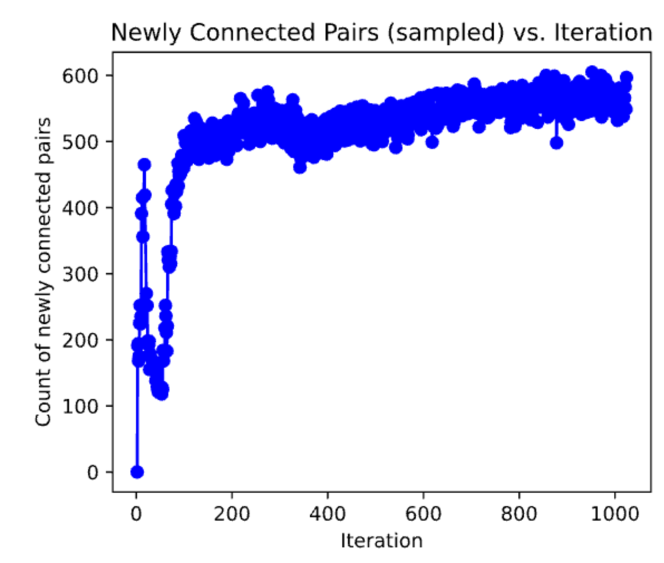
The chart depicts the relationship between the number of newly connected pairs (sampled) and iteration steps. Data points are represented as blue dots with error bars, showing variability in counts across iterations.
### Components/Axes
- **X-axis (Iteration)**: Labeled "Iteration," scaled from 0 to 1000 in increments of 200.
- **Y-axis (Count of newly connected pairs)**: Labeled "Count of newly connected pairs," scaled from 0 to 600 in increments of 100.
- **Data Points**: Blue dots with vertical error bars, indicating measurement uncertainty. No explicit legend is visible, but the color (blue) is consistent across all points.
### Detailed Analysis
- **Initial Phase (Iteration 0–100)**:
- Count rises sharply from 0 to ~450, with significant variability (error bars span ~100–200 units).
- Example: At iteration 50, count ≈ 400; at iteration 100, count ≈ 450.
- **Stabilization Phase (Iteration 100–300)**:
- Count plateaus between ~450–500, with reduced variability (error bars ~50–100 units).
- Example: At iteration 200, count ≈ 500; at iteration 300, count ≈ 480.
- **Gradual Increase (Iteration 300–1000)**:
- Count increases steadily from ~480 to ~580, with minor fluctuations.
- Example: At iteration 500, count ≈ 500; at iteration 1000, count ≈ 580.
- **Notable Dip**: A temporary drop to ~450 occurs around iteration 500, followed by recovery.
### Key Observations
1. **Rapid Initial Growth**: The system forms connections quickly in early iterations.
2. **Saturation Effect**: After ~100 iterations, growth slows, suggesting a capacity limit.
3. **Fluctuations**: Variability decreases during stabilization but persists in later phases.
4. **Anomaly**: The dip at iteration 500 may indicate a sampling artifact or system adjustment.
### Interpretation
The data suggests a process where connections proliferate rapidly initially, then stabilize as the system reaches a critical mass. The dip at iteration 500 could reflect a methodological change (e.g., sampling bias) or a temporary system failure. The final plateau (~580 pairs) implies diminishing returns, where additional iterations yield fewer new connections. Error bars highlight measurement uncertainty, particularly in early iterations, where variability exceeds 20% of the mean count. This pattern aligns with network growth models, where early-stage expansion is exponential, followed by logarithmic stabilization.