\n
## Histograms: Distribution Comparison of Three Language Models
### Overview
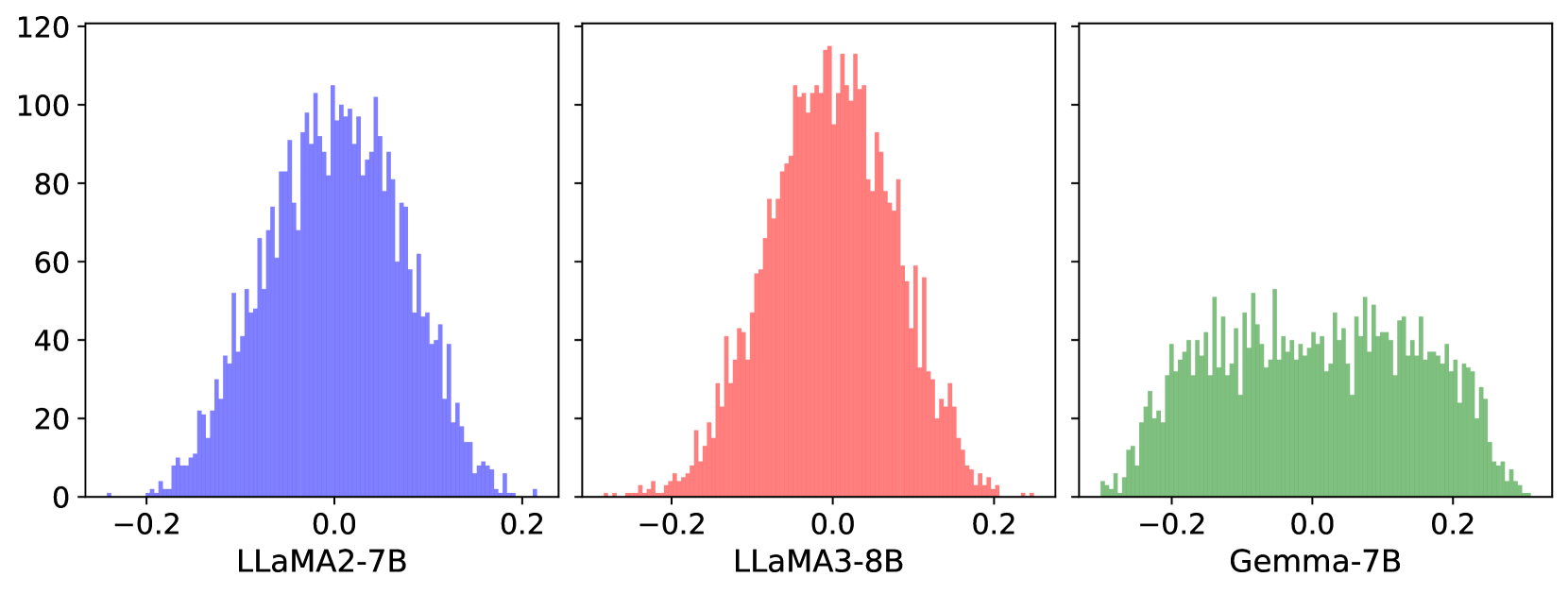
The image displays three separate histograms arranged horizontally in a single row. Each histogram visualizes the distribution of a numerical variable (likely a performance metric, embedding similarity, or output score) for a different large language model. The models compared are LLaMA2-7B, LLaMA3-8B, and Gemma-7B. The charts share a common y-axis scale but have individual x-axes.
### Components/Axes
* **Chart Type:** Three separate histograms (frequency distributions).
* **Layout:** Three panels arranged horizontally from left to right.
* **Y-Axis (Common to all panels):**
* **Label:** Not explicitly labeled. Represents frequency or count.
* **Scale:** Linear scale from 0 to 120, with major tick marks at 0, 20, 40, 60, 80, 100, 120.
* **X-Axis (Individual for each panel):**
* **Scale:** Linear scale from approximately -0.25 to +0.25 for all three charts. Major tick marks are visible at -0.2, 0.0, and 0.2.
* **Labels (Centered below each histogram):**
* Left Panel: `LLaMA2-7B`
* Middle Panel: `LLaMA3-8B`
* Right Panel: `Gemma-7B`
* **Data Series (Color-Coded):**
* **LLaMA2-7B (Left Panel):** Blue histogram bars.
* **LLaMA3-8B (Middle Panel):** Red/Salmon histogram bars.
* **Gemma-7B (Right Panel):** Green histogram bars.
* **Legend:** Not present as a separate box. The model names below each panel serve as the legend, with color being the differentiating factor.
### Detailed Analysis
**1. LLaMA2-7B (Blue, Left Panel):**
* **Trend/Shape:** The distribution is unimodal and approximately symmetric, forming a classic bell curve (normal distribution shape).
* **Central Tendency:** The peak (mode) is centered very close to `0.0` on the x-axis.
* **Spread/Range:** The bulk of the data lies between approximately `-0.15` and `+0.15`. The distribution tapers off smoothly on both sides, with very low frequencies approaching `-0.2` and `+0.2`.
* **Peak Frequency:** The highest bar reaches a frequency of approximately `105` (just above the 100 mark).
**2. LLaMA3-8B (Red, Middle Panel):**
* **Trend/Shape:** The distribution is unimodal and symmetric, also resembling a normal distribution. It appears slightly more peaked (leptokurtic) than the LLaMA2-7B distribution.
* **Central Tendency:** The peak is centered at or extremely close to `0.0`.
* **Spread/Range:** The data is more concentrated around the mean. The visible range is roughly between `-0.15` and `+0.15`, with the tails appearing to drop off more sharply than LLaMA2-7B near the extremes.
* **Peak Frequency:** This histogram has the highest peak of the three, with the tallest bar reaching approximately `115` (close to the 120 mark).
**3. Gemma-7B (Green, Right Panel):**
* **Trend/Shape:** The distribution is markedly different. It is platykurtic (flatter) and wider, with a less defined single peak. It appears more uniform or multi-modal across a broad central region.
* **Central Tendency:** The center of mass is around `0.0`, but there is no sharp, singular peak. The highest frequencies are spread across a plateau from roughly `-0.1` to `+0.1`.
* **Spread/Range:** This distribution has the widest spread. Significant frequencies are observed from approximately `-0.2` to `+0.2`, with the tails extending slightly beyond these points. The data is much more dispersed.
* **Peak Frequency:** The maximum frequency is lower than the other two models, with the tallest bars reaching only about `50-55`.
### Key Observations
1. **Distribution Shape Contrast:** LLaMA2-7B and LLaMA3-8B show tight, normal-like distributions centered at zero, while Gemma-7B shows a broad, flat distribution.
2. **Peak Magnitude:** LLaMA3-8B exhibits the highest concentration of values near zero (highest peak frequency), suggesting the most consistent or least variable outputs for the measured metric.
3. **Dispersion:** Gemma-7B has the highest variance or dispersion in its values, as indicated by its wide, flat histogram. LLaMA3-8B appears to have the lowest variance.
4. **Symmetry:** All three distributions are roughly symmetric around zero, indicating no strong positive or negative bias in the measured metric for any model.
### Interpretation
This visualization compares the statistical behavior of three language models on a specific, zero-centered metric. The stark difference in distribution shapes suggests fundamental differences in model characteristics:
* **LLaMA3-8B's** tall, narrow distribution implies high precision and consistency. Its outputs for this metric are highly predictable and cluster tightly around the central value (0.0). This could indicate a model that is very stable or has been fine-tuned to produce outputs within a narrow band.
* **LLaMA2-7B** shows similar but slightly less concentrated behavior than its successor, which is an expected progression in model refinement.
* **Gemma-7B's** broad, flat distribution indicates high variability and less predictability. Its outputs are spread across a wide range of values. This could be interpreted in two ways: either the model is less stable/consistent, or it possesses greater diversity in its outputs for this metric, which might be desirable for certain creative or exploratory tasks.
The shared symmetry around zero suggests the metric itself is designed to be balanced (e.g., a similarity score where 0 is neutral, a sentiment score, or a deviation from a reference). The comparison highlights that model size (7B vs 8B) is not the sole determinant of output distribution; architectural differences (LLaMA vs Gemma) lead to qualitatively different statistical profiles.