## Diagram: Bidirectional Relationship Between A and B with Connections to X and Y
### Overview
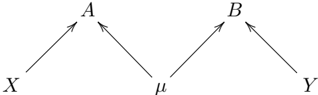
The diagram depicts a bidirectional relationship between two nodes labeled **A** and **B**, connected by a double-headed arrow labeled **μ**. Both **A** and **B** have unidirectional arrows pointing to two lower nodes labeled **X** and **Y**, respectively. The structure suggests a system where **A** and **B** influence **X** and **Y**, while maintaining a mutual relationship via **μ**.
### Components/Axes
- **Nodes**:
- **A** (top-left triangle)
- **B** (top-right triangle)
- **X** (bottom-left node)
- **Y** (bottom-right node)
- **Arrows**:
- **μ**: Double-headed arrow between **A** and **B** (center of diagram).
- Unidirectional arrows from **A** to **X** and **Y** (left side).
- Unidirectional arrows from **B** to **X** and **Y** (right side).
- **Labels**:
- All labels are in uppercase Latin script (English).
### Detailed Analysis
- **μ**: Positioned centrally between **A** and **B**, indicating a reciprocal or interdependent relationship.
- **A → X/Y**: Arrows from **A** to **X** and **Y** suggest **A** directly influences or contributes to both **X** and **Y**.
- **B → X/Y**: Similarly, **B** has direct influence over **X** and **Y**, mirroring **A**'s role.
- **Spatial Layout**:
- **A** and **B** are positioned at the top, forming a symmetrical pair.
- **X** and **Y** are at the bottom, acting as shared targets for **A** and **B**.
- **μ** bridges **A** and **B**, emphasizing their interconnectedness.
### Key Observations
1. **Symmetry**: The diagram is horizontally symmetrical, with **A** and **B** mirroring each other in structure.
2. **Shared Influence**: Both **A** and **B** independently target **X** and **Y**, implying redundancy or collaboration in their effects.
3. **Bidirectional μ**: The double-headed arrow **μ** suggests a feedback loop or equilibrium between **A** and **B**.
### Interpretation
This diagram likely represents a system where two entities (**A** and **B**) operate in tandem, influencing shared outcomes (**X** and **Y**). The bidirectional **μ** implies that **A** and **B** are not isolated; their relationship is dynamic, potentially involving mutual adjustment or dependency. For example:
- **A** and **B** could represent competing or complementary processes (e.g., supply chains, biological pathways) that jointly affect downstream outcomes (**X**, **Y**).
- The absence of numerical data or explicit directionality (e.g., "A → X" vs. "B → Y") leaves the nature of the influence (e.g., additive, competitive) open to interpretation.
- The symmetry suggests a designed balance, though real-world systems might introduce asymmetry (e.g., one node dominating the other).
### Notable Anomalies
- No explicit directionality for **μ** (double-headed arrow) could imply equal influence, but real-world systems often have asymmetrical power dynamics.
- **X** and **Y** lack distinguishing features, making it unclear if they represent distinct outcomes or interchangeable states.
This structure is common in models of interdependent systems, such as ecological networks, economic models, or organizational workflows, where mutual relationships and shared targets are critical to understanding system behavior.